


While Everyone Waits for AI to Transform Healthcare, the Real Disruption Is Already Underway

MRR® Industry Intelligence Briefing Healthcare · Pharmaceuticals · Market Analysis
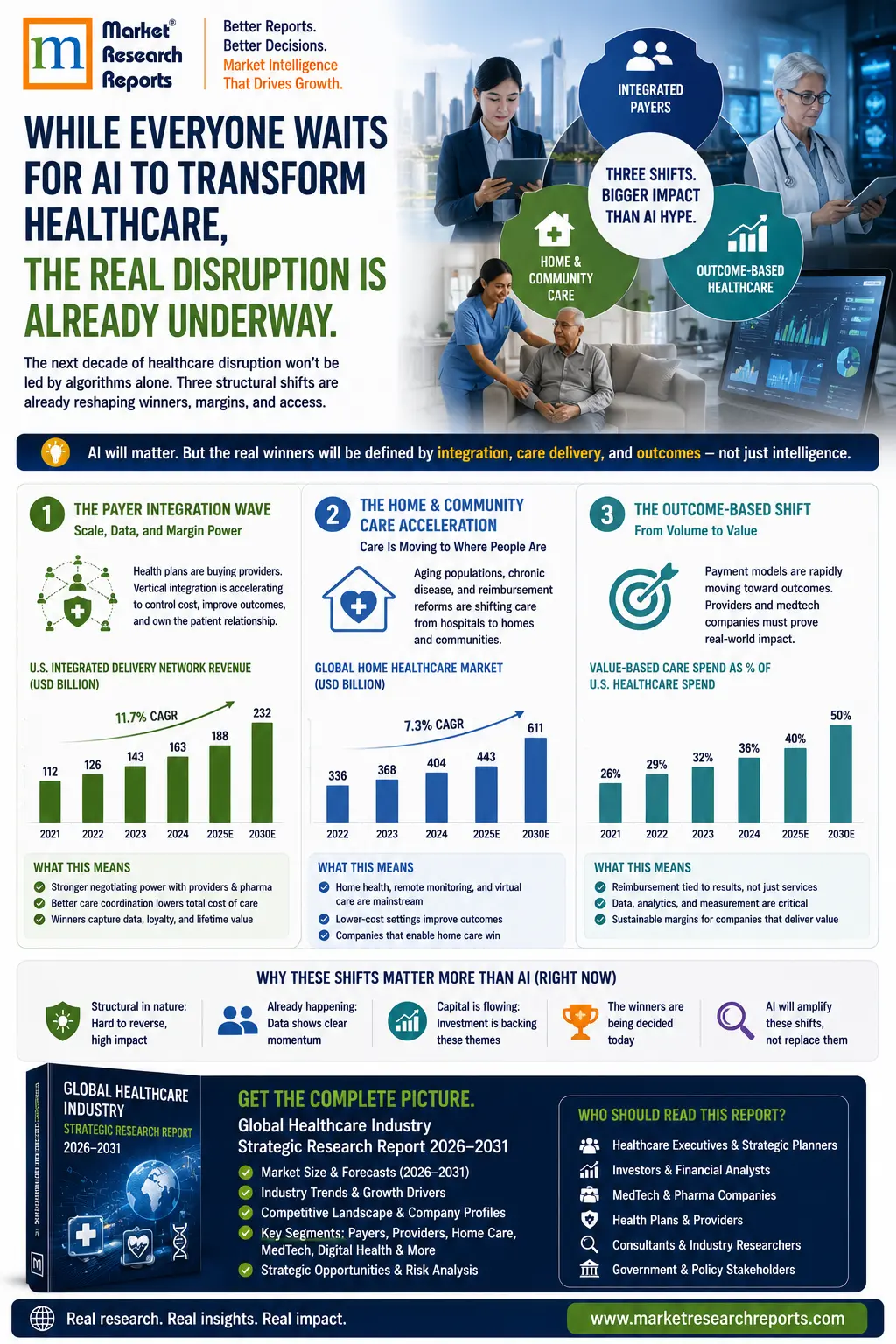
Most healthcare industry coverage right now is waiting for one story: AI finally transforming clinical care at scale. That story is coming, but it's obscuring two disruptions that are already well underway and showing up clearly in the numbers - a payer vertical-integration wave that's quietly redrawing who captures value across the care continuum, and a structural shift toward home-based care that's been building for years without matching its share of the headlines.
Executive Summary
The global healthcare services industry reached an estimated $8,911.9 billion in 2025, forecast to reach $13,524.6 billion by 2031, a 7.2% compound annual growth rate, according to Navadhi Market Research's Global Healthcare Industry Strategic Research Report. Twenty-five companies are profiled in depth, and the more useful story for anyone assessing competitive position right now isn't the industry's steady overall growth rate - it's three structural shifts moving beneath that headline number: payers acquiring their way deeper into care delivery, home-based care quietly taking share from hospitals, and a medical cost-trend squeeze compressing margins across every major national payer simultaneously, regardless of how well any individual company is otherwise performing.
The Research Problem: A 7.2% Growth Rate Hides Three Different Stories
A single blended growth rate for an $8.9 trillion industry inevitably flattens real structural change into a single smooth line. Hospital and outpatient care remains the largest category by a wide margin, and coverage anchored to that fact alone isn't wrong about the present - but it understates how much ground home-based care has already gained, and how deliberately the largest payers have been acquiring their way into direct care delivery rather than remaining pure insurance underwriters.
The shift most underweighted in generalist coverage is home-based care's share gain. Home Health Care & Residential Nursing Care is the fastest-growing service-type category in this report, projected to rise from 11.5% of total market value in 2022 to 17.5% by 2031 - driven by remote patient monitoring adoption and a well-documented aging-population preference for care delivered outside a hospital setting. Telehealth tells a similar story at a smaller scale: still just 3.5% of care-delivery-model value in 2025, but more than doubling to 7.1% by 2031.
The second underweighted story is payer M&A. UnitedHealth Group's acquisition of Change Healthcare significantly expanded Optum's data infrastructure into one of the largest health data repositories in the world, while CVS Health's Oak Street Health and Signify Health acquisitions moved the company directly into value-based primary care and in-home health evaluation. A competitive assessment that treats "payers" and "providers" as separate, non-overlapping categories will misjudge where several of the largest companies in this industry are actually competing.
Three Structural Shifts, Three Different Competitive Games
Shift One - Payers Are Buying Their Way Into Care Delivery
The 2022-2026 M&A cycle in healthcare has been characterized by vertical integration deepening within the U.S. payer segment specifically. UnitedHealth's Change Healthcare acquisition and CVS Health's Oak Street Health ($10.6 billion) and Signify Health deals aren't isolated transactions - they're the same company type making the same structural bet: that owning data infrastructure and direct care delivery, not just underwriting risk, is where the next decade of margin and market power gets built. Kaiser Permanente has operated this integrated model for decades; the largest national payers are now actively building toward it.
Shift Two - Home-Based Care Is Taking Real Share, Quietly
Home Health Care & Residential Nursing Care's projected rise from 11.5% to 17.5% of total market value between 2022 and 2031 represents one of the largest share shifts in this report's entire segmentation - larger, proportionally, than most single-year swings that generate substantially more coverage. This isn't a pandemic-era telehealth spike that's since normalized downward; it's a sustained, multi-year structural trend toward care delivered outside traditional hospital and outpatient settings, with direct implications for any company whose commercial strategy still assumes hospital-centric care delivery as the default.
Shift Three - Every Major Payer Is Fighting the Same Margin War
Elevated medical cost trends - particularly within Medicare Advantage plans - compressed profitability across all six major U.S. national payers through 2025, a shared pressure that cuts across otherwise-intense competitive rivalry. This is a genuinely different kind of competitive dynamic than most industries face: the largest companies in the sector are simultaneously competing for market share and jointly exposed to the same external cost-trend pressure, meaning near-term financial performance says as much about each company's cost-management execution as it does about competitive positioning.
Where the Top Companies Sit Across the Three Shifts
| Company | Primary Shift Exposure | What to Watch |
|---|---|---|
| UnitedHealth Group | Payer-to-provider integration (Optum/Change Healthcare) | Largest healthcare company globally; antitrust scrutiny of data-layer consolidation |
| CVS Health | Payer-to-provider integration (Oak Street, Signify) + home-based care | Integration execution across payer-pharmacy-PBM-provider footprint |
| Elevance Health | Medical cost-trend margin pressure | 2026 positioned as a "year of execution and repositioning" per company guidance |
| Centene Corporation | Medical cost-trend pressure (Medicaid/Marketplace concentrated) | Government-program cost trends distinct from commercial insurance dynamics |
| Humana | Medical cost-trend pressure (Medicare Advantage concentrated) | Most direct bellwether for MA-specific cost trend severity |
| Kaiser Permanente | Integrated payer-provider model (established, not newly building) | Long-run template other payers are now acquiring their way toward |
| HCA Healthcare | Pure-play hospital exposure (not home-based care shift beneficiary) | Cleanest read on hospital-setting care economics without integration noise |
| Teladoc Health | Telehealth (pure-play) | Revenue declined despite telehealth being the fastest-growing delivery model by share - rising competition, not falling demand |
Source: Navadhi Market Research, Global Healthcare Industry Strategic Research Report; company disclosures.
Analyst Insight
The most consequential structural fact in this report isn't the $13.5 trillion 2031 total - it's that home-based care's share gain (11.5% to 17.5%) and the payer M&A wave are two expressions of the same underlying shift: value in healthcare is migrating away from the traditional hospital-centric delivery model, and the largest payers are moving fastest and most deliberately to position themselves on the winning side of that migration before smaller, less capitalized competitors can catch up. Teladoc's declining revenue despite telehealth being the fastest-growing delivery model by share is the clearest evidence that being early to a structural trend doesn't guarantee capturing its value - intensifying competition, including from payers building their own virtual care capability in-house, matters as much as the underlying demand trend.
Strategic Lessons for Market Participants
| Observation | Strategic Implication |
|---|---|
| Home-based care's share is projected to rise from 11.5% to 17.5% of total market value, 2022-2031 | Companies and investors anchored to hospital-centric delivery models should treat this as an active, multi-year structural shift, not a temporary post-pandemic artifact |
| The largest payers are acquiring directly into care delivery (Change Healthcare, Oak Street, Signify) | The traditional payer/provider category boundary is dissolving for the largest national players specifically - competitive analysis should account for integrated positioning, not treat payer and provider revenue as cleanly separable |
| Medical cost-trend pressure has compressed all six major U.S. payers' profitability simultaneously | Near-term payer financial results reflect shared industry-wide cost pressure as much as company-specific execution - peer comparisons should account for this shared headwind explicitly |
| Teladoc's revenue declined despite telehealth being the fastest-growing delivery model by category share | Structural demand growth in a category does not guarantee individual company capture - competitive intensity within a growing category can offset the category's own tailwind |
Frequently Asked Questions
What is the size of the global healthcare services market?
The market reached an estimated $8,911.9 billion in 2025, projected to reach $13,524.6 billion by 2031, a compound annual growth rate of approximately 7.2%.
Why are healthcare payers acquiring care-delivery companies?
Vertical integration lets payers capture value from both underwriting risk and delivering care directly, rather than only the former. UnitedHealth's Change Healthcare acquisition and CVS Health's Oak Street Health and Signify Health deals both reflect this strategy, following the long-established integrated model Kaiser Permanente has operated for decades.
Which healthcare category is growing fastest?
Home Health Care & Residential Nursing Care, projected to rise from 11.5% of total market value in 2022 to 17.5% by 2031, driven by remote patient monitoring adoption and aging-population preference for home-based care.
Which companies are profiled in this report?
Twenty-five companies spanning the healthcare value chain, including UnitedHealth Group (the largest healthcare company globally by revenue), CVS Health, McKesson, Cencora, Cigna, Elevance Health, HCA Healthcare, and Kaiser Permanente, across payers, hospital systems, distributors, and diagnostic labs.
What is driving margin pressure across major health insurers?
Elevated medical cost trends, particularly within Medicare Advantage plans, compressed profitability across all six major U.S. national payers through 2025 - a shared industry-wide pressure rather than a company-specific issue.
For full segment, application, regional, and country-level detail, complete methodology, and all twenty-five company profiles, see our Global Healthcare Industry Strategic Research Report. For bespoke healthcare market analysis, commission custom research.