


Industry Intelligence Briefing: How Restaurants and Hospitality Are Adapting to Humanoid Robots
MRR® Industry Intelligence Briefing Hospitality · Robotics · Labour Economics
The question boards of hospitality companies are actually asking in 2026 is not whether humanoid robots will arrive in their sector. It is whether the operators currently dismissing the technology as a gimmick will still be competitive when their labour cost structure diverges irreversibly from early adopters who are not. Here is some of the key findings from our newly launched Global Humanoid Robotics Commercial Deployment Market Strategic Research Report.
The number that changes the conversation: USD 16,000
In March 2024, Unitree Robotics launched the G1 bipedal humanoid at a list price of USD 16,000. That single data point made every prior analysis of humanoid robotics in hospitality obsolete. The previous cost floor for a commercially deployable bipedal humanoid was approximately USD 150,000–250,000 — a price point that produced compelling proof-of-concept demonstrations and almost no commercially rational deployment decisions outside of Fortune 500 manufacturing environments.
At USD 16,000, the calculation changes structurally. A full-service restaurant in a US market paying USD 18–22 per hour for a back-of-house associate — factoring in benefits, turnover costs averaging 75% annually in quick-service, and scheduling overhead — is looking at an all-in annual labour cost of approximately USD 45,000–55,000 for that role. At USD 16,000 amortised over three years, the robot's capital cost is under USD 5,500 per year before any financing or RaaS discount is applied. The question is no longer whether the economics work in principle. It is which specific tasks can be reliably executed at commercial quality, in what timeline, and at what operational risk.
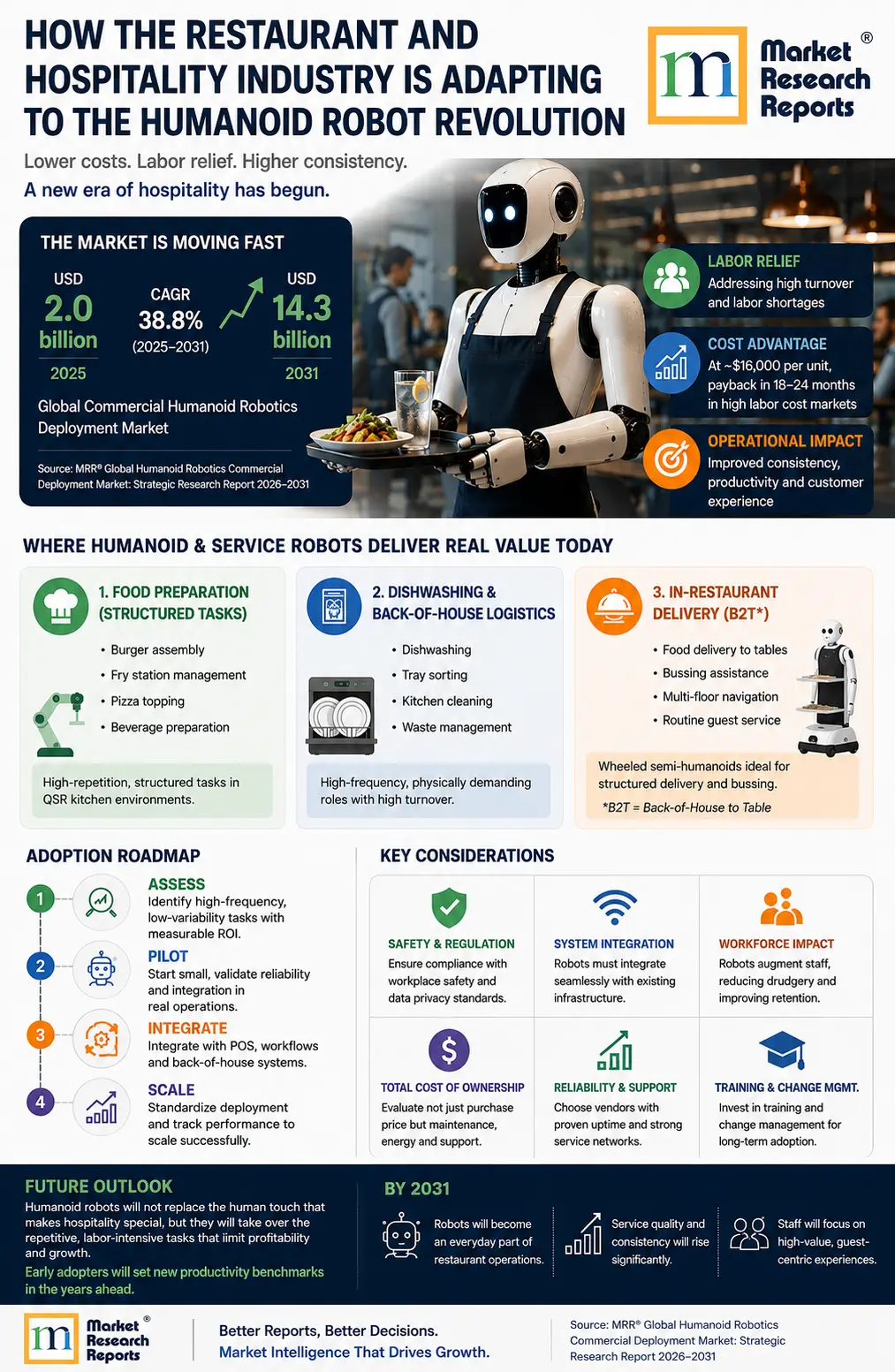
Our full report on this market — Global Humanoid Robotics Commercial Deployment Market: Strategic Research Report 2026–2031 — sizes the commercial humanoid robotics deployment market at USD 2.0 billion in 2025, forecast to reach USD 14.3 billion by 2031 at a CAGR of 38.8%. The Retail, Hospitality & Customer Service segment, while not the market's largest vertical by absolute revenue, represents the most strategically complex adoption challenge — and the one where the gap between early movers and laggards will be most consequential.
What the verified deployment data actually shows — and what it does not
Sanctuary AI's Series B disclosure (USD 140 million, 2024, led by Accenture Ventures) cited retail and customer service applications as a primary commercial target. Sanctuary's Phoenix robot has been publicly documented in pilot deployments in a Canadian retail environment. These are genuine commercial engagements — not laboratory demonstrations — but they are also carefully scoped to specific tasks: stocking shelves, retrieving items, performing inventory counts. They are not the all-purpose customer-facing robots that hospitality operators sometimes imagine when they first encounter the technology.
The critical distinction that operators need to understand is between structured task automation and customer interaction automation. Every commercially validated humanoid deployment in the food and hospitality sector as of 2025 falls into the first category. The Amazon/Agility Robotics deployment in fulfillment centers — confirmed in Amazon's FY2024 10-K as operational across "select fulfillment centers" with an estimated deployment value of USD 80 million — involves robots performing tote handling in a controlled logistics environment. The BMW/Figure AI pilot at Spartanburg documented in BMW's FY2024 Annual Report involves robots performing assembly-adjacent tasks in a structured manufacturing setting. Neither involves the exception-handling, social reading, and contextual judgment that a front-of-house hospitality role requires.
Operators who evaluate humanoid robotics by watching demonstration videos of robots gracefully performing complex hospitality tasks are looking at the technology's directional capability, not its current commercial deployment reality. The strategically correct frame is not "can this robot do everything a hospitality worker does?" but "which specific, high-frequency tasks can this robot do reliably enough that the operator can redeploy human labour to higher-value functions?"
The three task categories where the ROI is currently real
Our market data identifies three application categories within food and hospitality where current-generation humanoid and semi-humanoid robots meet the reliability threshold for commercial deployment decisions:
Food preparation — specifically high-repetition, structured tasks. Automated burger assembly, fry station management, pizza topping, and beverage preparation in structured QSR kitchen environments have achieved commercial penetration sufficient to constitute real market revenue. The key word is "structured" — these systems perform well in kitchen layouts designed for robotic workflows, poorly in the legacy layouts of most existing QSR locations. This is why deployment is concentrated in new-build locations rather than retrofits, and why the capital cost of robotic kitchen integration is systematically higher than robot unit cost alone.
Dishwashing and back-of-house logistics. The most commercially rational initial deployment for most full-service restaurants. High-frequency, physically demanding, high-turnover role that requires no customer interaction and tolerates the current generation's limitations in exception handling. Payback periods in high-labour-cost markets (US, UK, Australia, Scandinavia) are demonstrably achievable within 24 months at current pricing.
In-restaurant food delivery (kitchen to table). The wheeled semi-humanoid category — Bear Robotics' Servi, Keenon Robotics, PuduTech — has achieved meaningful commercial scale in Asian markets and is growing in US casual dining. This is the category most visible to consumers and the one with the most consumer acceptance data. Our research indicates acceptance rates above 65% in casual dining contexts where the robot performs delivery functions only, declining sharply when robots are deployed in greeting or order-taking roles.
The structural pressure that competitors are not modelling correctly
The market dynamic that matters most for hospitality strategy is not the current technology capability — it is the price curve trajectory intersecting with the labour cost trajectory. Our report models three scenarios for bipedal humanoid unit economics through 2031. In all three, the economics of humanoid deployment in mid-scale food service cross the commercial viability threshold before 2029. The variable is not whether — it is how fast and with how much disruption to incumbents who have not prepared their operations.
The operators most exposed are those in the USD 15–45 average check range — above QSR (where automated ordering and cooking are already well-advanced) but below fine dining (where human service is part of the value proposition the customer is explicitly paying for). This segment's labour model — dependent on significant front-of-house staffing at wages that have risen 35–45% in real terms since 2019 in most developed markets — faces the most direct substitution pressure from robots that can reliably perform the high-frequency, low-judgment tasks that constitute a significant portion of those labour hours.
The strategic implication is not that humanoid robots will replace hospitality workers wholesale within this forecast period. Our 2031 scenario analysis models Retail, Hospitality & Customer Service as a segment generating approximately USD 580–640 million in humanoid deployment revenue — meaningful, but representing penetration of roughly 3–5% of addressable labour costs in the sector. The implication is that operators who have not tested, learned from, and iterated on robotic deployment by 2028 will face a 12–18 month disadvantage in operational capability relative to first movers, at exactly the moment when the technology becomes cheap enough for broad deployment decisions.
Three questions for hospitality executives in 2026
1. What is your actual back-of-house labour cost per location, and which specific tasks account for the highest-turnover, highest-cost positions? The answer tells you where to pilot first. Any answer other than a specific dollar figure for a specific task category means your organisation has not done the analysis required to make an informed robotics deployment decision.
2. Is your kitchen and operational layout compatible with current robotic deployment constraints, or does adoption require capital expenditure in layout redesign? The operators getting the best economics from robotic kitchen deployment are those who designed their new-build locations with robotic workflows in mind from the outset. Retrofitting is possible but materially more expensive and operationally disruptive than greenfield deployment.
3. Which of your competitors are piloting or deploying humanoid robotics, and what are you learning from their results? If the answer is "we don't know," that is itself a strategic data point.
The full MRR® Humanoid Robotics report provides complete application-segment revenue forecasts through 2031, verified competitive landscape data sourced from primary corporate disclosures, and scenario analysis covering conservative, base, and optimistic deployment trajectories. For intelligence designed around your specific competitive context, our custom research team can scope an engagement to your exact strategic question.