


Behind the Scenes: How AI Enables Faster, More Accurate Syndicated Research
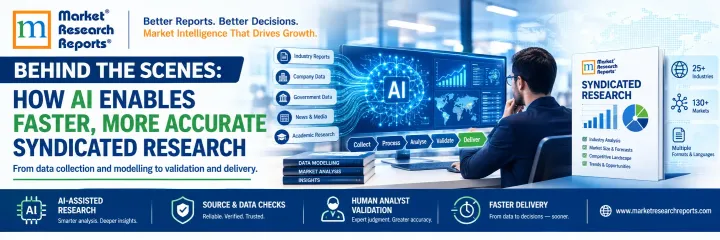
Most discussions of AI in market research focus on the output - faster reports, automated summaries, AI-generated analysis. Far less attention goes to where AI's contribution is most concrete and most defensible: the data pipeline that sits behind every syndicated market research report before a single word of analysis is written.
Understanding what happens in that pipeline - specifically how AI handles data extraction, cross-source mapping, and mathematical validation - matters for anyone commissioning or using syndicated research. It explains why report quality varies so dramatically across providers, and why the 24–48 hour delivery timelines that were implausible five years ago are now achievable without sacrificing rigour.
What syndicated market research actually involves
Syndicated market research is research conducted by a firm and made available for purchase to multiple clients, as opposed to custom research commissioned for a single buyer. A single syndicated report on a global market - say, lithium-ion battery separators - draws on government industrial output statistics from a dozen countries, trade flow data from customs authorities, company disclosures from publicly listed manufacturers, technical publications, patent filings, and trade association data. The volume of raw source material for a single report routinely exceeds ten thousand pages of documents.
The challenge is not finding data. It is extracting the right data points, reconciling inconsistencies across sources that use different definitions and time periods, and validating that the numbers in the final model are internally consistent. This is where AI's contribution is specific and measurable.
Data extraction - from unstructured sources to structured data points
Government statistical databases, company annual reports, and trade publications are not structured for easy extraction. A market size figure might appear in a paragraph of narrative text three pages into a government report, expressed in local currency, with a footnote revising a prior year's figure. An AI system trained on market research extraction tasks can identify, extract, and tag that figure - along with its source document, page reference, publication date, currency, and applicable year - in seconds. Multiply that by thousands of source documents and the compression of the extraction timeline becomes substantial.
The more important improvement is consistency. Manual extraction introduces human error - a misread number, a missed revision, a currency that was not converted. AI extraction applies the same rules to every document in the source set, and logs every extraction decision in a traceable record that an analyst can review. When a data point is questioned - by the analyst during quality review, or by a client after delivery - the source chain is auditable.
What AI extraction cannot do is judge source authority. An AI system will extract a market size figure from a low-quality trade blog with the same efficiency it extracts from an OECD statistical database. The analyst's role in reviewing extracted data includes source authority assessment - determining which figures to trust and which to treat as corroboration requiring independent verification.
Data mapping - reconciling inconsistent definitions across sources
The most common and least visible source of error in syndicated market research is definitional inconsistency. Two credible government sources may both report "pharmaceutical packaging market size" for the same country and the same year but produce different figures - because one includes both primary and secondary packaging while the other covers only primary. A currency conversion may have been made at the annual average exchange rate by one source and the year-end rate by another. A "forecast period" of 2024–2030 for one source and 2025–2031 for another makes direct comparison meaningless without adjustment.
AI data mapping applies a set of harmonisation rules to all extracted data points before they enter the model. It identifies scope definition mismatches by comparing the description text attached to each figure, flags currency and time-period inconsistencies, and groups data points by their effective scope so that like is compared with like. Where scope differences cannot be fully resolved algorithmically, the system flags the ambiguity for analyst review rather than silently passing through a potentially misleading comparison.
This harmonisation step is one of the most practically valuable applications of AI in the research pipeline, because it addresses a class of error that is nearly impossible to eliminate at scale through manual review alone.
Math checks and validation - catching what analysts miss
A market research model for a global industry might contain three hundred individual numeric cells. Each segment must sum correctly to the regional total. Each regional total must sum to the global total. Every CAGR stated in the report must be arithmetically derivable from the base year value and the forecast year value. Percentage breakdowns must total 100%. Year-over-year growth rates must be consistent with the absolute values they describe.
A human analyst reviewing this model will check the headline figures carefully. They will spot a CAGR that looks obviously wrong. What they will not reliably catch is a rounding error in row 247 of a data table, or a segment total that is off by 0.3% because a data entry error in one sub-region was carried forward through seven downstream calculations.
AI validation runs every arithmetic relationship in the model simultaneously. At MarketResearchReports.com, this is one component of the 47-point quality checklist every report passes before delivery. The validation runs in minutes. Every failed check generates a specific flag - "Segment totals for Asia-Pacific do not sum to regional total: discrepancy of $127M in forecast year 2028" - that the analyst then investigates and resolves before the report is approved for delivery.
The value of this layer is not that it catches errors the analyst would definitely have caught anyway. It is that it catches the errors the analyst would probably not have caught - the small, cascading inconsistencies that do not show up in headline figures but undermine the integrity of the full data model.
The handoff point - where AI stops and human analysts begin
The AI pipeline handles extraction, mapping, and mathematical validation. Everything after that - interpretation, context, strategic framing, source authority judgment - requires an experienced human analyst with sector-specific knowledge.
The 47-point quality checklist that every MRR® report passes before delivery is a human analyst checklist, not an AI checklist. It covers source authority assessment (is this figure from a reliable source and is it current?), driver-forecast alignment (do the market drivers identified actually support the stated growth trajectory?), competitive landscape plausibility (are these market share figures consistent with what is known about these companies' revenues?), and executive summary accuracy (does every headline claim in the summary match the supporting data in the body of the report?).
These checks require the kind of industry knowledge that comes from years of sector-specific analysis. A semiconductor specialist reviewing a chip packaging market report will recognise that a stated 40% market share for a particular company is implausible given their disclosed revenues. A generalist AI system running on extracted data has no basis for that judgment.
What this means for 24–48 hour delivery without quality sacrifice
Before AI-assisted pipelines, a credible syndicated report for a complex global market required three to four weeks of analyst time - most of it spent on extraction, harmonisation, and validation rather than analysis. AI compresses the mechanical pipeline to hours, redirecting analyst time to the interpretive work that actually generates the insight.
The 24–48 hour delivery SLA that MarketResearchReports.com guarantees for syndicated reports is only achievable because AI handles the data processing layer. The analyst time that used to go into manual extraction and arithmetic checking now goes into the interpretation, validation, and quality assurance that defines the analytical value of the report.
This is the correct application of AI in professional market research: using it to do faster what it does reliably, so that humans can do better what only humans can do well.
For a detailed breakdown of the full research process, see our research methodology page. For intelligence built specifically around your organisation's strategic questions, our custom research service applies the same hybrid pipeline to bespoke engagements.