


How to Choose the Right Market Research Company: 10 Questions Every Buyer Should Ask
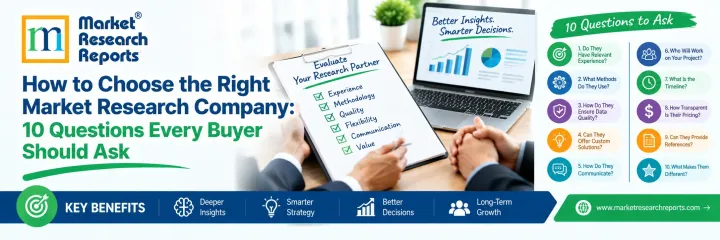
Choosing the wrong market research partner does not just waste budget. It produces intelligence that actively misleads strategy - presenting uncertain estimates as established facts, omitting important limitations, and providing no mechanism to identify or correct errors. The consequences of relying on low-quality market research in a board presentation, an investment thesis, or a market entry decision can significantly exceed the cost of the research itself.
The following ten questions, asked before any research is commissioned, reliably distinguish providers who operate a rigorous process from those who do not.
Types of market research companies - a brief orientation
The market research industry comprises several distinct provider types, each serving different needs. Syndicated publishers produce pre-made research reports available for purchase to multiple buyers - efficient for market orientation at lower cost, not proprietary. Custom research firms conduct bespoke research designed for a single client's specific question - proprietary but traditionally slow and expensive. RaaS (Research as a Service) platforms combine syndicated library access with on-demand custom research capability, delivered at platform speed - the model that MarketResearchReports.com operates on. Consulting firms provide research plus strategic advisory - appropriate when both data and strategic recommendation are needed, at higher cost. Survey and panel companies specialise in quantitative primary data collection - valuable for specific question types, not full-service market intelligence.
10 questions to ask any provider before commissioning
1. Do you publish your methodology?
A provider whose research process is documented in sufficient detail to publish - specific quality checkpoints, source categories, validation approach, named analyst accountability - is operating a defined process that can withstand scrutiny. A provider who describes their approach only in vague terms ("comprehensive multi-source research") is either not following a defined process or is not confident it would survive examination. Good answer: a specific, detailed methodology description that you can read before commissioning. Red flag: "our research is thorough and comprehensive" without specifics.
2. Who reviews the research before delivery?
Every professional research deliverable should pass through a defined quality review process, conducted by a named analyst with the sector expertise to catch domain-specific errors. Good answer: a named analyst review with specific quality checkpoints and sign-off accountability. Red flag: vague references to "quality control" without a described process, or outputs that are AI-generated without human review.
3. How do you handle conflicting data across sources?
Data conflicts - different figures for the same market from credible sources - are routine in professional research. How a provider handles them reveals the quality of their analytical process. Good answer: conflicting data is flagged, the conflict is investigated (usually by assessing source authority and scope definitions), the resolution is documented, and material conflicts are disclosed in the methodology section. Red flag: no process described, or a claim that their sources do not conflict (which indicates either very few sources or that conflicts are not being identified).
4. What is your source currency policy?
Market data ages. A market sized using two-year-old government statistics may significantly misrepresent current conditions in a rapidly changing sector. Good answer: a defined policy that flags data points older than a specified threshold (typically 18–24 months) for re-verification or explicit disclosure. Red flag: no described policy, or a claim that all data is "current" without an explanation of what that means.
5. Do you use AI to write your research reports?
This is the most important question in the AI age. AI tools are valuable for data processing, extraction, and mathematical validation. They produce unreliable results when used to generate market analysis without primary data inputs. Good answer: AI is used for data validation and processing; all analysis is conducted and reviewed by human analysts; the methodology describes specifically what AI does and what human analysts do. Red flag: vague claims about "AI-powered research" without distinguishing between AI as a processing tool and AI as a content generator.
6. What formats do you deliver in?
Professional research intelligence needs to be usable across different organisational workflows - a PDF for reading, an Excel model for analysis, a PowerPoint for presentations. Good answer: multiple format options including PDF, Excel, PowerPoint, and Word, with the ability to specify format requirements at commissioning. Red flag: a single format only, or format options that are add-on costs rather than standard options.
7. What is your guaranteed delivery timeline?
A delivery timeline claim should be operationally grounded in the provider's actual process, not aspirational. Good answer: a specific timeline with a defined process behind it - for example, 24–48 hours backed by an AI-assisted data pipeline and a defined analyst review process. Red flag: vague timelines ("typically a few weeks") or timelines that are described as "depending on scope" without any indication of what scope levels correspond to what timelines.
8. What happens if I disagree with a finding?
Research errors occur even in rigorous processes. How a provider handles identified errors reveals their confidence in their methodology and their commitment to accuracy. Good answer: a defined review process, a specific response timeline, and a commitment to issue corrections when errors are substantiated by evidence. Red flag: defensive responses, no defined process, or an implicit suggestion that the provider's findings are not subject to challenge.
9. Can you deliver in my language?
For organisations operating across multiple geographies, research delivered only in English requires internal translation before it can be used - a cost and delay that professional multilingual delivery eliminates. Good answer: professional human translation in multiple languages as a standard option, with translators who have domain expertise in the relevant industry. Red flag: machine translation offered as equivalent to professional translation, or language options described as requiring significantly extended timelines.
10. What does your pricing model look like?
Research pricing should be transparent and agreed before work begins. Good answer: clear pricing for standard engagements available upfront, a defined scoping process for custom work that produces a fixed price before fieldwork begins, and no post-delivery scope adjustment charges. Red flag: pricing only available after extensive scoping calls, vague references to "depending on complexity," or a history of post-delivery invoices for scope items not agreed at the outset.
Red flags that should end the conversation
Beyond the ten questions, these are the provider characteristics that indicate a quality problem regardless of what answers are given to direct questions: no published methodology; inability to provide specific examples of previous work in the relevant sector; AI-generated content presented as primary research; no named analyst contact for the engagement; and pricing that is implausibly low relative to the claimed research scope (which almost always indicates the research scope is not what it appears).
How MRR answers all ten
Our research methodology page documents our process in full, including our 7-phase research architecture and 47-point analyst quality checklist. Every report carries named analyst sign-off. Our AI layer performs data validation and quality checking - it does not generate research content. We deliver in PDF, Excel, PowerPoint, and Word formats in 10+ languages. Our standard delivery SLA is 24–48 hours. We have a defined process for reviewing and correcting identified errors. Our pricing is transparent. To discuss a specific research requirement, contact our custom research team.