


How to Commission Custom Market Research: The Complete Step-by-Step Guide
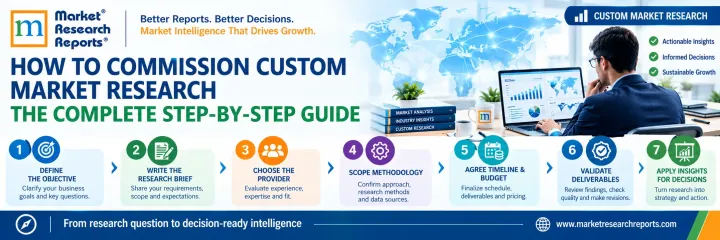
Custom market research is one of the highest-return strategic investments a company can make - when it is done correctly. When it is done incorrectly, it produces an expensive, beautifully formatted document that does not answer the question that actually drives the decision. The difference between these two outcomes is almost entirely determined by what happens before the research provider starts work.
This guide covers the complete process of commissioning custom market research, from the decision to commission it through to getting maximum value from the final deliverable.
What is custom market research?
Custom market research is research designed, scoped, and commissioned by a single client to answer that client's specific strategic questions. The research design, methodology, data sources, and deliverable format are determined by the client's needs rather than by a research firm's pre-existing product catalogue. The client owns the resulting data and intelligence exclusively - it is not shared with or sold to any other buyer.
This distinguishes custom research from syndicated research, which is designed by the research firm and sold to multiple buyers. Both have their place; the choice between them depends on whether your question is specific enough to require a bespoke research design. See our comparison of custom vs. syndicated research for guidance on which is appropriate for different situations.
When to commission custom research
Five specific situations consistently justify the investment in custom research over purchasing a syndicated report.
Your question is proprietary. If the answer to your research question would give you a competitive advantage that you do not want shared with competitors, a syndicated report - which is sold to multiple buyers including your competitors - provides no proprietary intelligence. Custom research produces intelligence that only you have.
The market segment is too specific for syndicated coverage. Syndicated reports cover markets at a level of aggregation that makes commercial sense for a wide audience. If you need intelligence on a specific geographic sub-market, a niche technology application, or a particular customer segment within a broader industry, syndicated reports will not have the granularity you need.
You need current data urgently. Syndicated reports reflect market conditions at the time of their last update. For time-sensitive decisions - an M&A target evaluation, a pre-IPO investor briefing, a market entry decision with a short window - you need intelligence that reflects current market conditions. Custom research can be delivered in 24–48 hours at MarketResearchReports.com.
You need to validate assumptions before committing capital. Major capital expenditure decisions, market entry investments, or product launch commitments benefit from research designed specifically to stress-test the assumptions driving the business case - not just to describe the general market.
You need primary data that does not exist in published sources. Competitive market share data, customer purchasing decision drivers, pricing sensitivity, and technology adoption intent are rarely available in published secondary sources. Custom primary research - expert interviews, surveys, supply chain conversations - collects data that does not exist elsewhere.
Step 1 - Define your research objective precisely
This is the most important step in the entire commissioning process, and the one most frequently done poorly. A vague research objective produces a vague research deliverable. A precisely defined objective produces intelligence that directly answers the question driving a decision.
The test of a well-defined research objective is whether you can complete this sentence: "The decision we need to make is [X], and we need this research to tell us [Y] so that we can make that decision with confidence." If you cannot complete that sentence, your objective is not yet defined precisely enough.
Common failure mode: "We need a market research report on the lithium-ion battery market." This is a topic, not an objective. A well-defined objective: "We are evaluating whether to establish a separator manufacturing facility in Southeast Asia. We need to understand current and projected demand for separators in the region, the competitive landscape for separator supply, and which customer segments are most accessible for a new entrant with our cost structure, so that we can decide whether and where to invest."
Step 2 - Write the research brief
The research brief is the document you provide to the research provider that defines the scope, questions, timeline, and deliverable requirements for the engagement. A well-written brief is the single most reliable predictor of a successful custom research engagement. See our detailed guide on how to write a custom research brief for a full framework and template.
The brief must include at minimum: the research objective, the business context and the decision it informs, the specific research questions in priority order, geographic and segment scope boundaries, required deliverable format and language, timeline requirements, and an indicative budget range.
Step 3 - Choose the right research provider
Four dimensions determine whether a research provider can deliver what you need.
Methodology transparency. A provider who can describe their research process in specific, step-by-step terms - including how they validate data, what sources they use, how they handle conflicting source data, and who reviews the final output - is operating a defined process. A provider whose methodology description is vague is either not following a rigorous process or is concealing the limitations of their process. Our research methodology page describes ours in full.
Sector specialisation. The analyst reviewing your deliverable should have deep sector knowledge, not just research methodology expertise. An analyst with five years of pharmaceutical industry experience will catch errors and provide contextual insights that a generalist researcher cannot.
Delivery timeline. For time-sensitive decisions, a 6–8 week research timeline is often not viable. At MarketResearchReports.com, custom research is delivered in 24–48 hours from brief confirmation for standard engagements, with a dedicated time-critical service for urgent requirements.
Pricing model. Custom research pricing varies widely. The key is whether pricing is transparent and whether costs are clearly explained. Hidden fees, vague "scope adjustment" charges, and post-engagement surcharges are red flags. Pricing should be fixed at scope confirmation, not adjusted after delivery.
Step 4 - The scoping call
Before any research begins, expect a structured scoping call with the research provider. This call has three purposes: to verify that the provider has understood your brief correctly, to agree the research design and methodology for your specific question, and to identify any scope ambiguities that could cause problems after fieldwork has begun.
Come to the scoping call with your priority research questions ranked. If the engagement needs to be scoped down due to budget or timeline constraints, knowing which questions are most critical ensures the most valuable intelligence is delivered within those constraints.
Step 5 - Typical timelines
A standard custom research engagement proceeds through: scoping call and brief confirmation (day 1), methodology agreement and source identification (days 1–2), secondary research and data collection (days 2–4), primary research where required (days 3–7), data modelling and analysis (days 5–8), first draft preparation (days 7–10), client review and revision (days 10–14), and final delivery (day 14–21 for a standard engagement). MarketResearchReports.com's 24–48 hour standard timeline compresses this through parallel workstreams and an AI-assisted data processing pipeline, with human analyst review at every decision point.
Step 6 - Understanding costs
Custom research costs range from under $5,000 for a focused, secondary-research-only engagement to over $100,000 for a multi-country, multi-methodology primary research programme. The main cost drivers are: geographic scope (each additional geography adds data collection and analysis time), primary research requirements (expert interviews, surveys, and focus groups are significantly more expensive than secondary research alone), depth of competitive analysis, and urgency premium for time-critical delivery.
Syndicated reports - where the research cost is amortised across multiple buyers - are significantly less expensive per buyer than custom research. For decisions requiring proprietary intelligence at a specific granularity, the ROI on custom research typically justifies the cost. For decisions where a general market overview is sufficient, syndicated reports are more cost-effective.
Step 7 - Evaluating the deliverable
When you receive the deliverable, check three things before reading the analysis. First, does the methodology section describe the specific sources used for the key data points, or only a generic description of research approach? Specific source disclosure is a quality signal. Second, are the data points in the executive summary consistent with the detailed tables in the body of the report? Inconsistencies between summary and detail indicate inadequate internal review. Third, are forecasts presented with scenario ranges (optimistic/base/conservative) or as single point estimates? Single-point forecasts without confidence ranges overstate precision.
Step 8 - Getting ROI from the intelligence
Custom research creates value only when it changes decisions or improves decision quality. The output of a custom research engagement should be actively translated into the strategic or operational decision it was commissioned to inform - not filed as a reference document. Plan for an internal presentation or workshop immediately after delivery, while the analyst who conducted the research is still available to answer questions and contextualise the findings.
For recurring strategic decisions, a research relationship with a consistent provider builds contextual knowledge over time, reducing scope-setting overhead and improving the quality of primary source relationships. The best custom research engagements are repeat engagements.
To discuss a specific custom research requirement, contact our custom research team. For background on how our research process works, see our research methodology page.