


15 Market Research Pitfalls That AI Makes Worse - and How to Avoid Every One
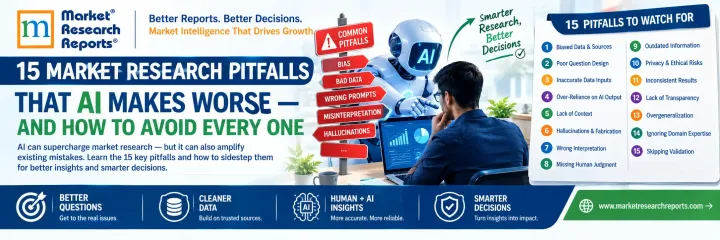
AI accelerates market research. It also accelerates market research mistakes - at a scale and speed that makes them far more consequential than the equivalent human error. In seventeen years of market research practice, the mistakes that damage strategic decisions have always been predictable. What has changed is that AI now gives those mistakes institutional velocity. A flawed assumption fed into an AI-assisted pipeline does not produce one flawed output. It produces dozens, consistently, before anyone notices.
The fifteen pitfalls below are not theoretical. They are the errors that now show up most frequently in research commissioned using AI-assisted workflows - drawn from the accumulated practitioner knowledge that underpins Ambarish Kumar Verma's foundational work on market research mistakes, updated for the AI age.
1. Hallucinated citations
How AI makes it worse: Generative AI systems produce plausible-sounding citations for market data that do not exist - specific report titles, page numbers, and statistics that were never published. A researcher who does not verify sources accepts these as real and builds analysis on invented foundations.
The fix: Every cited data point must be traceable to a primary source document that you can retrieve and verify. If you cannot find the original source, the data point does not go into the model.
2. Stale training data presented as current intelligence
How AI makes it worse: AI models have training data cutoffs. A model trained on data through 2023 will confidently describe 2023 market conditions as current - and will not flag that the regulatory environment, competitive landscape, or technology adoption curve has materially changed since then.
The fix: Treat any AI-generated market description as a starting point requiring verification against sources dated within the past 12–18 months, not as a current-state assessment.
3. Over-reliance on AI-generated CAGR figures
How AI makes it worse: AI tools that "calculate" market CAGRs are often interpolating from patterns in their training data rather than deriving from verified base and forecast figures. The resulting numbers can sound precise (7.4% CAGR) while being based on no defensible primary data.
The fix: Every CAGR used in strategic decisions must be derived arithmetically from a verified base year value and a verified forecast year value. A stated CAGR not so derivable is not a CAGR - it is a guess.
4. Ignoring primary sources entirely
How AI makes it worse: AI secondary research is fast and produces an impression of comprehensive coverage. This makes it tempting to skip primary research (expert interviews, supply chain conversations, primary surveys) entirely. But secondary sources describe what was publicly known at the time of publication - not what industry participants actually know now.
The fix: For any high-stakes strategic decision, secondary research establishes the framework; primary research tests it against current reality. Neither replaces the other.
5. Skipping human validation of AI outputs
How AI makes it worse: AI outputs arrive formatted, structured, and confident-looking. This presentation creates a psychological tendency to accept them with less scrutiny than raw data would receive. The result is that errors which would have been caught in human-generated output pass through unchallenged in AI-generated output.
The fix: Apply the same critical scrutiny to AI-generated analysis that you would apply to analysis from a junior analyst. Confidence of presentation is not evidence of accuracy.
6. Prompt bias contaminating findings
How AI makes it worse: AI systems are strongly influenced by how questions are framed. A prompt asking "What are the growth drivers for the electric vehicle market?" will produce an optimistic analysis. A prompt asking "What are the risks to electric vehicle market growth?" will produce a pessimistic one. Neither is a neutral assessment - but the outputs look equally authoritative.
The fix: For any strategic research question, run deliberately opposing prompts and compare outputs. The gap between them reveals where the AI is responding to framing rather than evidence.
7. Confusing AI confidence with accuracy
How AI makes it worse: AI language models do not have a reliable internal calibration between their confidence and their accuracy. They state uncertain things with the same fluency as well-established facts. Research buyers who interpret confident presentation as evidence of accuracy will accept incorrect information that a more tentative presentation would have prompted them to verify.
The fix: Evaluate AI-generated research outputs on the quality of their evidence and sourcing, never on the fluency or confidence of their prose.
8. Wrong geography definitions
How AI makes it worse: AI systems trained on market research documents encounter inconsistent geographic definitions (does "Asia-Pacific" include or exclude Japan? Does "Middle East" include Turkey and Pakistan?) and often adopt whichever convention appears most frequently in training data, without flagging that the convention differs from your report's stated scope.
The fix: Define geographic boundaries explicitly in every research brief and verify that every data source used applies the same definition. A market size discrepancy that looks like a factual error is often a geographic scope mismatch.
9. Incorrect base year assumptions
How AI makes it worse: AI systems may select a base year based on data availability rather than on analytical suitability. Using 2020 as a base year for a market that was severely disrupted by COVID produces a misleadingly low starting point and inflated forecast CAGRs. AI systems trained on research documents will replicate this error if many training examples used 2020 as a base year for the same market.
The fix: For markets affected by structural disruption events, validate the base year choice explicitly. A 2019 base year often produces more analytically meaningful trajectories than a 2020 or 2021 base year for COVID-affected sectors.
10. Currency normalisation failures
How AI makes it worse: AI data extraction pulls figures from sources denominated in multiple currencies, using exchange rates from different dates, without always flagging these inconsistencies. A model that aggregates USD, EUR, JPY, and CNY figures converted at different reference dates will produce apparent market growth that is partly real and partly an exchange rate artefact.
The fix: Mandate a single base currency and a single reference exchange rate (typically the annual average for the base year) across all sources, and verify that all converted figures use that rate.
11. Treating synthetic data as primary research
How AI makes it worse: Some AI tools generate synthetic survey responses or simulated consumer preference data. These are useful for stress-testing questionnaire design or exploring hypothetical scenarios. They are not a substitute for actual primary research with real market participants, and using them as primary evidence in strategic decisions is a category error.
The fix: Synthetic data should be labelled as such and used only for model design and hypothesis generation, never as evidentiary primary data in a final deliverable.
12. Not stress-testing forecasts
How AI makes it worse: AI-generated forecasts typically produce a single central estimate, which looks like a prediction rather than a probability distribution. Strategic decisions made against a point estimate - without sensitivity analysis, scenario modelling, or a stated confidence range - are decisions made with false precision.
The fix: Any forecast used for strategic decision-making should include at minimum a base case, an optimistic case, and a conservative case, with explicit documentation of the assumptions that differ between them.
13. Skipping competitor triangulation
How AI makes it worse: AI tools are efficient at producing competitive landscape summaries from public sources. They are less reliable at identifying what is not publicly disclosed - a company's actual pricing strategy, their real manufacturing capacity utilisation, or the competitive dynamics in a geography where public disclosure is limited. Research that relies only on what companies say publicly about themselves produces an optimistic competitive picture.
The fix: Competitive intelligence should triangulate public disclosures against patent filings, job posting patterns, supply chain relationships, and, where feasible, primary conversations with customers and distributors who see competitors' behaviour directly.
14. Correlation treated as causation
How AI makes it worse: AI pattern recognition is exceptionally good at identifying correlations in large datasets. It is not equipped to assess whether those correlations are causal, coincidental, or driven by a shared third variable. Market research that presents correlations as causal relationships - without mechanistic explanation of why one variable drives another - will produce misleading strategic conclusions.
The fix: For every driver-outcome relationship stated in a research report, require an explicit causal mechanism. "X correlates with Y" is a hypothesis. "X causes Y because of mechanism Z, which we can verify from primary sources A and B" is a finding.
15. Anchoring bias in AI outputs
How AI makes it worse: AI systems trained on existing market research documents will tend to produce estimates that cluster around the central estimates already published for well-studied markets. If the consensus estimate for a particular market is $12B and the actual figure (properly derived from primary data) is $8B, AI-assisted research will likely anchor near $12B - not because the evidence supports it, but because that is what previous research said.
The fix: For any market where you are challenging a published consensus, build the estimate from primary data upward rather than from the consensus downward. Bottom-up validation is the most reliable defence against anchoring.
The principle behind all fifteen
Every pitfall on this list is a variant of the same mistake: accepting AI's confidence in its own outputs as a substitute for independent evidence. AI systems are not modest about uncertainty. They produce plausible, well-formatted, internally consistent outputs regardless of whether those outputs are grounded in verifiable facts or in statistical patterns from training data that may not apply to your specific market or timeframe.
The role of the human analyst is not to distrust AI. It is to apply the same evidentiary standards to AI outputs that a rigorous researcher applies to any other source - asking not "does this look right?" but "can I trace this to a primary source I can verify?"
Our research methodology page describes in detail how the 47-point quality checklist at MarketResearchReports.com is designed to catch these failure modes before they reach a client deliverable. For research on your specific strategic question, our custom research team can discuss how these principles apply to your engagement.