


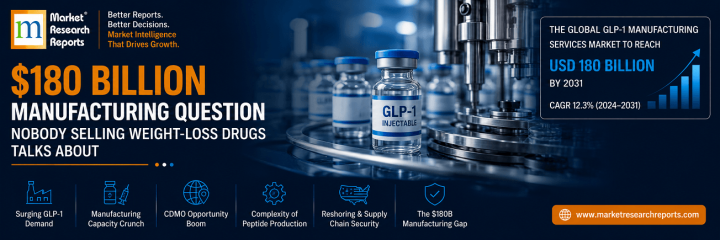
The $180 Billion Manufacturing Question Nobody Selling Weight-Loss Drugs Talks About
MRR® Industry Intelligence Briefing Pharmaceutical Manufacturing · CDMO · Supply Chain
Every headline about the GLP-1 boom is about demand - prescriptions, revenue, market capitalization. Almost none of them ask the question that actually determines how fast patients can get the drug: who is going to manufacture enough of it. That question has a real, specific dollar figure attached to it, a confirmed geopolitical disruption reshaping who gets to answer it, and a company most patients have never heard of sitting at the center of both.
Executive Summary
Global pharmaceutical manufacturing production reached an estimated $1.84 trillion in 2025, according to Navadhi Market Research's Global Pharmaceuticals Manufacturing Market Strategic Research Report 2026-2031, and is projected to reach $2.86 trillion by 2031 - a 7.7% compound annual growth rate, the fastest sustained growth rate in the industry's modern history, following a more moderate 5.9% CAGR over 2022-2025 as COVID-era vaccine production normalized. GLP-1 manufacturing alone is forecast to grow from approximately $45 billion in 2025 to $180 billion by 2031 - a fourfold increase in six years for a single drug category. Twenty-nine companies are profiled in depth, including 25 integrated pharmaceutical innovators and four dedicated contract development and manufacturing organizations (CDMOs), reflecting the genuinely expanding role specialized manufacturers now play in global pharmaceutical supply.
The Research Problem: Why "Who Makes the Drug" and "Who Makes It At Scale" Are Different Questions
Every major pharmaceutical company markets its own manufacturing capability. Eli Lilly and Novo Nordisk both talk publicly about billions of dollars in committed manufacturing capex. What gets less attention is that neither company - nor any single innovator - actually manufactures the majority of the world's complex biologics and peptide therapeutics alone. A substantial and growing share of that capacity sits with a small number of specialized contract manufacturers, and understanding who they are, and where they're located, turns out to matter more than most demand-side analysis accounts for.
Samsung Biologics is building what will be the world's largest single-location biologics manufacturing hub - over 600,000 liters of capacity in Incheon, South Korea, operational in the second half of 2026. Lonza, the largest CDMO globally by revenue at approximately $7.5 billion, has bioreactor capacity for commercial-scale biosimilar production already booked years in advance for 2027-2028 launches. Catalent, now owned by Novo Holdings, provides fill-finish and drug-device combination capacity - the specific, capital-intensive manufacturing step that turns bulk GLP-1 drug substance into the injector pens patients actually use.
The company that makes this story concrete rather than abstract is WuXi Biologics. WuXi is a real, established Chinese CDMO with deep, entrenched relationships across the biotech sector - and it has become the clearest example of a genuine, confirmed supply chain disruption reshaping this entire manufacturing landscape. Companies including Cabaletta Bio have publicly warned that losing WuXi as a supplier could disrupt their clinical timelines, real evidence of sponsor-side flight risk already occurring, not a hypothetical scenario analysts are modeling in advance. The reason is export-control and geopolitical disruption specifically affecting WuXi's operations, and the result is a confirmed, quantified reshoring wave: of $24.86 billion in total 2025 CDMO capacity investment industry-wide, $18.48 billion - nearly three-quarters - is flowing specifically to the United States and other non-China facilities.
A manufacturing market report that only tracked the branded pharmaceutical companies and treated CDMO capacity as a footnote would miss the mechanism actually determining whether GLP-1 supply can keep pace with the demand story everyone else is writing about.
Three Forces Behind the Market's 7.7% Growth Rate
Force 1 - GLP-1 Manufacturing Is Racing to Catch Up With Demand, Not Ahead of It
The fourfold growth in GLP-1 manufacturing capacity, from $45 billion to $180 billion by 2031, is not proactive capacity-building ahead of anticipated demand. It is real capacity investment attempting to close a documented, ongoing supply gap that has constrained prescription availability for the drug class since its earliest commercial years. This is a structurally different investment dynamic than typical pharmaceutical manufacturing expansion, where capacity usually leads or matches demand rather than visibly trailing it.
Force 2 - The Biosimilar Patent Cliff Is the Largest in Industry History
Running in parallel to the GLP-1 buildout, the industry is entering the largest wave of biosimilar patent expirations on record. This is driving a separate, substantial wave of manufacturing capacity investment specifically in biosimilar production - a category with its own distinct capital and regulatory requirements from small-molecule generics, and one where CDMOs like Lonza and Samsung Biologics are positioned to capture disproportionate share given their existing biologics-scale infrastructure.
Force 3 - Reshoring Is Redirecting Capital, Not Just Adding It
The $18.48 billion of 2025 CDMO investment flowing to the US and non-China facilities represents capital that would very plausibly have gone to Chinese manufacturing capacity in a pre-disruption environment. This is not simply new investment on top of an unchanged geographic distribution - it is a real redirection of where global biologics manufacturing capacity gets built, with second-order effects on which countries develop deep manufacturing expertise in the highest-growth categories over the next decade.
The Manufacturing Landscape: Innovators and CDMOs, Different Roles
| Company | Type | Real, Confirmed Position |
|---|---|---|
| Eli Lilly | Integrated Innovator | Multi-billion dollar disclosed capex program; 2026 revenue guidance $85-87B, GLP-1-driven |
| Novo Nordisk | Integrated Innovator | Real capacity investment continuing despite 2026 guidance cut; owns Catalent via Novo Holdings |
| Samsung Biologics | CDMO | 600,000+ liter Incheon facility, world's largest single-location biologics hub, operational H2 2026 |
| Lonza | CDMO | Largest CDMO globally by revenue (~$7.5B); biosimilar capacity booked years in advance |
| WuXi Biologics | CDMO | Confirmed real disruption; sponsors publicly citing clinical timeline risk from supply uncertainty |
| Catalent (Novo Holdings) | CDMO | Specialized GLP-1 fill-finish and drug-device combination capacity |
Source: Navadhi Market Research, Global Pharmaceuticals Manufacturing Market Strategic Research Report 2026-2031; company disclosures and 2025-2026 industry reporting.
Analyst Insight
The most counterintuitive finding in this report is that the reshoring wave is not primarily a story about tariffs or trade policy in the way that phrase usually implies. It's a story about sponsor companies making real-time risk-management decisions after watching a confirmed supply disruption unfold at a major supplier, and choosing to pay a premium for geographic diversification rather than risk a repeat. That's a meaningfully different, and more durable, driver than a policy-driven reshoring trend that could reverse with the next administration or trade agreement. Samsung Biologics and Lonza aren't winning reshored capacity because of a subsidy - they're winning it because sponsors independently concluded that concentration risk in a single geography, however cost-efficient, was no longer worth the exposure. That's the kind of structural shift that tends to persist well beyond the specific incident that triggered it.
Strategic Lessons for Market Participants
| Observation | Strategic Implication |
|---|---|
| GLP-1 manufacturing capacity is racing to close an existing demand gap, not building ahead of it | Investors and operators should expect continued capacity-driven supply constraints through at least the medium term, not near-term supply normalization |
| WuXi Biologics disruption produced confirmed, publicly-disclosed sponsor flight risk | Biotech sponsors should evaluate single-CDMO concentration risk explicitly, not treat manufacturing partner selection as a purely cost-driven decision |
| $18.48B of $24.86B in 2025 CDMO investment flowed to non-China facilities | Manufacturing capacity forecasts built on pre-2025 geographic distribution assumptions will materially misstate where new capacity is actually being built |
| Catalent's ownership by Novo Holdings creates a real strategic-alignment question for competing sponsors like Eli Lilly | Sponsors evaluating CDMO partners should weight ownership structure and potential conflicts of interest alongside pure capacity and cost considerations |
Frequently Asked Questions
What is the size of the global pharmaceutical manufacturing market?
Production reached an estimated $1.84 trillion in 2025, projected to reach $2.86 trillion by 2031, a compound annual growth rate of approximately 7.7% (2026-2031), following a more moderate 5.9% CAGR over 2022-2025 as COVID-era production normalized.
How much is GLP-1 manufacturing capacity actually growing?
From an estimated $45 billion in 2025 to approximately $180 billion by 2031 - a fourfold increase in six years, reflecting ongoing efforts to close a real, documented supply-demand gap rather than proactive capacity-building ahead of anticipated demand.
Why did WuXi Biologics face a reshoring-driven disruption?
Export-control and geopolitical developments specifically affecting WuXi's operations created real, confirmed supply continuity concerns for sponsor companies, some of which have publicly stated the risk to their own clinical timelines. This has contributed to a broader, quantified capital reallocation: $18.48 billion of $24.86 billion in total 2025 CDMO investment flowed to US and non-China facilities.
Which companies are profiled in this report?
Twenty-nine companies, including 25 integrated pharmaceutical innovators (Eli Lilly, Novo Nordisk, Pfizer, Roche, Johnson & Johnson, AstraZeneca, Novartis, Sanofi, Bristol-Myers Squibb, GSK, AbbVie, Takeda, Bayer, Boehringer Ingelheim, Amgen, Gilead, Vertex, Regeneron, Biogen, Moderna, Teva, Viatris, Sun Pharma, Dr. Reddy's, Merck) and 4 dedicated CDMOs (Samsung Biologics, Lonza, WuXi Biologics, Catalent).
How does this report relate to the companion Industry report?
This report covers pharmaceutical MANUFACTURING - production and supply-side capacity. A separate companion report covers pharmaceutical CONSUMPTION - demand-side, end-market revenue, including the GLP-1 demand growth this manufacturing buildout is racing to keep pace with.
For full production forecasts, country-level manufacturing capacity detail, and all twenty-nine company profiles, see our Global Pharmaceuticals Manufacturing Market Strategic Research Report 2026-2031. For the demand-side view of this same market, see our companion Global Pharmaceuticals Industry Strategic Research Report. For bespoke pharmaceutical manufacturing and supply chain analysis, commission custom research.