


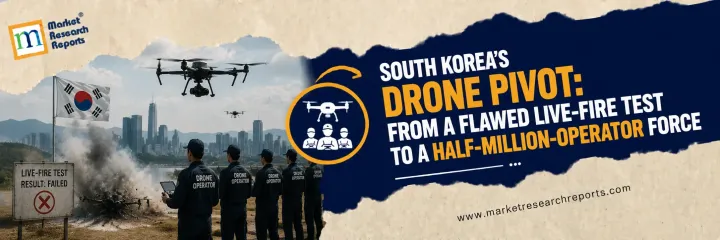
South Korea's Drone Pivot: From a Flawed Live-Fire Test to a Half-Million-Operator Force
MRR® Business Opportunity Analysis Market Research · South Korea
South Korea is executing one of the most aggressive military drone build-outs of any allied nation in 2026 — not because its technology is ahead of the curve, but because a series of uncomfortable data points have forced Seoul's hand. A June 23 live-fire exercise exposed real gaps in legacy air-defense systems. North Korean drone incursions into restricted airspace near the presidential compound remain a live political wound. And the Ministry of National Defense has responded not with a single silver-bullet weapon system, but with a workforce strategy: turn every conscript into a qualified drone pilot.
The figure from government sources - 500,000 trained "drone warriors"- is best understood not as a capability that exists today, but as a five-year infrastructure and manpower bet. This market brief unpacks what actually happened in the June drill, what's driving the policy response, and where the program's real execution risk lies.
Key takeaways:
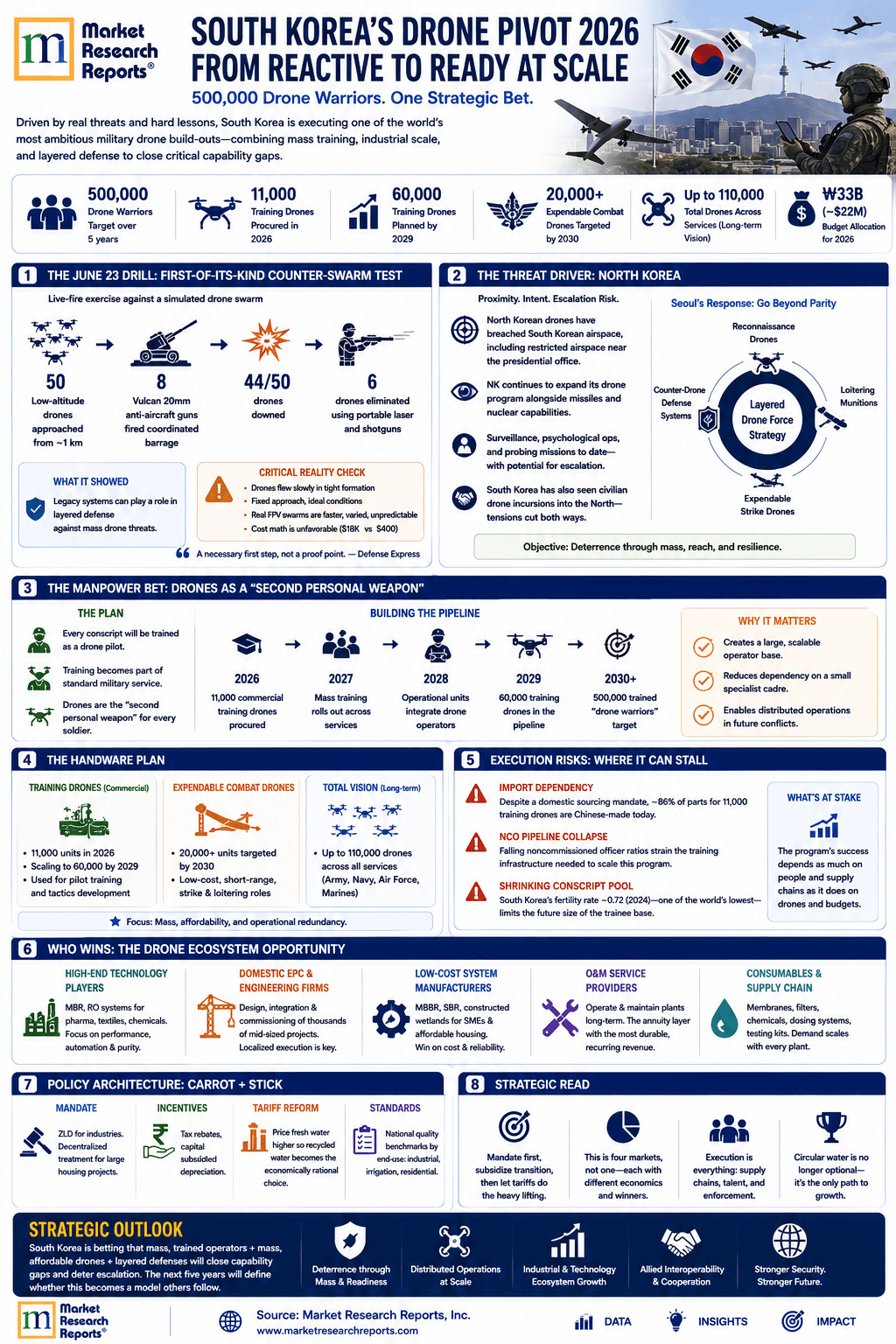
A first-of-its-kind counter-swarm drill showed that eight Vulcan 20mm anti-aircraft guns, firing in coordinated barrage, stopped 44 of 50 slow-moving, formation-flying drones — leaving the remainder to be finished off by a portable laser and soldiers with shotguns. Critics, including Ukrainian defense outlet Defense Express, argue the test understates the problem because real FPV drone swarms don't approach slowly or in tight formation.
The underlying anxiety is North Korea, not Ukraine. Small North Korean drones have previously crossed the border and penetrated restricted airspace near the presidential office, an episode that continues to shape Seoul's counter-drone posture.
The Ministry of National Defense's response is a mass-training program: roughly 11,000 commercial training drones procured in 2026, scaling toward 60,000 by 2029, alongside more than 20,000 low-cost expendable combat drones targeted for 2030 and a longer-range figure of up to 110,000 total units across services.
The program is funded at roughly 33 billion won (~$22 million) for 2026 - a modest opening allocation relative to the scale of the ambition.
Execution risk is concentrated in three places: import dependency on Chinese-made commercial drone components (despite a stated domestic-sourcing mandate), a collapsing noncommissioned officer pipeline that would normally carry out training, and a shrinking conscript pool tied to South Korea's fertility rate.
The Vulcan Test: A Necessary First Step, Not a Proof Point
On June 23, the Republic of Korea Air Force's Missile Defense Command ran the country's first live-fire exercise built specifically around a simulated drone swarm. Fifty low-altitude drones approached a west-coast training range from roughly a kilometer out. Eight M167 Vulcan 20mm anti-aircraft guns fired simultaneously in what the Air Force described as barrage fire, downing 44 of the 50. The remaining six were eliminated at close range by a portable laser system and five soldiers using shotguns.
 Navadhi Market Research · Aerospace & Defense
On demand
Global Military Drone Swarm Technology Market Strategic Research Report
The global military drone swarm technology market represents one of the most consequential shifts in modern defense procurement, valued at approximately USD 14.8 bil…
▲ 15.7%CAGR2025–2032
$3,500.00 from
Forecast $41.1B by 2032
Framed one way, this is South Korea validating that legacy Cold War-era air-defense hardware still has relevance against a modern threat class it was never designed for. Framed another way - and this is the critique that gained traction after Ukrainian outlet Defense Express published a detailed teardown of the drill footage - the exercise proved very little. The drones flew slowly, in a tight march formation, at a fixed range, against eight cannons lined up in a row. Real FPV drone swarms don't behave that way, and the cost math is unflattering: a single one-second burst from eight Vulcans firing in high-rate mode runs on the order of $18,000, against drones that cost roughly $400 apiece. Even South Korean lawmakers on the National Assembly's Defense Committee acknowledged the exercise's realism gap while defending its value as a first attempt, arguing that the country needs a layered counter-drone network rather than reliance on a single weapon type.
For MRR's purposes, the drill matters less as a combat readiness signal and more as a market signal: it's the moment South Korea publicly conceded that its existing air-defense inventory is insufficient against mass drone threats, which is precisely the gap the broader 2026 drone program is designed to close on both the offense and defense sides.
The Threat Driver: North Korea, Not Just Ukraine
Seoul's drone pivot is frequently described in the press as a "lesson from Ukraine," and that framing isn't wrong - the conflict has become the reference case for every defense ministry rethinking mass, low-cost unmanned systems. But the more immediate driver is domestic and specific: North Korean drones have previously breached South Korean airspace, including an incursion into restricted airspace near the presidential office that became a significant embarrassment for the South Korean air-defense establishment. North Korea has continued to build out its own drone fleet even as it advances missile and nuclear programs, and Kim Jong Un has publicly called for a more aggressive military posture in 2026. South Korea's government also confirmed earlier this year that its own civilians had separately flown drones across the border on several occasions, drawing a formal expression of regret from President Lee Jae-myung - a reminder that the drone dimension of inter-Korean tension now cuts in both directions.
North Korea's drone use to date has leaned toward surveillance, psychological operations, and probing South Korean defenses rather than mass strike capability. South Korea's response is explicitly designed to go further than parity: a layered force spanning reconnaissance, loitering munitions, and expendable strike drones, backed by a trained population large enough to operate at scale rather than through a small specialist cadre.
 Navadhi Market Research · Aerospace & Defense
On demand
Global Autonomous Swarm Drone Mission Control Software Market Strategic Research Report
The global autonomous swarm drone mission control software market occupies a strategically critical position at the intersection of defense modernization, commercial…
▲ 18.6%CAGR2025–2032
$3,500.00 from
Forecast $6.1B by 2032
The Manpower Bet: Drones as a "Second Personal Weapon"
The centerpiece of the strategy isn't a weapon system — it's a training mandate. In September 2025, Defense Minister Ahn Gyu-back announced a plan to train 500,000 "drone warriors," allowing every conscript to earn drone piloting credentials during mandatory service, anchored at a training base in Wonju. The minister has since reframed the ambition in blunt terms: drones "should no longer be equipment used by only a limited number of units," but a universal tool soldiers carry the way they carry a rifle — a second personal weapon.
This is a meaningful departure from how most militaries, including the U.S., have historically organized unmanned systems — as a specialist function sitting alongside, but separate from, the general infantry. South Korea is instead treating basic drone literacy the way it treats basic marksmanship: a baseline skill expected of the entire force, not a credential held by a small elite.
The logic holds up structurally. A force that fields tens of thousands of drones cannot function if piloting, imagery interpretation, electronic-warfare resilience, battery management, and field repair sit with a handful of specialists. Distributing those skills broadly is the only way mass-produced hardware translates into usable combat capacity — which is precisely the gap that undermined North Korea's early drone attempts and that Ukraine's war has repeatedly shown separates drones-as-inventory from drones-as-capability.
Market Sizing: 11,000 Today, 60,000–110,000 by Decade's End
The procurement numbers have shifted somewhat as the program has moved from announcement to funding, which is itself a useful signal of where the plan currently sits in its maturity curve:
| Milestone | Figure | Timing |
|---|---|---|
| Commercial training drones procured | ~11,000 | 2026 |
| Commercial/training drone fleet | ~60,000 | by 2029 |
| Low-cost expendable combat drones | 20,000+ | by 2030 |
| Total unmanned systems across all services (early figure) | up to 110,000 | by 2029 |
| Trained drone operators | 500,000 | ongoing, conscript-based |
| 2026 program funding | ~33 billion won (~$22M) | approved by National Assembly, Dec. 2025 |
Navadhi Market Research · Aerospace & DefenseOn demand
Global Autonomous Wingman Unmanned Combat Aircraft Market Strategic Research Report
The global autonomous wingman unmanned combat aircraft (UWCA) market occupies a strategically critical position at the intersection of next-generation air combat doc…
▲ 18.2%CAGR2025–2032
$3,500.00 from
Forecast $7.7B by 2032
The Ministry has publicly walked back its earlier 110,000-unit figure toward a more conservative ~60,000, which reads less as a retreat and more as the plan encountering the realities of supply chain and budget constraints. On the strike side, defense primes Hanwha and LIG Nex1 are running loitering-munition programs, including the K-Lucas — a loitering strike drone designed to circle a target area before engaging, giving Seoul a stand-off strike option without committing manned aircraft into contested airspace. That system sits on a three-to-five-year development horizon, separate from and slower than the commercial training-drone layer intended for conscripts.
Where the Program Is Exposed
Three structural risks stand out, and they're worth weighing against the headline numbers rather than taking the 500,000 figure at face value:
Supply chain dependency. South Korea has mandated domestically produced core components for its training and combat drones, explicitly to reduce reliance on Chinese parts. But Korea's own investment promotion agency has reported that roughly nine in ten small commercial drones currently in service domestically are imported, overwhelmingly from China. A domestic-sourcing requirement written into a 2026 procurement schedule is not the same as a domestic supply chain that can meet 2026 delivery volumes.
A thinning training pipeline. The soldiers who would actually run this program — noncommissioned officers (NCOs) - are in short supply. Army NCO recruitment has fallen sharply over the past several years, according to figures submitted to the National Assembly, which is a direct constraint on instructor capacity regardless of how many drones are procured.
A shrinking, faster-cycling conscript pool. South Korea's fertility rate remains far below the replacement level even after a modest uptick, meaning the pool of eighteen-year-old draftees is structurally shrinking. Compounding this, President Lee Jae-myung has floated a "selective conscription" reform that would shorten standard service from eighteen months to roughly ten for most draftees, while creating a longer career track for skill-intensive roles. A shorter standard term leaves less time to turn a conscript into a competent drone operator, pushing more of the training burden onto the already-strained NCO career track.
None of these risks are unique to South Korea's drone plan - they're the same demographic and industrial-base pressures reshaping the ROK military more broadly. But they land with particular force on a program whose central claim to differentiation is the scale of trained personnel.
Guidance for Stakeholders
For allied defense planners: South Korea's conscript-wide training model is worth tracking as a potential template, but the near-term signal is about training infrastructure and supply chain resilience, not about a proven doctrine. Wait for 2027–2028 fielding data before treating the "universal operator" model as validated.
For component and drone suppliers: The domestic-sourcing mandate creates a near-term opportunity for South Korean and allied-nation suppliers of drone core components (flight controllers, batteries, RF systems) that can meet the government's non-Chinese sourcing requirement — but only if they can scale to the volumes the 2026–2029 schedule requires, which current domestic supply has not demonstrated.
For counter-drone system vendors: The Vulcan drill's mixed results, and the public critique that followed it, point to a near-term procurement opening for layered counter-drone systems - directed energy, RF jamming, and proximity-fused ammunition - that can be integrated with legacy kinetic systems rather than replacing them outright.
For regional security analysts: The most reliable leading indicator of whether this program succeeds won't be drone unit counts. It will be NCO retention data and the outcome of the conscription-length reform debate, since both determine whether the training pipeline can actually absorb 500,000 conscripts at meaningful skill depth.
This industry brief synthesizes public reporting from The Defense News, SOFX, Aju Press, Korea Times, Defense Express, War on the Rocks, Defence Matters, and other open sources as of late June 2026. Figures reflect the most recently reported Ministry of National Defense guidance and are subject to revision as the program moves from announcement to appropriation.