


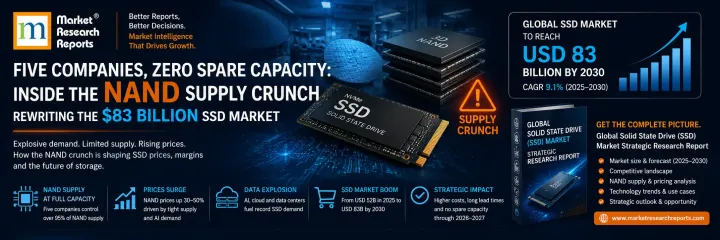
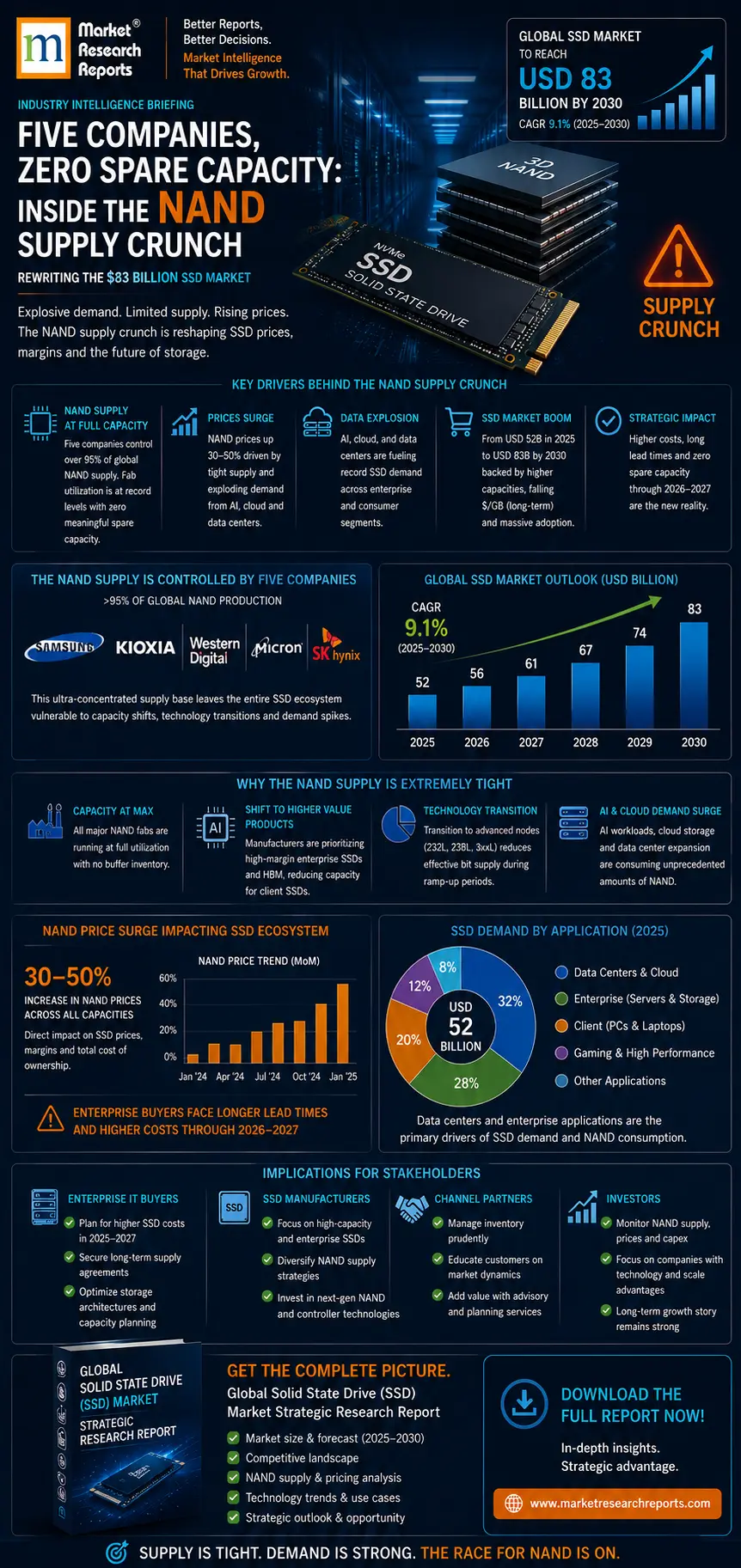
Five Companies, Zero Spare Capacity: Inside the NAND Supply Crunch Rewriting the $83 Billion SSD Market
MRR® Industry Intelligence Briefing Semiconductors · Data Storage · Supply Chain
In 2025, Western Digital split itself in two. The hard disk drive business kept the Western Digital name. The flash storage business became SanDisk Corporation - an independent, publicly traded company for the first time in over a decade. The timing was not incidental. NAND flash, the technology underlying every solid state drive, had entered a confirmed global supply crunch, and separating the flash business let it raise capital, negotiate supply agreements, and make capacity decisions without being tied to the economics of spinning platters. Here is what a five-company oligopoly with zero effective spare capacity looks like from the inside - and why enterprise buyers are already feeling it.
Executive Summary
The global Solid State Drive market is valued at US$27.86 billion in 2025 and is forecast to reach US$83.18 billion by 2031, a 20.0% CAGR, according to Navadhi Market Research's Global Solid State Drive (SSD) Market Strategic Research Report 2026-2031. This figure was built through genuine bottom-up reconstruction from real, publicly disclosed quarterly company revenue - anchored to TrendForce's transaction-based NAND revenue tracking and Kioxia's own directly disclosed SSD & Storage segment - rather than adopted from a single third-party forecast. The market structure is a confirmed five-company oligopoly: Samsung Electronics, SK hynix (including its Solidigm subsidiary), Kioxia Corporation, SanDisk Corporation, and Micron Technology. A single structural fact defines the current moment: Samsung and SK hynix do not separately disclose NAND-only revenue in public filings, meaning even sophisticated market participants are triangulating supply and pricing signals from incomplete public data - a genuine information asymmetry that is itself shaping how enterprise buyers are securing supply commitments in 2025-2026.
The Research Problem: Why a Five-Company Market Still Has Buyers Guessing
An oligopoly with five participants sounds transparent by definition - five companies, five sets of disclosures, a clear picture. The reality for NAND and SSD buyers in 2025-2026 is considerably murkier, for three specific reasons.
First, disclosure asymmetry is real and structural, not incidental. Samsung and SK hynix report NAND revenue bundled within broader memory or semiconductor segments, not as a standalone line item. Kioxia is the only one of the five companies that directly discloses a distinct SSD & Storage segment in its own financial reporting. This means the two largest players in the market - by most industry estimates - are also the two hardest to independently verify from public filings alone, forcing analysts and buyers toward TrendForce-style transaction tracking rather than company-reported figures for the majority of the market.
Second, the SanDisk spin-off is a direct market response to capital allocation pressure under supply-constrained conditions. Western Digital's decision to separate its flash and HDD businesses in 2025 reflects a genuine strategic reality: NAND flash capacity investment decisions, pricing negotiations, and capital raising work on a fundamentally different cycle and risk profile than hard disk drive manufacturing. An independent SanDisk can negotiate wafer allocation, packaging capacity, and enterprise supply agreements without the HDD business's capital needs competing for the same balance sheet.
Third, the same NAND supply crunch driving SSD pricing is directly connected to the broader memory supercycle. The five companies in this market's oligopoly overlap substantially with the five companies controlling the broader DRAM and HBM memory market - Samsung, SK hynix, Micron, Kioxia, and SanDisk are the same five names, because NAND flash and the SSDs built from it draw on the same wafer capacity, packaging facilities, and corporate capital allocation decisions as the DRAM and HBM segments experiencing the AI-driven supercycle. When SK hynix redirects fabrication capacity toward higher-margin HBM, the NAND supply available for enterprise and consumer SSDs is directly affected by the same reallocation dynamic.
Three Forces Reshaping the SSD Market
Force 1 - Enterprise AI Storage Demand
Enterprise and hyperscale data center SSD demand has absorbed a disproportionate share of available NAND capacity as AI training and inference infrastructure scales. Enterprise-grade SSDs command substantially higher margins than consumer-grade drives, giving all five suppliers a direct commercial incentive to prioritize enterprise allocation - a dynamic that is compressing consumer and client-PC SSD availability and pricing in parallel with the enterprise buildout.
Force 2 - The NAND-HBM Capacity Competition
Because NAND flash and HBM/DRAM production compete for overlapping fabrication and packaging capacity within the same five companies, the memory supercycle described in Navadhi's companion Memory Market report is not a separate phenomenon from the SSD supply crunch - it is the same underlying capacity constraint expressed across two different product categories. Capital and wafer allocation decisions made at the corporate level (not the product level) are determining how much NAND reaches the SSD market versus how much capacity shifts toward higher-margin memory products.
Force 3 - Structural Independence: The SanDisk Precedent
SanDisk's 2025 spin-off from Western Digital may prove to be the first of a broader pattern: as NAND capacity decisions become increasingly strategic and capital-intensive under supply-constrained conditions, businesses with mixed storage-technology portfolios face growing pressure to separate flash operations from legacy technologies to compete effectively for capacity, capital, and enterprise supply agreements on their own terms.
The Competitive Landscape: A Genuine Five-Company Oligopoly
| Company | Segment Position | Disclosure Status | Structural Note |
|---|---|---|---|
| Samsung Electronics | Market leader by most industry estimates | NAND revenue bundled within broader memory segment; not separately disclosed | Largest overall memory and NAND producer; disclosure asymmetry limits independent verification |
| SK hynix Inc. (incl. Solidigm) | Major NAND/SSD supplier | NAND revenue bundled within broader semiconductor segment | Solidigm subsidiary (acquired from Intel's NAND business) adds enterprise SSD-specific capability |
| Kioxia Corporation | Major NAND-focused supplier | Only one of the five to directly disclose a distinct SSD & Storage segment | Highest-transparency source among the five companies for direct SSD-specific financial tracking |
| SanDisk Corporation | NAND-focused, independent since 2025 | Newly independent public reporting following 2025 spin-off from Western Digital | First major structural separation of flash from legacy storage technology in the sector |
| Micron Technology | Balanced DRAM/NAND/HBM portfolio | Segment reporting includes NAND alongside broader memory products | Same five-company structure as the broader memory market; capacity decisions shared across product lines |
Source: Navadhi Market Research, Global Solid State Drive (SSD) Market Strategic Research Report 2026-2031; TrendForce transaction-based NAND revenue tracking; Kioxia direct segment disclosures.
Analyst Insight
The single most important structural fact in this market is not the growth rate - it is that two of the five companies controlling the overwhelming majority of global NAND supply do not separately disclose the number that would let buyers and analysts independently verify pricing and capacity claims. That is not a data gap this report can close through better research; it is a genuine, structural information asymmetry that shapes how enterprise buyers are actually behaving in 2025-2026 - securing longer-term supply agreements, diversifying across more of the five suppliers than historically necessary, and treating TrendForce-style transaction tracking as a more reliable near-real-time signal than quarterly corporate disclosures. Buyers and investors evaluating this market should weight transaction-based tracking data more heavily than headline company revenue figures precisely because of this disclosure gap.
Strategic Lessons for Market Participants
| Observation | Strategic Implication |
|---|---|
| Samsung and SK hynix do not separately disclose NAND revenue | Analysts and buyers should treat TrendForce-style transaction tracking as the more reliable near-term signal for these two companies specifically, rather than waiting on quarterly disclosures that bundle NAND into broader segments |
| NAND and HBM/DRAM compete for the same fabrication capacity within the same five companies | SSD buyers should monitor the broader memory market's HBM capacity allocation decisions as a leading indicator for NAND/SSD supply tightness, not treat the two markets as independent |
| Kioxia is the only company with direct SSD-segment disclosure | Kioxia's quarterly reporting is disproportionately valuable as a market-wide bellwether, given its transparency advantage over the other four suppliers |
| SanDisk's 2025 independence may be a leading indicator for sector-wide structural change | Companies and investors should watch for similar flash-versus-legacy-technology separations at other diversified storage companies as a signal of how supply-constrained conditions are reshaping corporate structure across the sector |
Frequently Asked Questions
Why can't Samsung and SK hynix's NAND revenue be independently verified from public filings?
Both companies report NAND flash revenue bundled within broader memory or semiconductor business segments in their financial disclosures, rather than as a standalone line item. This is a genuine structural limitation in publicly available data, not a report methodology gap - it is why this report anchors its bottom-up market sizing to TrendForce's transaction-based tracking (which monitors actual market transactions rather than relying solely on company-reported figures) alongside Kioxia's directly disclosed segment data.
Is the SanDisk spin-off likely to change competitive dynamics in this market?
The spin-off gives SanDisk independent capital allocation and negotiating capability specifically for NAND flash and SSD operations, no longer constrained by competing for capital against Western Digital's HDD business. Whether this translates into meaningfully different competitive behavior - more aggressive capacity investment, different pricing strategy, or new enterprise partnerships - is a genuine open question this report tracks but does not yet have a full post-spin-off track record to assess definitively.
How directly connected is the SSD supply crunch to the broader AI memory supercycle?
Very directly. The same five companies - Samsung, SK hynix, Micron, Kioxia, and SanDisk - control both the SSD/NAND market and the broader DRAM/HBM memory market covered in Navadhi's companion Memory Market report, and NAND flash competes with DRAM/HBM for overlapping fabrication and packaging capacity within each company's own capital allocation decisions. The 2025-2026 memory supercycle and the NAND supply crunch are two expressions of the same underlying capacity constraint.
What is Solidigm and why does it matter for SK hynix's position in this market?
Solidigm is the enterprise SSD business SK hynix acquired from Intel's NAND division, giving SK hynix dedicated enterprise-grade SSD product capability alongside its broader NAND and memory operations. This acquisition is a direct example of how the current supply-constrained environment is driving consolidation and specialization moves among the five major suppliers.
Which segment of the SSD market is most exposed to the current supply crunch?
Consumer and client-PC SSDs face the most direct exposure, since all five suppliers have a clear commercial incentive to prioritize higher-margin enterprise and hyperscale data center allocation under supply-constrained conditions - meaning consumer availability and pricing bear a disproportionate share of the adjustment as NAND capacity gets reallocated toward the highest-margin use cases.
For full market sizing, regional forecasts, and vendor profiles across the global SSD landscape, see our Global Solid State Drive (SSD) Market Strategic Research Report 2026-2031. For the broader chip-level memory market driving this same supply dynamic, read our companion report on the Global Memory Market. For bespoke semiconductor and storage market analysis, commission custom research.