


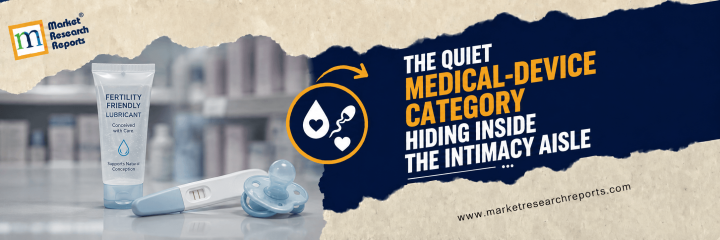
The Quiet Medical-Device Category Hiding Inside the Intimacy Aisle
MRR® Emerging Industry Analysis Market Research · Fertility Industry
A strategic read on fertility-friendly lubricants, with data and analysis from our proprietary report
Most personal lubricants are regulated as cosmetics. Fertility-friendly lubricants are not — they are Class II medical devices, cleared by the FDA under a specific product code that exists for exactly one reason: standard lubricants can impair sperm motility and survival at the exact moment a couple is trying to conceive. That regulatory distinction is easy to miss on a drugstore shelf, but it's the entire foundation of this category, and it's also why the category's growth potential is more reliably read from public health statistics than from any brand's marketing copy.
The demand-side case doesn't require projection. Government and international-body data already describe a large, durable, and in some places growing population of exactly the customer this category serves: couples experiencing difficulty conceiving, in every income bracket, in every country. The supply-side case is narrower and more interesting — this is one of a small number of consumer intimacy products that requires the same battery of biocompatibility testing as a surgical device, which means the barrier to entry is regulatory, not creative or marketing-based. That combination — large, well-documented demand and a real compliance moat — is the strategic story here.
 Navadhi Market Research · Healthcare & Medical Devices
Published
Global Fertility-Friendly Lubricant Market Strategic Research Report
The fertility-friendly lubricant market occupies a structurally distinct position within the broader personal lubricant and reproductive health categories. Unlike co…
▲ 9.7%CAGR2025–2031
$3,500.00 from
Forecast $223.1 by 2031
The Regulatory Foundation
The FDA does not treat "fertility-friendly" as a marketing claim — it treats it as a device classification. Fertility lubricants fall under 21 CFR 884.5300, the FDA's Class II medical device regulation for personal exposure with barrier (PEB) lubricants, and to reach market a manufacturer must demonstrate through 510(k) clearance that the product does not harm sperm motility, sperm survival, or embryo development. This isn't a one-time hurdle. Once a fertility lubricant is cleared and on the market, the manufacturer is required to test each production batch to verify it does not impair sperm motility, survival, or integrity — an ongoing quality-control burden that a standard cosmetic-grade lubricant never has to carry.
The clinical testing bar itself is specific and well-documented across cleared products: manufacturers must show biocompatibility for eggs and embryos, freedom from harmful bacterial endotoxins, and pH and viscosity calibrated to match cervical mucus and semen, with target ranges around pH 7 to 8, mirroring the natural pH of semen and cervical mucus. This is, functionally, a small but real medical-device compliance category sitting inside a consumer retail aisle — which is precisely why it's easy for outside observers to underestimate how defensible it is.
The Demand Data
This is where public health statistics do the heavy lifting, because the population this category exists to serve is measured, tracked, and published by health authorities on a recurring basis.
Globally, the World Health Organization's first comprehensive review of infertility prevalence in a decade found that around 17.5% of the global adult population — roughly 1 in 6 people worldwide — experience infertility in their lifetime, with a lifetime prevalence of 17.8% in high-income countries and 16.5% in low- and middle-income countries — a rare public health condition where prevalence is essentially flat across income levels. WHO also reported a period prevalence of 12.6%, meaning that share of the adult population is experiencing infertility at any given point in time, not just at some point across a lifetime.
In the United States, the government's own longitudinal survey infrastructure backs this up in more granular form. The NIH's National Institute of Child Health and Human Development states that after one year of unprotected sex, 12% to 15% of couples are unable to conceive, and after two years, roughly 10% of couples still have not had a live birth. The CDC's National Survey of Family Growth — administered by the National Center for Health Statistics — separately tracks the downstream care-seeking behavior this population generates, having found in past cycles that roughly 12% of women aged 15–44 have ever received infertility services.
The clinical end of that funnel is directly counted by the CDC every year, by law. Under the Fertility Clinic Success Rate and Certification Act, U.S. fertility clinics are required to report every ART cycle they perform, and the CDC's most recent published national summary shows 435,426 ART cycles performed on 251,542 unique patients across 457 reporting clinics in a single year, resulting in 94,039 live-birth deliveries and 98,289 live-born infants — about 2.6% of all infants born in the United States that year.
The Data, at a Glance
| Data Point | Figure | Source |
|---|---|---|
| Global lifetime infertility prevalence | 17.5% (~1 in 6 adults) | World Health Organization, 2023 |
| Global period infertility prevalence | 12.6% | World Health Organization, 2023 |
| Lifetime prevalence, high-income countries | 17.8% | World Health Organization, 2023 |
| Lifetime prevalence, low/middle-income countries | 16.5% | World Health Organization, 2023 |
| US couples unable to conceive after 1 year | 12–15% | NIH / NICHD |
| US couples without live birth after 2 years | ~10% | NIH / NICHD |
| US women 15–44 who ever received infertility services | ~12% | CDC / NCHS, NSFG |
| US ART cycles performed (latest reporting year) | 435,426 cycles / 251,542 patients / 457 clinics | CDC National ART Surveillance System |
| US infants born via ART | 98,289 (2.6% of all US births) | CDC National ART Surveillance System |
| FDA device classification | Class II, PEB product code, 21 CFR 884.5300 | U.S. Food and Drug Administration |
Reading the Strategic Signal
1. This is a health-data-anchored category, not a trend-anchored one. Unlike most personal-care subcategories, the addressable population here is independently measured by a public health authority every year, by statute, whether or not any company markets to it. That's an unusually stable demand signal to build a product strategy against.
2. The compliance requirement is the moat. Any company can launch a lubricant with "TTC" (trying to conceive) language on the label. Far fewer can carry the FDA 510(k) clearance and ongoing batch-level sperm-safety testing that the PEB classification actually requires. The gap between "marketed as fertility-friendly" and "cleared as fertility-friendly" is the single most useful filter for evaluating any competitor or acquisition target in this space — and it's a filter the government, not a market analyst, has already built.
3. The clinical funnel below the lubricant aisle is large and countable. With CDC data showing over 435,000 ART cycles a year in the U.S. alone, the population actively engaged with fertility clinics — the most receptive, highest-intent customer segment for any adjacent product — is not a projection. It's a mandatory federal disclosure, refreshed annually.
4. Global headroom looks structural, not cyclical. Because WHO's data shows infertility prevalence holding roughly flat across income levels and regions, this isn't a category whose addressable market is concentrated in wealthy markets with existing fertility-clinic infrastructure. The underlying health condition this product category serves is, per WHO's own framing, one that "does not discriminate" — which points toward international expansion being a demand question, not just a distribution and affordability one.
The Bottom Line
The fertility-friendly lubricant category sits at an unusual intersection: a consumer intimacy product with a genuine medical-device compliance burden, serving a population that public health authorities already count, in detail, every single year. The growth story here doesn't need a market-sizing exercise to be credible — it needs a careful read of what the FDA, the CDC, the NIH, and the WHO are already publishing, and an honest assessment of which competitors in the space are actually operating inside that regulatory perimeter versus simply borrowing its language.
Related Reports
Navadhi Market Research · Biotechnology & Life SciencesPublished
Global In-Vitro Fertilization Market Strategic Research Report
Global demand for in-vitro fertilization services and supporting technologies has transitioned from a niche clinical segment into a structurally resilient, high-grow…
▲ 9.6%CAGR2025–2031
$3,500.00 from
Forecast $41.7B by 2031
Navadhi Market Research · PharmaceuticalsOn demand
Global Subfertility Assisted Reproductive Therapeutics Market Strategic Research Report
The global subfertility assisted reproductive therapeutics market occupies a critical intersection of clinical medicine, pharmacology, and advanced laboratory scienc…
▲ 6.8%CAGR2025–2032
$3,500.00 from
Forecast $7.6B by 2032
Navadhi Market Research · PharmaceuticalsOn demand
Global Infertility Hormonal Stimulation Therapeutics Market Strategic Research Report
The global infertility hormonal stimulation therapeutics market represents one of the most clinically consequential segments within reproductive medicine, encompassi…
▲ 6.7%CAGR2025–2032
$3,500.00 from
Forecast $7.6B by 2032