


The World's 15 Largest Tire Manufacturers by Revenue (2026)
Global Tire Industry Strategic Realignment: Financial Solvency, Portfolio Rationalization, and the Pure-Play Transformation
The global tire market is undergoing an era-defining structural transformation, driven by macroeconomic headwinds, aggressive portfolio reorganizations, and the compounding technical requirements of vehicle electrification. Rising raw material costs, sticky inflation, and volatile international trade tariff regimes have forced major multinational operators to dismantle legacy multi-sector conglomerate models in favor of highly focused, pure-play tire operations. This comprehensive research blog delivers a detailed evaluation of how the world's leading tire companies are adjusting their strategic positioning, financial health, and operational frameworks to navigate these shifting macro-level dynamics. Back in July 2018, we published a highly popular feature ranking the top 15 tire companies by revenue. Today, we are excited to share this fully updated analysis to keep our readers ahead of the latest industry shifts.
Global Market Projections and Macroeconomic Undercurrents
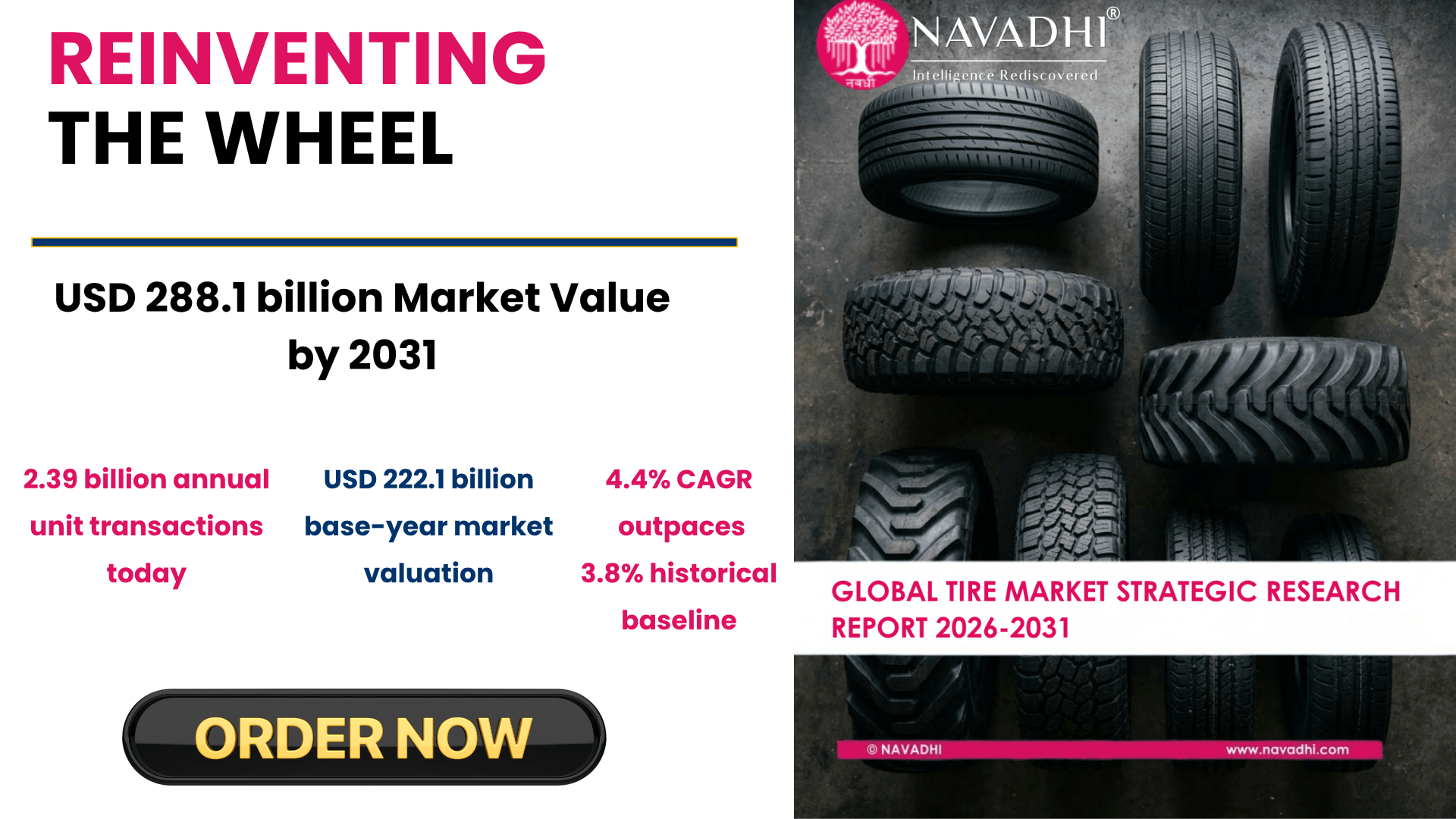
The global tire industry is entering a period of profound structural transformation rather than a simple growth phase, according to the latest study by leading research firm NAVADHI. In its newly released Global Tire Market Strategic Research Report 2026–2031, NAVADHI values the market at a base-year figure of USD 222.1 billion. The industry is projected to reach USD 288.1 billion by 2031, accelerating at a Compounded Annual Growth Rate (CAGR) of 4.4%—a notable jump from its historical baseline of 3.8%. This momentum is driven by a current annual volume of over 2.39 billion unit transactions, which is expected to rise to 2,813 million units by the end of the forecast period.
Regionally, the Asia-Pacific region represents the primary volume engine of the global market, propelled by rapid vehicle assembly in China and India, infrastructure spending, and an expanding middle class. Mature markets, such as the United States and Western Europe, exhibit slower organic volume growth but lead in value capture due to high consumer preference for ultra-high-performance (UHP) and high-rim-diameter passenger tires.
Comparative Analysis of the Top Global Tire Manufacturers
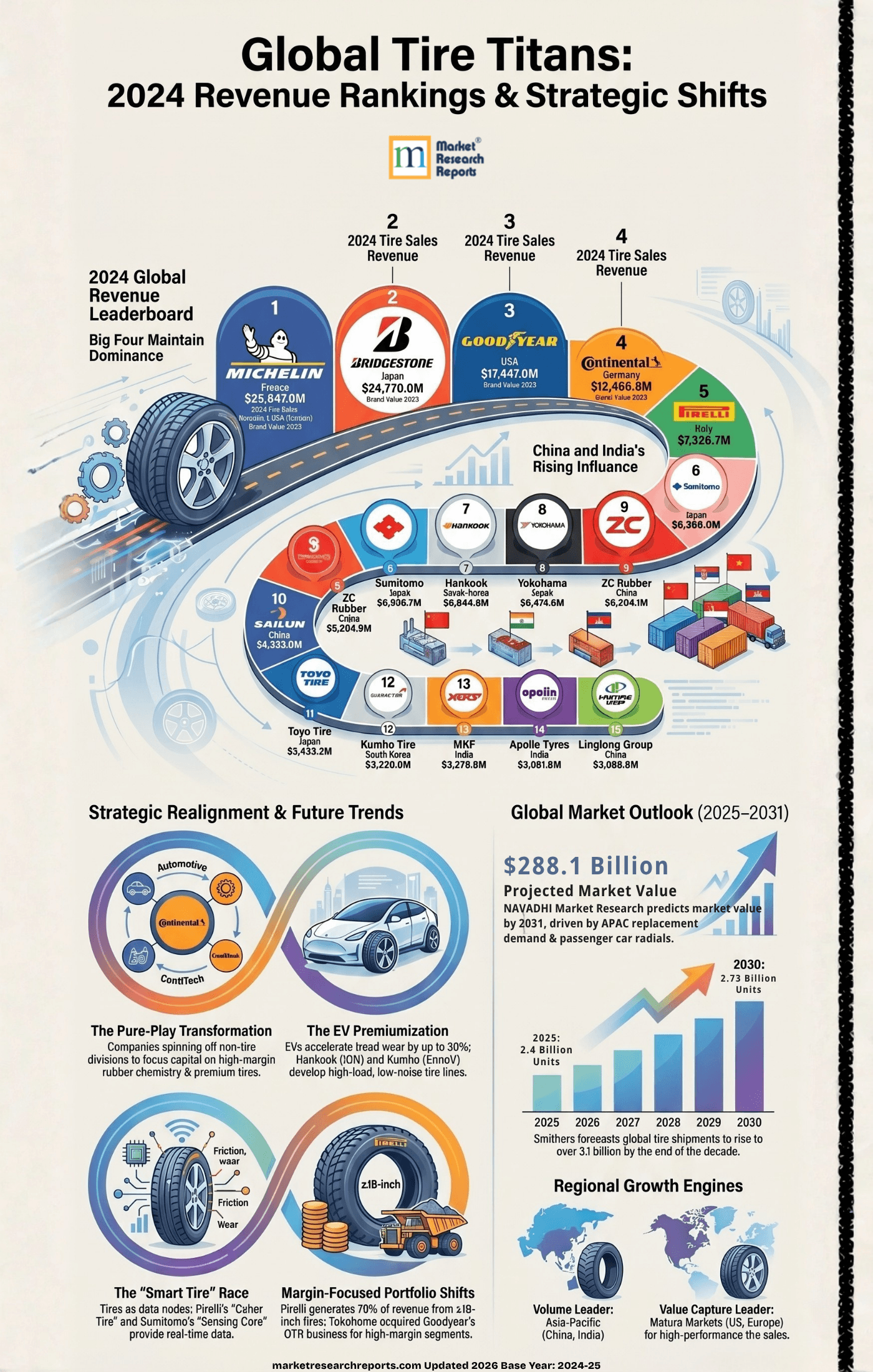
The competitive landscape remains dominated by a core group of Tier 1 legacy brands, though high-growth Tier 2 and challenger brands from emerging markets are rapidly capturing unit market share. The Global Tire Report (GTR) 2025 rankings reveal a highly stable top tier, with the "Big Four"—Michelin, Bridgestone, Goodyear, and Continental—maintaining their long-held market positions despite absorbing varying degrees of top-line revenue compression.
The following comprehensive directory provides an analytical overview of the top tire companies, including their headquarters, GTR 2024 ranking, tire sales revenues, and prevailing brand values.
GTR Rank | Company | Global Headquarters | 2024 Tire Sales Revenue (USD Millions) | Brand Value 2025 (USD Millions) | Primary Operational Focus & Capital Reinvestment |
|---|---|---|---|---|---|
1 | Compagnie Générale des Établissements Michelin | Clermont-Ferrand, France | $25,647.0 | $8,763 | Premium consumer radials, road transportation fleet services, specialties |
2 | Bridgestone Corporation | Tokyo, Japan | $24,770.0 | $8,253 | Dan-Totsu premium replacement, mining (MASTERCORE), corporate restructuring |
3 | The Goodyear Tire & Rubber Company | Akron, Ohio | $17,447.0 | $2,267 | Portfolio deleveraging (Goodyear Forward), retail networks, Cooper integration |
4 | Continental AG (Tires Sector) | Hanover, Germany | $12,466.0 | $3,904 | Pure-play tire transition, EV OE homologation, premium passenger radials |
5 | Pirelli & C. S.p.A. | Milan, Italy | $7,328.7 | $1,941 | High-value passenger car tires ($\\ge18$-inch), prestige OEM partnerships |
6 | Sumitomo Rubber Industries, Ltd. | Kobe, Japan | $6,906.9 | $1,956 (Dunlop) | Dunlop brand consolidation, premiumization targets, smart tire systems |
7 | Hankook Tire & Technology Co., Ltd. | Seoul, South Korea | $6,844.8 | $1,664 | EV-focused tires (iON), Hanon Systems consolidation, high-inch radials |
8 | The Yokohama Rubber Co., Ltd. | Hiratsuka, Japan | $6,474.6 | $1,494 | High-margin SUV tires, Off-Highway (OTR) expansion via acquisitions |
9 | Zhongce Rubber Group Co. Ltd. (ZC Rubber) | Hangzhou, China | $5,204.1 | N.A. | Budget-to-mid consumer, high-volume domestic distribution, commercial TBR |
10 | Sailun Group Co., Ltd. | Qingdao, China | $4,363.0 | $905 | Low-cost manufacturing hubs, international commercial replacement |
11 | Toyo Tire Corporation | Hyogo, Japan | $3,433.2 | $886 (2024) | SUV/Light Truck (Open Country), North American niche segments, Mitsubishi tie-up |
12 | Kumho Tire Co. Inc. | Seoul, South Korea | $3,320.0 | N.A. | Specialized EV tires (EnnoV), high sales efficiency per employee |
13 | MRF Ltd. (Madras Rubber Factory) | Chennai, India | $3,278.0 | N.A. | Local Indian market leadership, massive farm/commercial fleet footprint |
14 | Apollo Tyres Ltd. | Gurgaon, India | $3,081.8 | N.A. | Vredestein premium brand scaling, European high-rim, Andhra Pradesh capex |
15 | Linglong Group Co., Ltd. | Shandong, China | $3,068.5 | N.A. | Serbia manufacturing corridor, cost-effective EV replacement tires, |
Exhaustive Company Profiles and Strategic updates
#1 Compagnie Générale des Établissements Michelin
Michelin has successfully defended its position as the world's most valuable and strongest tire brand, posting steady operating results despite structural volume declines in industrial shipping. The Clermont-Ferrand-based group reported total FY2025 sales of EUR 26.0 billion, a decline of 1.4% at constant exchange rates (CER) and 4.4% on a reported basis. This top-line contraction was primarily driven by a 4.7% drop in tire sales volumes, over 80% of which was caused by shrinking Original Equipment (OE) demand in North American agricultural and commercial trucking segments.
In response, Michelin aggressively pivoted toward high-rim-diameter consumer radial tires, growing its high-value product mix so that 18-inch and larger tires accounted for 68% of MICHELIN-brand passenger car sales in FY2025, rising further to 69% in Q1 2026. In the replacement segment, MICHELIN-brand volumes rose 3% in early 2026, offsetting a distributor-led stockpiling of low-priced budget tires.
The group achieved EUR 2.1 billion in free cash flow before M&A, supported by disciplined capital deployment, and improved its gearing to a conservative 13%. Michelin's board announced a EUR 2.0 billion share buyback program for the 2026–2028 period, reflecting confidence in its high-margin polymer composites and experiences divisions.
Quick Facts
- HQ: Clermont-Ferrand, France
- FY2025 Financial Results: Sales: €26.0 Billion; Segment Operating Income: €2.9 Billion (10.9% of sales); Net Income: €1.7 Billion (down 12%); FCF before M&A: €2.1 Billion
- Key Tire Products: Pilot Sport 5 (UHP Summer), CrossClimate 3 (All-Season), Primacy 5 (Premium Passenger)
- Primary Strategic Segments: Automotive & Two-Wheel (11.7% operating margin); Specialties (13.5% margin); Road Transportation (4.7% margin)
- 2024-2026 Update: Integrated the Cooley Group in January 2026 to expand its high-value Polymer Composite Solutions. Adjusted domestic capacity to cushion North American Class 8 truck OEM declines. Advanced premium passenger mixes with replacement gains (+3% volume in Q1 2026).
#2 Bridgestone Corporation
Bridgestone Corporation's consolidated FY2025 results demonstrated its ability to enhance operating margins through aggressive structural cost reductions, even as revenues remained flat at JPY 4,429.5 billion. Adjusted operating profit rose 2.2% to JPY 493.7 billion, pushing the operating margin to 11.1%. Profit attributable to owners surged 14.8% to JPY 327.3 billion, heavily supported by a JPY 70.4 billion tax reversal from prior uncertain tax positions.
Regionally, performance was highly polarized: North American adjusted operating margins expanded by 150 basis points to 11.0% (generating JPY 1,822.6 billion in sales) through strict pricing discipline, which neutralized severe truck and bus OEM declines. European operations experienced a dramatic turnaround, with operating margins rising 240 basis points to 5.5% (revenue of JPY 721.6 billion) due to commercial retail restructuring. Conversely, the Latin American division struggled, barely securing a break-even operating margin of 0.1% due to low-end imports and conversion inefficiencies.
Under its restructuring plan, Bridgestone incurred JPY 72 billion in reorganization expenses, which included closing its Lanklaar retread facility in Belgium, reducing commercial tire capacity in Bilbao, and transferring its steel cord business in Thailand and China. Bridgestone implemented a 2-for-1 stock split effective January 1, 2026, while accelerating its transition to advanced ENLITEN Gen2 and MASTERCORE Gen2 premium lines.
Quick Facts
- HQ: Tokyo, Japan
- FY2025 Financial Results: Revenue: ¥4,429.5 Billion; Adjusted Operating Profit: ¥493.7 Billion (11.1% of sales); Net Profit Attributable to Owners: ¥327.3 Billion (up 14.8%); Operating Cash Flow: ¥660.4 Billion
- Key Tire Products: Blizzak LM005 (Winter), Potenza S001 (Run-Flat/UHP), DriveGuard (Extended Mobility)
- Primary Strategic Segments: Americas (¥201.5B adj. operating profit); Europe (¥721.6B revenue); Japan; Asia Pacific/India/China
- 2024-2026 Update: Implemented a 2-for-1 stock split on January 1, 2026. Restructured European operations and closed its Lanklaar retread plant. Divested non-core logistics and steel cord businesses in Thailand, Mexico, and China.
#3 The Goodyear Tire & Rubber Company
The Goodyear Tire & Rubber Company successfully concluded its multi-year "Goodyear Forward" transformation plan in FY2025, taking major actions to optimize its corporate portfolio and address financial leverage. Goodyear reported net sales of USD 18.28 billion for FY2025 and recorded a substantial consolidated net loss of USD 1.72 billion. This net loss was primarily driven by non-cash charges, including a USD 674 million goodwill and intangible asset impairment in the third quarter of 2025, rationalization expenses, and pension settlement charges. Tire volumes fell to 158.7 million units, down from 166.6 million in FY2024, reflecting soft commercial volumes.
Despite the reported net loss, the Goodyear Forward plan successfully generated USD 2.2 billion to USD 2.3 billion in gross proceeds through key non-core asset sales: the Off-the-Road (OTR) tire business was divested to Yokohama for USD 905 million on February 3, 2025 , and the Dunlop brand rights in Western markets were transferred to Sumitomo for USD 735 million on May 7, 2025. These proceeds were strictly deployed to reduce consolidated debt to approximately USD 6.2 billion.
Operationally, Goodyear achieved USD 1.5 billion in annual run-rate cost reductions, allowing the group to achieve a seven-year high segment operating margin of 8.5% (segment profit of USD 416 million) in Q4 2025. The integration of Cooper Tire was successfully consolidated within these optimized manufacturing locations, establishing a significantly more streamlined capital structure.
Quick Facts
- HQ: Akron, Ohio
- FY2025 Financial Results: Net Sales: $18,280 Million; Consolidated Net Loss: $1,721 Million; Q4 Segment Operating Income: $416 Million (8.5% margin); Consolidated Debt: $6.2 Billion
- Key Tire Products: Eagle F1 Asymmetric 6 (UHP Summer), EfficientGrip Performance 2 (Touring), Assurance WeatherReady (All-Weather)
- Primary Strategic Segments: Americas ($5,164M net sales 9M 2025); EMEA ($2,621M net sales 9M 2025); Asia Pacific ($933M net sales 9M 2025)
- 2024-2026 Update: Fully completed the "Goodyear Forward" rationalization program, exceeding asset sale targets by JPY 300 million. Consolidated Cooper Tire operations into optimized local segments. Paid down debt using JPY 2.3 billion in total asset sale proceeds.
#4 Continental AG (Tires Group Sector)
Continental AG’s Tires Group Sector demonstrated significant operational resilience, posting flat FY2025 sales of EUR 13.8 billion (compared to EUR 13.9 billion in FY2024) and sustaining a highly profitable adjusted EBIT margin of 13.6%. While the parent Continental Group reported consolidated sales of EUR 19.7 billion and a net loss of EUR 165 million—heavily impacted by EUR 1.718 billion in transformation, restructuring, and carve-out expenses —the tire segment remained highly cash-generative. It successfully offset over EUR 100 million in US tariff costs through positive price/mix effects and peak seasonal winter tire demand in Europe.
Continental is in the final stages of a structural corporate transformation: having confirmed the sale of its ContiTech industrial division (with the OESL business area sold in early 2026 for EUR 1.4 billion) and paving the way to spin off its massive USD 21 billion Automotive division by 2026, Continental is systematically transforming itself into a pure-play tire company. This strategy is already yielding positive results: in Q1 2026, the Tires division reported an adjusted EBIT margin of 14.4% on sales of EUR 3.3 billion, demonstrating that pure-play operations can systematically outpace diversified structures.
Quick Facts
- HQ: Hanover, Germany
- FY2025 Financial Results: Tires Sector Sales: €13.8 Billion; Tires Sector Adjusted EBIT Margin: 13.6% (14.3% in Q4); Consolidated Group Sales: €19.7 Billion; Group Adjusted FCF: €959 Million
- Key Tire Products: EcoContact 7 & 7 S (Premium Summer), WinterContact TS 870 P (Winter), AllSeasonContact 2 (All-Season)
- Primary Strategic Segments: Tires Group Sector (EMEA accounts for 53% of segment sales); ContiTech (OESL division classified under IFRS 5)
- 2024-2026 Update: Progressed toward spinning off the Automotive group sector by 2026 to transition into a pure-play tire company. Secured premium OE homologations for Volkswagen T-Roc and the smart #5 electric SUV. Navigated JPY 100 million+ in US tariff headwinds in the Tires sector.
#5 Pirelli & C. S.p.A.
Pirelli & C. S.p.A. has recorded highly consistent profitability by executing an uncompromising, high-value premiumization strategy. Under its updated Industrial Plan, Pirelli reported stable FY2025 revenues of EUR 6,776.2 million (+4.2% organic growth). Remarkably, 79% of group sales were generated by its High-Value segment (passenger car tires $\\ge18$-inch), up from 76% in FY2024, while the company deliberately downsized its exposure to low-margin standard passenger segments (car tires $\\le17$-inch, down 11% by volume).
This structural shift drove a best-in-class adjusted EBITDA margin of 22.8% (EUR 1,548 million) and an adjusted EBIT margin of 16.0% (EUR 1,081 million), representing the highest operating profitability among Tier 1 global manufacturers. Consolidated net profit rose 5.9% to EUR 530.7 million.
By securing EUR 158 million in internal operational efficiencies, Pirelli fully neutralized EUR 320 million in cumulative headwinds from exchange rate volatility, tariffs, and input cost inflation. Strong operating cash generation and the conversion of its equity-linked bond accelerated deleveraging, cutting net debt to EUR 1.1 billion and driving the net-debt-to-EBITDA ratio down to an ultra-lean 0.71x.
Quick Facts
- HQ: Milan, Italy
- FY2025 Financial Results: Revenues: €6,776.2 Million (+4.2% organic growth); Adjusted EBIT: €1,081 Million (16.0% margin); Consolidated Net Profit: €530.7 Million; Net Debt: €1,102 Million (0.71x Net Debt/EBITDA)
- Key Tire Products: P Zero (Prestige High Performance), Cinturato All Season SF3, Cyber Tire (Sensor-embedded intelligent tire)
- Primary Strategic Segments: High Value (Tires $\\ge18$-inch, contributing 79% of revenue); Standard (Selective select segment reduction)
- 2024-2026 Update: Secured 210 new prestige homologations in the first 9M of 2025. Gained EUR 158 million in structural operational efficiencies. Cyber Tire awarded "Vehicle-2-Everything Innovation of the Year" at the 2025 AutoTech Breakthrough Awards.
#6 Sumitomo Rubber Industries, Ltd.
Sumitomo Rubber Industries, Ltd. registered a record-setting FY2024, achieving consolidated sales of approximately JPY 1.6 trillion and business profits of JPY 110 billion, though overall net earnings were pressured by North American structural restructuring charges. Sumitomo’s primary strategic milestone of FY2025 was the USD 735 million completion of the Dunlop brand acquisition from Goodyear on May 7, 2025. This transaction unifies trademark rights for the Dunlop brand across key Western European, North American, and Oceanian consumer and commercial segments, allowing Sumitomo to eliminate brand fragmentation and implement a synchronized, global premiumization strategy.
Sumitomo’s long-term framework targeting 2035 is highly ambitious: the group aims to increase premium tire sales to 60% of its total portfolio, double its corporate operating profit margin to 15%, expand its retread production (currently a USD 14.5 billion market), and accelerate the commercialization of its proprietary "Sensing Core" smart tire sensor technology.
Quick Facts
- HQ: Kobe, Japan
- FY2024/25 Financial Results: FY24 Sales Revenue: ~¥1,600 Billion; Business Profit: ~¥110 Billion; 2024 Global Tire Sales: $6,906.9 Million
- Key Tire Products: Falken Azenis FK520 (UHP Summer), Dunlop Grandtrek (SUV/4x4), Sensing Core (Software-based friction sensor)
- Primary Strategic Segments: Premium Tires; Sports & Industrial Rubber Products
- 2024-2026 Update: Completed the USD 735 million acquisition of the Dunlop brand rights in Western markets. Initiated structural reforms in North America to address net profit compression. Targeted premium tire sales to reach 60% of its mix by 2035.
#7 Hankook Tire & Technology Co., Ltd.
Hankook Tire & Technology Co., Ltd. reported highly robust FY2025 financial results, with consolidated global revenues surging to KRW 21.2022 trillion (EUR 13.19 billion) and operating profits reaching KRW 1.8425 trillion. This scale expansion was driven by the consolidation of Hanon Systems—a global leader in automotive thermal management—which added KRW 10.88 trillion in thermal division revenues.
In its core tire business, Hankook achieved record revenues of KRW 10.3186 trillion (up 9.6% YoY) with an operating profit of KRW 1.6843 trillion, reflecting a tire operating margin of 16.3%. Hankook’s success is anchored in the EV transition: specialized EV tires represented 27% of its total Passenger Car and Light Truck (PCLT) tire sales in FY2025, while high-inch tires grew to 47.8%. Through its flagship iON EV tire brand and its official exclusive tire partnership with the FIA Formula E World Championship, Hankook has achieved deep technological integration with premium EV OEMs, including Porsche, BMW, and Xiaomi.
Quick Facts
- HQ: Seoul, South Korea
- FY2025 Financial Results: Consolidated Sales: ₩21.202 Trillion; Operating Profit: ₩1.843 Trillion; Tire Division Sales: ₩10.319 Trillion (16.3% margin); PCLT EV Mix: 27%
- Key Tire Products: iON Evo (Premium EV Summer), Ventus S1 evo3 (UHP), Dynapro HPX (SUV)
- Primary Strategic Segments: Tire Segment (47.8% high-inch mix); Thermal Management Systems (Hanon Systems consolidated subsidiary)
- 2024-2026 Update: Consolidated Hanon Systems in Q1 2025 to capture EV thermal and structural integration. Grew high-inch radial tire sales to 47.8%. Supplied original equipment tires for Porsche Macan, Xiaomi YU7, and BMW iX/i4.
#8 The Yokohama Rubber Co., Ltd.
The Yokohama Rubber Co., Ltd. has executed a highly aggressive, margin-accretive growth strategy. Ranked eighth globally with USD 6.47 billion in 2024 tire sales , Yokohama was recognized by Brand Finance as the fastest-growing brand in the top 10 for 2025, with its brand value surging 23% to USD 1.49 billion. Profitability was driven by strong pricing and robust replacement sales of high-margin consumer tires.
Yokohama’s primary strategic milestone of 2025 was the USD 905 million cash acquisition of Goodyear’s Off-the-Road (OTR) tire business, completed on February 3, 2025. This acquisition immediately expands Yokohama’s off-highway tire footprint, capturing specialized mining, agricultural, and industrial segments that command structurally superior margins and are less sensitive to consumer retail cycles. Concurrently, Yokohama has engaged in advanced R&D collaborations, including genetic analysis of para rubber trees with Japanese academic institutions to secure stable, high-yielding natural rubber sources.
Quick Facts
- HQ: Hiratsuka, Japan
- FY2024/25 Financial Results: 2024 Tire Sales: $6,474.6 Million; Brand Value 2025: $1,494 Million (+23%); Achieved Record-High Consolidated Profitability
- Key Tire Products: Advan Sport V107 (UHP), Geolandar X-CV (Premium SUV), Alliance/Galaxy (OTR Brands acquired)
- Primary Strategic Segments: High-Rim Consumer Radials; Off-Highway (OTR) Specialty Tires
- 2024-2026 Update: Completed the USD 905 million acquisition of Goodyear's OTR tire business. Partnered with Yokohama City University for marker-assisted breeding of elite natural rubber trees. Capitalized on strong pricing strategies to achieve double-digit growth across all core financial metrics.
#9 Zhongce Rubber Group Co. Ltd. (ZC Rubber)
Zhongce Rubber Group Co. Ltd. (ZC Rubber) maintains its position as China's largest tire manufacturer, posting 2024 tire sales of USD 5.20 billion, an increase of 9% year-over-year. ZC Rubber has leveraged its highly integrated domestic supply chain to expand its global market share. Operating through its flagship Westlake, Arisun, and Chaoyang brands, the group has successfully premiumized its commercial truck and bus radial (TBR) segments while expanding high-volume domestic distribution networks.
To offset Western tariff barriers, ZC Rubber is actively routing capital toward automated manufacturing hubs across Southeast Asia to secure export corridors.
Quick Facts
- HQ: Hangzhou, China
- FY2024/25 Financial Results: 2024 Tire Sales: $5,204.1 Million (up 9% YoY)
- Key Tire Products: Westlake SA37 (Passenger), Arisun AS600 (Commercial Steer)
- Primary Strategic Segments: Commercial TBR (Truck/Bus); High-Volume PCR (Passenger)
- 2024-2026 Update: Upgraded its smart tire fleet monitoring systems to capture domestic commercial logistics growth. Automated key production lines to mitigate labor inflation.
#10 Sailun Group Co., Ltd.
Sailun Group Co., Ltd. continues its rapid global expansion, posting 2024 tire sales of USD 4.36 billion, reflecting a massive 21% year-over-year growth. It entered the Brand Finance global top 10 for the first time in 2025 with a brand value of USD 905 million. Sailun's growth is heavily supported by a surge in overseas demand for its cost-effective PCR and TBR lines, which utilize its proprietary "EcoPoint3" liquid-phase mixing technology to reduce rolling resistance and tread wear.
By establishing optimized manufacturing bases in Vietnam and Cambodia, Sailun has minimized direct tariff exposures and captured high replacement volumes in North America and Europe.
Quick Facts
- HQ: Qingdao, China
- FY2024/25 Financial Results: 2024 Tire Sales: $4,363.0 Million (up 21% YoY); Brand Value 2025: $905 Million
- Key Tire Products: Atrezzo ZSR2 (UHP Passenger), Terramax HLT (Premium SUV), EcoPoint3 (compounding platform)
- Primary Strategic Segments: Value-tier PCR and TBR replacement markets
- 2024-2026 Update: Scaled liquid-phase chemical mixing to reduce passenger rolling resistance. Leveraged Southeast Asian manufacturing corridors to secure double-digit market share gains in Western replacement markets.
#11 Toyo Tire Corporation
Toyo Tire Corporation relies on a highly focused, geographically concentrated niche strategy. Historically generating USD 3.43 billion in annual tire sales, Toyo is heavily dependent on the North American market, which contributes roughly 55% of its total revenues. This geographic concentration is leveraged through its premium Open Country light truck and SUV tire line, which accounted for 42% of its North American sales in 2025, yielding superior gross margins of 28% compared to just 18% for its standard passenger car lines.
To support this niche premiumization, Toyo deploys its proprietary Nano Balance Technology to control rubber compounding at the molecular level, delivering a 7% reduction in rolling resistance and extending tread life by 12%. Toyo's strategic alliance with Mitsubishi Corporation (which holds a 20.01% stake) provides 3% to 5% procurement savings and has driven an 8% OEM sales CAGR.
However, Toyo faces headwinds: for the nine months ended September 30, 2025, consolidated sales rose 3.5% to JPY 435.3 billion, but operating income fell 5.5% to JPY 72.1 billion, reflecting rising conversion and freight costs.
Quick Facts
- HQ: Hyogo, Japan
- FY2025 Financial Results (9M): Net Sales: ¥435.3 Billion (+3.5%); Operating Income: ¥72.1 Billion (down 5.5%); Net Profit: ¥53.1 Billion; NA Gross Margin: ~28% on niche tires
- Key Tire Products: Open Country R/T Pro (Rugged Terrain Hybrid), Proxes Sport A (UHP Summer), Celsius II (All-Weather)
- Primary Strategic Segments: SUV & Off-Road (Open Country accounts for 42% of NA sales); Passenger Radials; Automotive Parts
- 2024-2026 Update: Tatsuo Mitsuhata appointed Chairman and CEO of Toyo Tire Americas in March 2025. Relocated European sales headquarters to Serbia to optimize regional logistics. Launched premium Kei-car lines in Japan featuring a 12% improvement in wet braking.
#12 Kumho Tire Co. Inc.
Kumho Tire Co. Inc. has achieved outstanding operational efficiency, posting 2024 tire sales of USD 3.32 billion and recording the highest average sales per employee in the tire industry at USD 599,892. The Seoul-based group has undergone a successful turnaround, shifting capital toward high-inch premium replacement markets in Europe and North America.
Kumho is positioning itself as an early innovator in the EV segment, launching its dedicated "EnnoV" electric vehicle tire series. The EnnoV series features advanced high-load-capacity (HL) compounding and a customized sound-absorbing foam matrix, addressing the high mass and low noise specifications of premium EV platforms.
Quick Facts
- HQ: Seoul, South Korea
- FY2024/25 Financial Results: 2024 Tire Sales: $3,320.0 Million; Sales per Employee: $599,892 (Industry Lead)
- Key Tire Products: EnnoV HL (EV Specialized), Ecesta PS71 (UHP), Solus TA51 (All-Season)
- Primary Strategic Segments: Premium Passenger PCR; Electric Vehicle Specialized Tires
- 2024-2026 Update: Launched the "EnnoV" EV tire series featuring high-load structural certification. Leveraged high manufacturing automation to maintain leading industry labor productivity.
#13 MRF Ltd. (Madras Rubber Factory)
MRF Ltd. continues to assert its absolute dominance over the Indian tire landscape, reporting a consolidated total income of INR 28,561 crores for FY2025, up 12.1% YoY from INR 25,486 crores in FY2024. However, the unprecedented rise in raw material input costs squeezed margins, driving consolidated net profit down 10% to INR 1,869 crores. MRF maintains an exceptionally strong balance sheet with total shareholder equity of INR 209.7 billion against a conservative total debt of INR 23.7 billion, translating to an ultra-low debt-to-equity ratio of 11.3%.
Operationally, MRF is capitalizing on India's infrastructure expansion, with FY2026 earnings rebounding sharply to a net profit of INR 24.3 billion on revenues of INR 311.5 billion (net margin recovering to 7.8%). To support long-term volume growth, MRF signed an MoU to establish a new state-of-the-art manufacturing facility in SIPCOT, Tamil Nadu, committing INR 5,300 crores over a 12-year horizon. On the sustainability front, MRF is scaling its renewable energy sourcing and has achieved a 100% reliance on desalinated seawater at one of its key coastal manufacturing plants to mitigate local freshwater strain.
Quick Facts
- HQ: Chennai, India
- FY2025 Financial Results: Consolidated Revenue: ₹28,561 Crores (+12.1% YoY); Net Profit: ₹1,869 Crores; Total Shareholder Equity: ₹209.7 Billion; Total Debt: ₹23.7 Billion (11.3% D/E)
- Key Tire Products: Perfinza (Luxury Passenger), Muscle (Commercial Truck), Wanderer (SUV)
- Primary Strategic Segments: Indian Domestic PCR, TBR, Agricultural and Two-Wheeler sectors
- 2024-2026 Update: Committed JPY 5,300 crores to construct a greenfield manufacturing plant in SIPCOT, Tamil Nadu. Scaled its coastal desalinated water reliance to 100%. Arun Mammen elected Chairman of the Automotive Tyre Manufacturers' Association (ATMA) in March 2025.
#14 Apollo Tyres Ltd.
Apollo Tyres Ltd. has achieved a remarkable operational turnaround, reporting FY2026 consolidated revenues of INR 28,471 crores (up 9% YoY) and an operating profit of INR 4,143 crores (up 16% YoY). Net profit rose 22.4% to INR 1,372 crores, recovering strongly from the raw-material-driven margin squeeze of FY2025, where revenues stood at INR 26,123 crores but profits had contracted to INR 1,121 crores. Apollo's financial management has been highly disciplined, generating powerful operational cash flows that allowed the group to slash consolidated net debt to INR 13 billion by December 2025, achieving an ultra-lean Net Debt-to-EBITDA ratio of 0.4x.
Under its dual-brand strategy, Apollo utilizes the Vredestein brand to capture premium high-inch passenger car radial (PCR) markets in Europe and North America, while expanding its domestic commercial truck and bus radial (TBR) footprint. To meet structural demand, Apollo’s board approved a massive capital expenditure of INR 5,800 crores for its Andhra Pradesh plant to expand PCR capacity by 52% and TBR capacity by 82% by 2029. In technology, Apollo introduced the A-rated EnduMile LHT rolling resistance tire to establish an early lead in the commercial EV fleet segment.
Quick Facts
- HQ: Gurgaon, India
- FY2026 Financial Results: Consolidated Revenue: ₹28,471 Crores (+9%); Operating Profit: ₹4,143 Crores (+16%); Consolidated Net Profit: ₹1,372 Crores (+22.4%); Consolidated Net Debt: ₹13 Billion (0.4x Net Debt/EBITDA)
- Key Tire Products: Vredestein Ultrac Pro (UHP), EnduMile LHT (A-rated EV Truck), Apterra HT2 (SUV)
- Primary Strategic Segments: Premium PCR (Vredestein brand); India Domestic Commercial TBR (Apollo brand)
- 2024-2026 Update: Approved a JPY 5,800 crore expansion for the Andhra Pradesh facility to raise PCR capacity by 52% and TBR by 82% by 2029. Reduced Net Debt-to-EBITDA to an ultra-low 0.4x. Launched the EnduMile LHT commercial EV tire line.
#15 Linglong Group Co., Ltd.
Linglong Group Co., Ltd. ranks 15th globally, posting 2024 tire sales of USD 3.07 billion. Headquartered in Shandong, China, the company has prioritized the construction of international manufacturing bases to diversify its geopolitical footprint. Linglong is heavily investing in its state-of-the-art production facility in Serbia, which acts as its primary export gateway to Western European automotive OEMs.
In 2024, the group established "Powerhall 7," an advanced in-house technology center designed to simulate extreme operational and environmental conditions for battery systems and specialized EV tires before mass assembly.
Quick Facts
- HQ: Shandong, China
- FY2024/25 Financial Results: 2024 Tire Sales: $3,068.5 Million
- Key Tire Products: Green-Max HP010 (EV Passenger), Sport Master (UHP)
- Primary Strategic Segments: Budget-to-mid consumer PCR; Western European OE segments
- 2024-2026 Update: Expanded its Serbia manufacturing corridor. Opened "Powerhall 7" in 2024 to support extreme physical simulation and testing of EV structures.
Specialized & Emerging Competitors
To ensure a complete and exhaustive analysis of the twenty major tire companies listed in the industry setup, the following section profiles the remaining specialized, consolidated, and emerging operators.
Cooper Tire & Rubber Company
Cooper Tire & Rubber Company, historically a leading mid-tier North American manufacturer, was acquired by Goodyear in 2021. By FY2025, Cooper's global manufacturing footprint and brand portfolio (including Cooper, Starfire, and Mastercraft) were fully integrated and consolidated into Goodyear’s Americas and EMEA regional reporting segments. During Goodyear’s comprehensive "Goodyear Forward" rationalization, Cooper's production assets were optimized to support Goodyear’s USD 1.5 billion annual run-rate cost reduction program, successfully streamlining its domestic multi-brand PCR footprint.
Giti Tire Pte. Ltd.
Giti Tire Pte. Ltd., headquartered in Singapore, ranks 17th globally with 2024 tire sales of USD 2.94 billion. It was recognized by Brand Finance as the fastest-growing tire brand in 2024, with its brand value reaching USD 1.07 billion in 2025 (holding 9th place globally). Giti's financial health is underpinned by dominant replacement and OEM market shares in China and Indonesia, which together generate over 65% of its total revenue. Giti enjoys exceptionally high consumer recommendation and familiarity metrics in China, reflecting robust product satisfaction.
Maxxis International (Cheng Shin Rubber Ind. Co., Ltd.)
Maxxis International, operated by Cheng Shin Rubber, ranks 16th globally with 2024 tire sales of USD 3.00 billion. Headquartered in Yuanlin, Taiwan, Maxxis is a dominant participant in the global two-wheeler, ATV, and specialty tire segments, while expanding its presence in passenger car radials in Asian and Latin American replacement markets. The group is heavily investing in highly automated tire compounding to offset labor cost inflation in its domestic manufacturing facilities.
Nexen Tire Corporation
Nexen Tire Corporation, headquartered in Seoul, South Korea, ranks 18th globally with 2024 tire sales of USD 2.27 billion. Nexen has successfully pursued an aggressive electric vehicle original equipment expansion strategy, obtaining specialized EV certifications from premium European passenger car brands. Nexen's advanced compounding focuses on extreme rolling resistance reductions to support the range-extension targets of European EV platforms.
Triangle Tyre Co., Ltd.
Triangle Tyre Co., Ltd., based in Shandong, China, ranks 25th globally with 2024 tire sales of USD 1.40 billion. Triangle remains a leading exporter of value-tier consumer radial and heavy-duty commercial OTR tires. The group relies on strict cost-control and automated molecular mixing to maintain high-volume replacement market access in North America and Western Europe despite tariff constraints.
CEAT Ltd.
CEAT Ltd., headquartered in Mumbai, India, ranks 20th globally with 2024 tire sales of USD 1.58 billion. CEAT is a primary volume participant in the Indian domestic agricultural, commercial TBR, and two-wheeler segments. To support premiumization, CEAT has scaled up its investment in high-inch passenger car radials to capture urban replacement demand, utilizing smart tire compound architectures to withstand regional infrastructure conditions.
Corporate Financial Analysis
- To evaluate the solvency, capital structures, and operating efficiency of these major tire companies, corporate analysts track several core financial formulas.
- First, the operating efficiency of a tire manufacturer is determined by its segment operating margin, which isolates the performance of the tire sector from non-operating variables, such as tax adjustments or non-cash impairments:
- Second, the solvency and debt concentration of capital-intensive operators (such as Goodyear and MRF) are evaluated using the classic Debt-to-Equity ratio:
- Third, relative leverage constraints and the speed of deleveraging are assessed by tracking the Net Debt-to-EBITDA ratio, which measures the number of years required to pay off net debt using core operating cash flow:
Key Market Developments (2022-2026)
- Goodyear Portfolio Rationalization (2025): Under the "Goodyear Forward" program, the company raised JPY 2.3 billion in asset proceeds by divesting its OTR business to Yokohama (closed Feb 2025) and its Western Dunlop brand rights to Sumitomo (closed May 2025) to pay down consolidated debt.
- Continental Pure-Play Spin-off (2025-2026): Continental confirmed the sale of its ContiTech group sector and advanced plans to spin off its JPY 21 billion Automotive unit by 2026, transitioning the parent group into a highly focused, pure-play tire operator.
- Hankook and Hanon Systems Consolidation (2025): Hankook Tire consolidated thermal management leader Hanon Systems in Q1 2025, adding JPY 10.88 trillion in thermal revenue and creating a vertically integrated EV platform developer.
- Yokohama OTR Scale Expansion (2025): Yokohama completed the JPY 905 million cash acquisition of Goodyear's OTR tire division, positioning itself as a dominant high-margin off-highway specialty tire manufacturer.
- Pirelli Cyber Tire V2X Breakthrough (2025): Pirelli's Cyber Tire was awarded "Vehicle-2-Everything Innovation of the Year" at the 2025 AutoTech Breakthrough Awards, validating the commercial integration of physical tires with software-defined vehicles.
- Rise of Indian Greenfield Capex (2025-2026): MRF and Apollo Tyres committed massive domestic investments—INR 5,300 crores and INR 5,800 crores respectively—to scale up high-inch PCR and commercial TBR capacities, hedging against global tariff risks.
Strategic Trends and Industry Outlook
The EV Revolution and Specialized Compounding
Vehicle electrification is redrawing the technical parameters of tire compounding. Electric vehicles exert structurally higher mass and immediate torque on the tire carcass, accelerating tread wear by up to 30% compared to internal combustion engines. Concurrently, the absence of engine noise amplifies cabin road noise, requiring advanced sound-absorbing polyurethane foam structures.
To address these specifications, Tier 1 manufacturers have developed highly specialized EV tire lines—such as Hankook's "iON" and Kumho's "EnnoV". These tires employ high-load-capacity (HL) constructions, liquid-phase mixed polymers, and high-concentration silica compounds to reduce rolling resistance and extend the vehicle's driving range. Premium EV OEMs are increasingly selecting these specialized lines, allowing manufacturers to capture higher average selling prices (ASPs).
The Intelligent / Smart Tire Race
As software-defined vehicles (SDVs) become the baseline for modern automotive architecture, the tire is transitioning from a mechanical product into an active data node. Real-time data collection at the road-tire interface is critical for advanced driver assistance systems (ADAS) and vehicle stability controls.
Pirelli is leading this transition with its "Cyber Tire" platform, which embeds miniature sensors directly into the tire tread to transmit pressure, temperature, and road friction coefficient data directly to the vehicle's central computer. Similarly, Sumitomo's software-based "Sensing Core" technology analyzes wheel-speed signal variations to estimate tire wear, load, and local road conditions without requiring physical wheel sensors. This digital shift is expected to significantly enhance fleet customer lock-in by providing predictive tire maintenance capabilities.
Conglomerate Disintegration and Pure-Play Operations
The global capital markets are increasingly penalizing the multi-sector conglomerate model in favor of pure-play operators. Continental AG's planned spin-off of its Automotive unit and the divestiture of ContiTech reflect the structural difficulties of operating diversified automotive divisions under a single balance sheet.
Diversified conglomerates face high internal capital competition, where low-margin, capital-intensive automotive parts divisions systematically consume the cash flows generated by highly profitable tire sectors. By dismantling these conglomerate structures, companies can direct their capital deployment exclusively toward premium tire technologies and advanced rubber chemistry, unlocking superior valuation multiples and improving long-term cash generation.
Sustainability, Circular Materials, and Alternative Sourcing
The tire industry is facing intense regulatory pressure to reduce its reliance on fossil-fuel-derived carbon blacks, synthetic polymers, and heavy freshwater resources. Major manufacturers are responding with targeted sustainability investments. For example, Sumitomo is actively expanding its retread tire production (reducing chemical consumption) and investing in chemical recycling of waste rubber.
In India, MRF has scaled up its green energy sourcing and has achieved 100% reliance on desalinated seawater at its coastal manufacturing plants, mitigating local municipal water strain. Concurrently, Yokohama is leading advanced genome mapping of rubber trees in Indonesia to secure natural rubber supply chains. These circular initiatives are critical to satisfying the strict "all-sustainable" requirements of next-generation premium automotive OEMs.
Geographic Shifting and Emerging Manufacturing Corridors
To mitigate complex Western tariff regimes and currency fluctuations, global manufacturers are restructuring their geographic footprints. Toyo Tire’s high dependence on the North American market (~55% of sales) exposes it to JPY/USD currency swings, prompting regional restructurings, including shifting European sales operations to Serbia. Similarly, Chinese manufacturers like Linglong and Sailun are bypassing import tariffs by constructing automated greenfield facilities in Serbia and Cambodia.
In India, domestic market leaders like MRF and Apollo Tyres are capitalizing on robust regional demand by approving massive domestic capital projects. These localized manufacturing corridors allow companies to secure regional supply chains and protect operating profits from global trade disputes.