


Top Memory Chip Manufacturers in the World
MRR® Semiconductor (Memory) Industry Analysis Market Research · Competitive Intelligence
The Memory Oligopoly's Growth-Share Matrix: Mapping Samsung, SK hynix, Micron, Kioxia, and SanDisk Through the AI
The global memory semiconductor market — DRAM, NAND, and High Bandwidth Memory (HBM) combined — is on a trajectory from an estimated US$214.8 billion in 2025 to US$657.6 billion by 2031, a 20.5% CAGR, anchored to World Semiconductor Trade Statistics data. Five companies capture the entire value pool essentially: Samsung Electronics, SK hynix, Micron Technology, Kioxia Corporation, and SanDisk Corporation. Every one of the five has now reported record or near-record quarterly results through mid-2026, giving analysts an unusually clean, executive-confirmed dataset to work from — no third-party modeling required.
This briefing applies BCG's growth-share framework — Stars, Cash Cows, Question Marks, and Dogs — directly to the disclosed segment economics of each company, using only what the five oligopolists have themselves disclosed to shareholders, regulators, and the investing public in FY2025–FY2026 filings and earnings releases. The picture that emerges is a market rotating in real time: HBM is manufacturing new Stars, legacy DRAM and NAND are being repriced from mature Cash Cows back into high-growth territory by the AI supercycle, and every management team on the call is now talking about multi-year, take-or-pay customer agreements as the mechanism for converting a historically cyclical business into a structurally durable one.
Market Sizing Snapshot, 2025–2031
| Metric | Figure |
|---|---|
| Base market size (2025) | US$214.8B |
| Forecast market size (2031) | US$657.6B |
| CAGR (2025–2031) | 20.5% |
| Market structure | Five-company oligopoly |
| Largest single sub-segment growth driver | HBM (AI accelerators) |
| Regions covered | Asia Pacific, North America, Europe, Latin America, MEA |
Source: Global Memory Market Strategic Research Report, Market Research Reports Inc.
The Growth-Share Lens, Applied to Memory
The classic BCG matrix plots relative market share against market growth rate. In semiconductor memory, that translates cleanly into three product lines that behave almost like separate businesses under one balance sheet:
- HBM — the highest-growth line in the industry, revenue estimated near US$54.6 billion in calendar 2026, up roughly 58% year-on-year, and structurally supply-constrained through at least 2028 by most executive commentary.
- Conventional server/PC/mobile DRAM — a mature category by unit growth, but repriced into Star-like economics by the current supercycle, with average selling prices up 60%+ sequentially at several suppliers this year.
- NAND / enterprise SSD — historically the lowest-margin, most commoditized memory category, now being pulled into growth by datacenter and AI-inference storage demand, with the addressable market itself reclassified upward (SanDisk now guides to a >$300B calendar-2026 NAND TAM, en route to ~$500B in 2027).
Below, each of the five majors is positioned against this framework using only what they disclosed in their own earnings releases, SEC/FSS filings, and investor presentations.
Company-by-Company Positioning
Samsung Electronics - the broad-portfolio Star reclaiming HBM share
Samsung's Device Solutions (DS) division — the umbrella for memory — posted KRW 127.5 trillion in Q2 2026 revenue and KRW 89.2 trillion in operating profit, both all-time highs, on the back of what the company itself called a record quarter for its Memory Business across DRAM, HBM, and NAND. Samsung was first in the industry to move HBM4 into mass production, and management's own H2 2026 guidance points to continued server memory strength "underpinned by continued AI infrastructure spending and the expanding reach of agentic AI." The company has also signed a memorandum of understanding with Broadcom, worth up to $200 billion over five years, spanning memory, foundry, and advanced packaging collaboration.
Core DRAM and NAND franchises sit as Cash Cows repriced into Star economics — Samsung holds top-tier share in both categories and is now capturing supercycle pricing on top of that share. HBM is a Question Mark trending toward Star: Samsung is investing to close a share gap against SK hynix (independent trackers place Samsung's HBM revenue share in the low-to-mid-20% range as of Q1 2026, up from the mid-teens a year earlier), and HBM4 mass-production leadership is the lever management is pulling to convert that position.
SK hynix - the HBM Star, now compounding into a Cash Cow
SK hynix reported record Q2 2026 revenue of KRW 79.32 trillion (~$54.6B) and operating profit of KRW 60.54 trillion, a 76% operating margin. In its own SEC filings, the company discloses a 34.8% global DRAM revenue share and 63.2% HBM revenue share for 2025 (IDC-sourced, company-cited). HBM4 entered mass shipments in Q2 2026, and the company has concluded roughly ten multi-year long-term agreements (LTAs) with major customers, with five-year standard terms. SK hynix also completed a Nasdaq ADR listing on July 10, 2026, broadening its investor base ahead of a capex program guided to the high-₩40 trillion range for 2026.
HBM is SK hynix's textbook Star - dominant share in the industry's fastest-growing sub-segment — and the shift toward five-year LTAs is a deliberate move to harvest it into Cash Cow durability without sacrificing growth capture. Conventional DRAM, where SK hynix now leads the market outright by IDC's revenue accounting, has been re-rated from Cash Cow to Star by the same pricing dynamics lifting the whole industry.
Micron Technology - the fastest share-gainer, moving Question Marks toward Stars
Micron's fiscal Q3 2026 (ended May 28, 2026) delivered record revenue of $41.46 billion, up from $9.30 billion a year earlier, with DRAM revenue of $31.3 billion (76% of total, +343% YoY) and NAND revenue of $9.9 billion (24% of total, +361% YoY), at an 84.9% gross margin. Micron has now signed 16 Strategic Customer Agreements covering roughly 20% of forward DRAM volume and a third of NAND volume through calendar 2030, with about $22 billion in associated customer cash deposits and commitments. HBM4, built on Micron's 1-beta node, is in high-volume shipments to a lead customer, with more than $1 billion in HBM4 revenue already recognized.
Micron's overall DRAM and NAND franchises are Cash Cows converting to Stars under the same industry repricing dynamic as its peers, while HBM remains a Question Mark with Star momentum — a smaller share base than SK hynix or Samsung, but the fastest sequential ramp of the three, and the Strategic Customer Agreement program is the explicit mechanism management is using to lock in that trajectory.
Kioxia Corporation - the enterprise-SSD specialist turning a Question Mark into a Star
Kioxia's fiscal Q1 2026 (April–June) delivered record revenue of ¥1.7671 trillion (~$11.1B), up 415.5% year-on-year, with non-GAAP operating profit of ¥1.326 trillion at a 75% margin — already ahead of the company's entire prior full fiscal year's operating profit in a single quarter. Enterprise SSD and datacenter sales now account for over 60% of Kioxia's revenue, up from a much smaller base historically, and management guided Q2 revenue toward ¥2.39 trillion. The company has moved to a net cash position after repaying all senior debt, launched an ¥800 billion buyback, and executed a 3-for-1 stock split. Kioxia has also filed for a U.S. ADS listing to broaden its investor base following its December 2024 Tokyo IPO, and July 2026 reporting points to exploratory talks with Western Digital on a possible combination of flash-memory assets.
Kioxia's historical NAND commodity business — long a Question Mark given third-place share (independent trackers put it near 13–14% of global NAND revenue, clustered tightly with Micron and SanDisk) — is being deliberately repositioned as a Star through the pivot toward enterprise SSD and datacenter mix, which now drives the majority of revenue. The possible Western Digital tie-up, if it proceeds, would be a scale move consistent with consolidating a Question Mark position into a stronger share base.
SanDisk Corporation - from spin-off to datacenter Star
SanDisk, separated from Western Digital in February 2025, delivered fiscal Q4 2026 revenue of $8.97 billion (+372% YoY, +51% QoQ), with full fiscal-year 2026 revenue of $20.25 billion, up 175% year-on-year. The standout figure is the mix shift: Datacenter revenue was up 437% year-on-year, and management's own guidance has datacenter's share of SanDisk's total addressable market rising from roughly 30% in calendar 2025 to about 50% in calendar 2026. SanDisk has signed ten "New Business Model" (NBM) long-term agreements with an estimated $42 billion contracted revenue backlog, and the board has authorized an additional $14 billion in buybacks, bringing total remaining repurchase authorization to $15.5 billion on a zero-debt balance sheet.
As a recent spin-off, SanDisk's overall NAND franchise began life as a Question Mark relative to its five-year-younger public trading history, but the datacenter-led mix shift — now the fastest-growing segment industry-wide — is pulling the whole business toward Star status faster than any peer's percentage terms, aided by the NBM contract structure converting spot-market exposure into locked-in, multi-year economics.
Consolidated Growth-Share Matrix - Memory Industry, 2026
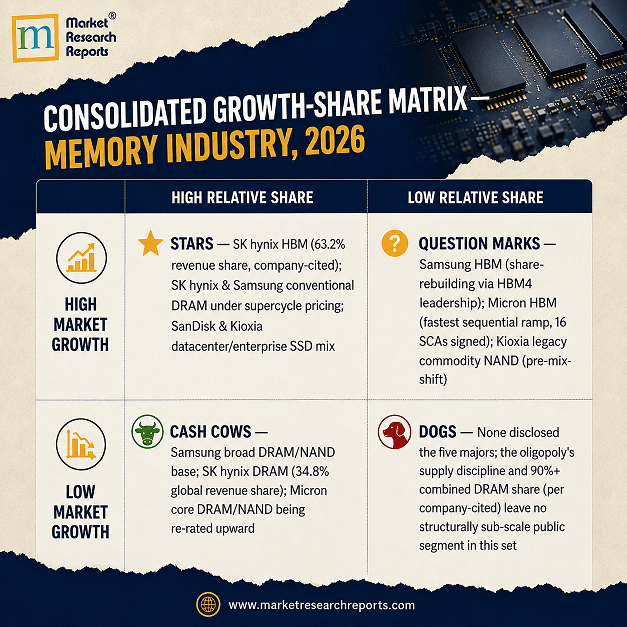
The absence of a "Dogs" quadrant is itself the headline finding: public disclosures across all five companies show every major product line either compounding on existing share or being actively repositioned toward it, a function of the industry's high barriers to entry and the AI-driven demand shock lifting even legacy DRAM and commodity NAND out of their traditional low-growth classification.
Strategic Imperatives for 2026–2031
- Convert supercycle pricing into contracted, multi-year revenue. Every one of the five companies — SK hynix's LTAs, Micron's SCAs, SanDisk's NBMs — is running the same playbook: trade some near-term spot-price upside for locked multi-year volume and pricing commitments. This is the clearest signal that management teams view the current upcycle as durable rather than purely cyclical, and it is the single most repeated theme across Q2 2026 earnings calls industry-wide.
- HBM leadership is now a capital-allocation race, not just a technology race. SK hynix's high-₩40 trillion 2026 capex guidance, Samsung's Broadcom collaboration, and Micron's continued HBM4E development all point to the next competitive battleground being who can bring qualified HBM4/HBM4E capacity online fastest — not simply who has the best die stack.
- NAND's re-rating toward datacenter is a genuine structural opportunity, not a one-quarter story. With SanDisk guiding the NAND TAM toward $500 billion by calendar 2027 and Kioxia's enterprise SSD mix already exceeding 60% of revenue, the category once treated as the industry's low-margin Cash Cow is being actively re-underwritten by all three NAND-weighted suppliers (Kioxia, SanDisk, and Samsung/SK hynix's combined NAND businesses) as a growth vector in its own right.
- Consolidation optionality remains on the table. The reported Kioxia–Western Digital exploratory discussions signal that even well-capitalized players see scale benefits in further tightening the five-company structure, particularly in NAND where the top five suppliers together hold over 95% of revenue share per IDC.
Outlook
With the report's underlying WSTS-anchored forecast projecting the market roughly tripling by 2031, and with every one of the five oligopolists now reporting record or near-record quarters through mid-2026, the strategic question for 2026–2031 is less "who wins the memory market" — the oligopoly structure is a settled fact — and more "who converts today's Question Marks into tomorrow's Stars fastest." On the disclosed evidence, that race is currently led by SK hynix and Samsung in HBM, by SanDisk and Kioxia in datacenter-mix NAND, and by Micron across both categories simultaneously via its Strategic Customer Agreement program.
This analysis draws on company-reported earnings releases, investor presentations, and public regulatory filings (SEC/FSS) from Samsung Electronics, SK hynix, Micron Technology, Kioxia Holdings, and SanDisk Corporation, current through August 2026, together with the market-sizing framework of the Global Memory Market Strategic Research Report