


Traceability and Blockchain Supply Chain Auditing for Luxury Apparel and Leading Companies
The global luxury apparel and fashion sector is currently undergoing a profound structural and philosophical transformation. Historically, luxury conglomerates and independent maisons cultivated an aura of deliberate opacity surrounding their supply chains, viewing their sourcing networks, artisanal manufacturing techniques, and proprietary supplier relationships as closely guarded trade secrets. This traditional paradigm of guarded savoir-faire has been irreversibly shattered by an escalating convergence of regulatory mandates, shifting consumer demands for ethical provenance, and the relentless proliferation of the global counterfeit market. The illicit trade in counterfeit consumer goods is now estimated to be worth between $500 billion and $1 trillion globally, establishing itself as one of the most profitable illegal enterprises worldwide and presenting an existential threat to brand equity.
Simultaneously, the fashion industry faces an unprecedented wave of international legislation that shifts the burden of proof regarding environmental, social, and governance (ESG) from the state to the importer. The European Union's impending Ecodesign for Sustainable Products Regulation (ESPR) is the most consequential of these frameworks, introducing the mandate for a Digital Product Passport (DPP). The DPP dictates that by the end of the decade, all textiles sold within the EU must feature a scannable digital identity detailing the product's precise material composition, environmental impact assessments, repairability metrics, and end-of-life recycling pathways. Concurrently, the EU Corporate Sustainability Due Diligence Directive (CSDDD) requires corporations to actively identify, prevent, and mitigate human rights violations and environmental degradation across their entire global value chains, spanning from raw material extraction to final assembly.
In the United States, enforcement mechanisms such as the Uyghur Forced Labor Prevention Act (UFLPA) have empowered Customs and Border Protection (CBP) to detain shipments lacking exhaustive, transaction-level chain-of-custody documentation that proves goods were not produced using forced labour. To navigate this fiercely complex operational landscape, luxury brands are abandoning legacy Enterprise Resource Planning (ERP) systems and static spreadsheets in favour of advanced, interconnected digital traceability infrastructures.
We recently launched our report — Global Traceability and Blockchain Supply Chain Auditing Market for Luxury Apparel — covering the complete market scenario across product types including Blockchain-Native Provenance Platforms, Hybrid RFID/NFC + Distributed Ledger Solutions, Supply Chain Audit & Compliance Consulting Services, AI-Augmented Traceability Analytics Software, and Digital Product Passport and QR Authentication Tools.
The report also covers key application areas such as Raw Material and Fiber Origin Verification, Anti-Counterfeiting and Brand Authentication, Labor Practice and Ethical Sourcing Auditing, Luxury Resale and Secondary Market Certification, and ESG Reporting and Regulatory Compliance Documentation.
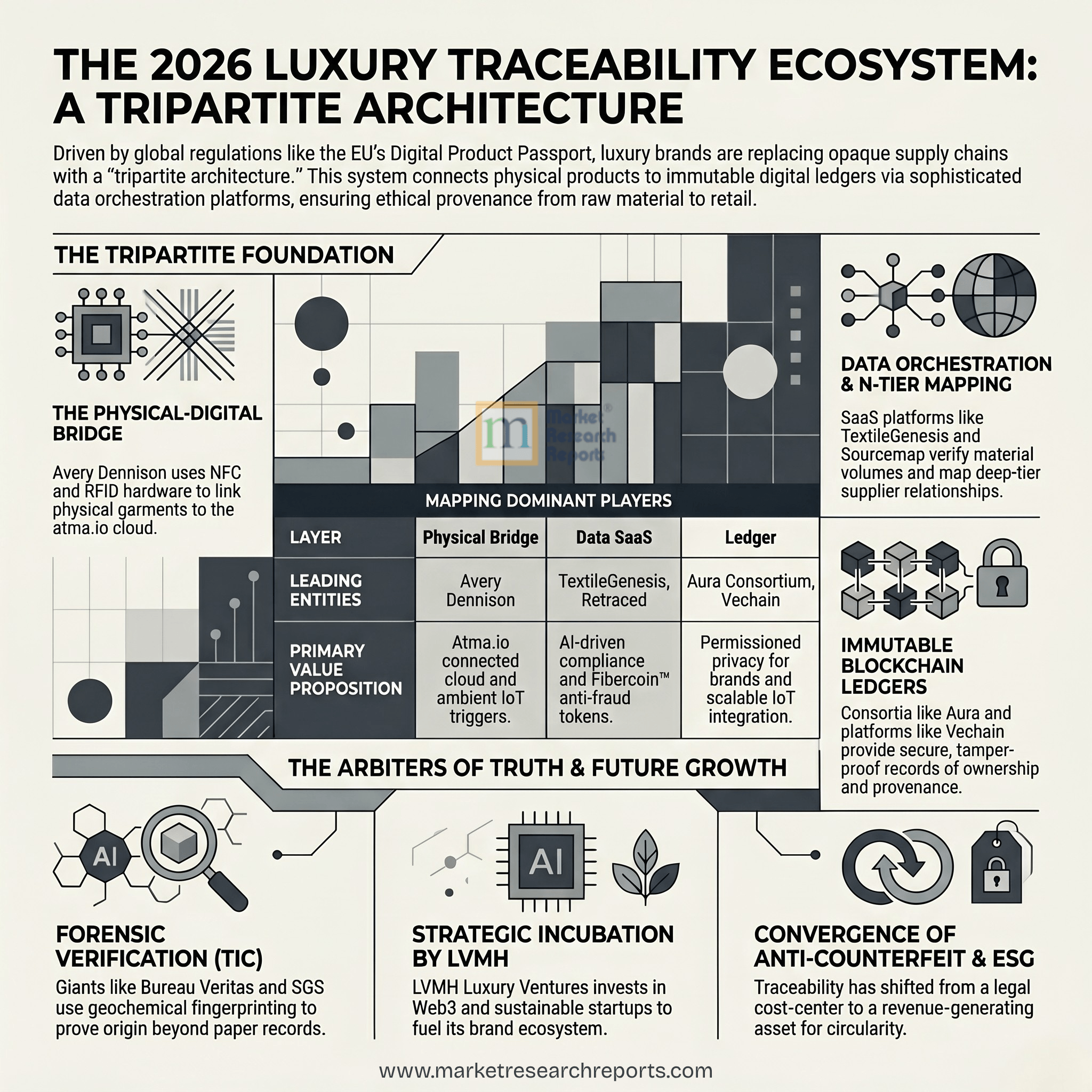
This comprehensive analysis dissects the technological and strategic frameworks underpinning modern supply chain auditing in the luxury sector. By examining the contributions of the Aura Blockchain Consortium, Avery Dennison Corporation, TextileGenesis, Retraced GmbH, Sourcemap Inc., Everledger Ltd., the Vechain Foundation, Bureau Veritas SA, SGS SA, and LVMH Luxury Ventures, a clear tripartite architecture emerges. This architecture—which forms the foundation of the 2026 luxury supply chain—consists of physical verification and digital triggers, sophisticated Software-as-a-Service (SaaS) data orchestration platforms, and immutable distributed ledgers (blockchain) that secure authenticated ownership and facilitate circular business models.
| Regulatory Framework | Jurisdiction | Core Mandate | Technological Implication for Luxury Brands |
|---|---|---|---|
| Digital Product Passport (DPP) / ESPR | European Union | Mandatory digital identities detailing composition, circularity, and lifecycle impact. | Requires integration of physical triggers (NFC/QR) with consumer-facing platforms hosting verified lifecycle data. |
| Corporate Sustainability Due Diligence (CSDDD) | European Union | Mandatory identification and mitigation of ESG risks across all supplier tiers. | Necessitates multi-tier supply chain mapping tools capable of tracking sub-suppliers to the raw material level. |
| U.S. CBP Forced Labor Regulations (UFLPA) | United States | Prohibition of goods linked to forced labour, shifting burden of proof to the importer. | Demands transaction-level traceability and automated watchlist monitoring to prevent border detentions. |
| Anti-Waste for a Circular Economy (AGEC) | France | Promotes the circular economy through stringent product lifecycle reporting. | Drives the adoption of blockchain for authenticated resale and end-of-life recycling tracking. |
The Foundational Ledger: Private Consortia and Enterprise Blockchains
To secure the massive volumes of sensitive data generated by global supply chains, the luxury industry has turned to distributed ledger technology. However, the adoption of blockchain in this sector has been highly nuanced, eschewing permissionless, public networks (like the Bitcoin or public Ethereum networks) in favour of meticulously governed, enterprise-grade architectures that prioritise data privacy, scalability, and energy efficiency.
The Aura Blockchain Consortium: The Luxury Walled Garden
The most formidable institutional response to the demand for digital authentication has been the creation of the Aura Blockchain Consortium. Established in April 2021 by LVMH, the Prada Group, and Cartier (a Richemont maison), and subsequently joined by the OTB Group and Mercedes-Benz, Aura represents a historic, unprecedented alliance of fierce commercial rivals. Operating as a non-profit association headquartered in Geneva, Switzerland, Aura provides blockchain-agnostic solutions tailored explicitly to the exacting standards of the luxury sector.
The fundamental philosophy driving Aura is that technology addressing industry-wide challenges—such as counterfeiting, responsible sourcing, and grey market diversion—should be developed collaboratively, ensuring a single, interoperable global standard. Technologically, the Aura platform is built upon Quorum, a permissioned enterprise iteration of the Ethereum blockchain originally developed by JPMorgan Chase, hosted on Microsoft Azure cloud infrastructure, and engineered in deep collaboration with the blockchain software firm ConsenSys. This specific architectural choice resolves the primary hesitations luxury conglomerates hold regarding public blockchains. As a "closed permissioned" network, only thoroughly vetted consortium members possess the cryptographic keys to access or validate the blockchain. This ensures that highly sensitive production volumes, proprietary supplier identities, and personal customer data remain strictly confidential, partitioned safely away from public view while still leveraging the immutable security of decentralised consensus.
By 2026, the Aura Blockchain Consortium had achieved remarkable scale, surpassing 60 million luxury products registered across its private network, representing over 50 member brands. The consortium's suite of solutions encompasses several layers of enterprise utility. For brands lacking internal blockchain engineering expertise, Aura provides a Software-as-a-Service (SaaS) solution that utilises the ERC-721 protocol to seamlessly mint Non-Fungible Tokens (NFTs), which function as highly secure digital certificates of authenticity. Furthermore, Aura introduced the Multi-Token Minter (MTM), an advanced routing feature that allows member brands to deploy smart contracts not only on Aura's private, permissioned ledger but also across major public blockchains such as the Ethereum mainnet, Polygon, and Solana. This interoperability is vital for brands seeking to engage younger demographics through broader Web3 marketing campaigns, digital collectables, and metaverse integrations, while keeping their core supply chain data securely sequestered on the private chain.
The practical deployments of Aura's technology across its member brands vividly illustrate the platform's versatility. Loro Piana, the LVMH-owned maison renowned for its exquisite textiles, implemented Aura to provide absolute traceability for "The Gift of Kings" collection. Customers purchasing these ultra-premium woollen garments can scan an embedded QR code to access a digital certificate that immutably traces the shirt's journey from the specific farm where the wool was shorn, through the weaving and manufacturing processes, directly to the retail boutique. The OTB Group, a founding member, has aggressively scaled its integration, encrypting over 3 million products across its Maison Margiela, Marni, and Jil Sander lines since 2022. By embedding Near Field Communication (NFC) chips directly into products—such as the iconic Maison Margiela Tabi shoe—the OTB Group links the physical item to an Aura-backed digital certificate, providing customers with an incorruptible guarantee of value while rendering counterfeiting virtually impossible.
Other notable implementations include Hublot, which uses visual recognition technology akin to facial recognition to map the unique micro-structure of a watch's materials, storing this data as an e-warranty NFT on the Aura blockchain. Similarly, Louis Vuitton launched the LV Diamond Certificate, which documents the sourcing, cutting, and setting of precious stones, guaranteeing ethical provenance to the final buyer. In a powerful demonstration of ecosystem synergy, the New York-based luxury brand Another Tomorrow debuted the next generation of its Digital Product Passport across its 2026 collection by combining Aura's blockchain with NFC crypto tags developed by Temera (an Aura ecosystem partner). This integration not only verifies material sourcing but facilitates Another Tomorrow's in-house Authenticated Resale program, embedding circularity directly into the garment's lifecycle.
The Vechain Foundation: Public-Enterprise Synergies
While the Aura Consortium dominates the ultra-luxury European conglomerates, the Vechain Foundation has established a formidable presence by focusing on broader enterprise adoption across logistics, fast-moving consumer goods, and fashion. Founded in 2015 by Sunny Lu—who previously served as the Chief Information Officer for Louis Vuitton China—and Jay Zhang, Vechain was explicitly architected to overcome the friction of applying public blockchain technology to real-world, high-volume supply chains.
The VechainThor blockchain operates on a Proof of Authority (PoA) consensus mechanism. Unlike the computationally intensive Proof of Work (used by Bitcoin) or Proof of Stake algorithms, PoA relies on exactly 101 vetted "authority nodes" to validate blocks and process transactions. This deliberate balance between centralisation and decentralisation ensures high transactional throughput, massive scalability, and energy efficiency, making it ideally suited for enterprise-level tracking where millions of individual items must be logged daily.
Vechain's most significant structural innovation is its dual-token economy, a mechanism designed to solve the critical issue of transaction cost volatility. The ecosystem utilises two distinct tokens: VET (VeChain Token) and VTHO (VeThor Token). VET serves as the primary value-transfer and governance token; holding VET grants stakeholders voting rights on network upgrades. Crucially, holding VET automatically generates VTHO, which acts as the "gas" required to execute smart contracts and write data to the blockchain. By decoupling the speculative value of the platform (VET) from the operational cost of using it (VTHO), Vechain provides corporate Chief Financial Officers with predictable overheads. Enterprises do not need to fear that a sudden spike in cryptocurrency market prices will exponentially increase their supply chain auditing costs.
To lower the barrier to entry, Vechain introduced ToolChain, a comprehensive Blockchain-as-a-Service (BaaS) platform that allows companies to build sophisticated tracking applications without requiring deep, in-house blockchain engineering talent. ToolChain seamlessly integrates with IoT hardware, including NFC chips, RFID tags, and QR code printers, enabling factories to upload logistics data directly to the VechainThor blockchain with minimal friction.
In the luxury apparel sector, Vechain has demonstrated robust utility. The platform partnered with the LVMH maison Givenchy to equip handbags with Vechain chips, allowing consumers to cryptographically verify authenticity and combat the proliferation of highly convincing "superfakes". Furthermore, Vechain's strategic alliance with DNV, an internationally accredited registrar and classification society, birthed the "My Story" solution. "My Story" allows brands to audit and immutably record critical product data—such as ethical sourcing, animal welfare metrics, and environmental footprints. DNV auditors independently verify the data before it is permanently added to the blockchain, allowing the end consumer to scan a QR code on a hangtag and interact with a trustworthy, third-party-verified narrative of the product's journey.
Everledger Ltd.: The Realities of Capital-Intensive Traceability
The trajectory of Everledger Ltd. serves as a profound and cautionary case study regarding the economic realities and volatility of scaling pure-play blockchain startups within global supply chains. Founded in 2015 by Australian entrepreneur Leanne Kemp, Everledger initially garnered immense global acclaim for pioneering the use of blockchain to trace the provenance of diamonds, creating a digital twin for precious stones to prevent conflict minerals from entering legitimate markets. The company successfully raised over $27 million from an array of venture capitalists and government entities, expanding its operations beyond diamonds to track coloured gemstones, critical minerals, fine art, and luxury apparel. Everledger collaborated with major industry pillars, including the Gemological Institute of America (GIA), Brilliant Earth, and the Provenance Proof initiative.
However, the capital-intensive nature of building bespoke blockchain infrastructure, combined with the notoriously slow sales cycles of the luxury and mining industries, placed intense pressure on the company's balance sheet. In early 2023, following the sudden withdrawal of a primary investor who allegedly failed to honour a funding agreement, Everledger fell into severe financial distress. The company's UK parent entity, Foreverhold Limited, entered liquidation owing creditors approximately £7.4 million, while its Australian affiliate was placed under voluntary administration (the local equivalent of bankruptcy proceedings) with debts mounting to $9.5 million. The collapse sent shockwaves through the fashion and tech sectors, raising critical questions about the sustainability of independent blockchain traceability models, with some analysts critiquing the operation as a "solution looking for a problem" that lacked adequately diversified, recurring revenue streams.
Despite this near-fatal contraction, Kemp successfully navigated the administration process, orchestrating a buyout and restructuring to regain sole ownership of the firm. Emerging as a leaner entity dubbed "Everledger 2.0," the company downsized from a peak of 55 employees to a highly focused core technical team of 15. Kemp shed the expansive global sales apparatus to concentrate entirely on the underlying technology and product development for core markets: gems, minerals, and textiles.
The restructured Everledger quickly proved its enduring technical relevance by securing a major collaborative partnership with Signet Jewelers' UK chain, Ernest Jones, to launch the "Origin by Ernest Jones" collection. This highly advanced initiative traces diamonds on the Everledger blockchain, moving beyond mere geographical origin tracking to catalogue the specific metals used, the manufacturing processes employed, and the renewable energy utilised during production. Buyers receive a "digital storybook" and an "Everledger Jewellery Passport" containing deep sustainability insights. The Everledger narrative underscores a vital third-order insight for the industry: building independent traceability infrastructure relies heavily on macroeconomic conditions and venture capital stability. Conversely, consortium-backed platforms like Aura possess the captive clientele and immense capital reserves of their luxury conglomerate founders, granting them structural immunity to funding shocks.
| Blockchain Infrastructure | Consensus / Architecture | Core Value Proposition | Notable Luxury / Apparel Implementations |
|---|---|---|---|
| Aura Blockchain Consortium | Quorum (Private, Permissioned) | Absolute data privacy, luxury-specific standards, cross-chain MTM minting. | Loro Piana, Maison Margiela, Cartier, Bulgari, Another Tomorrow. |
| Vechain Foundation | Proof of Authority (Public-Enterprise) | Predictable transaction costs (VET/VTHO), scalable IoT integration. | Givenchy, H&M, DNV "My Story" supply chain verification. |
| Everledger | Hyperledger Fabric (Enterprise) | Provenance tracking for high-value conflict commodities and textiles. | Signet Jewelers (Ernest Jones), Brilliant Earth, Provenance Proof. |
The Data Orchestration Layer: Specialised SaaS Mapping Platforms/ Companies
While blockchain provides an immutable ledger, it does not inherently gather or organise supply chain data. Between the physical reality of a garment and the final cryptographic record sits the data orchestration layer. Specialised Software-as-a-Service (SaaS) platforms have emerged to handle the labyrinthine complexity of discovering, mapping, and verifying fashion supply chains across multiple, heavily fragmented global tiers.
1. TextileGenesis (A Lectra Company): Eradicating Double-Counting
Founded in 2018 and subsequently acquired by Lectra—a global leader in smart industrial fashion solutions—TextileGenesis is a trailblazing traceability platform purpose-built from the ground up for the unique demands of the textile ecosystem. The platform explicitly targets one of the most pervasive and damaging issues in sustainable fashion: the fraudulent double-counting of certified sustainable materials. Historically, because paper-based certificates can be easily copied or assigned to multiple shipments, a single volume of organic cotton could be claimed by multiple brands simultaneously, destroying the integrity of sustainability metrics.
TextileGenesis mitigates this through a rigorous "fiber-forward" approach, tracing materials from their absolute raw origin (Tier 4 or Tier 5 farms and spinners) down to the retail distribution level. The technological linchpin of this system is Fibercoin™ technology. Unlike speculative, tradable cryptocurrencies, a Fibercoin is a closed-loop digital token that functions strictly as a digital twin for physical materials. When a verified producer extracts or harvests certified sustainable material, the system mints Fibercoins equivalent to that exact physical volume (e.g., 1 kilogram of verified organic cotton equates exactly to 1 Fibercoin). As the physical material moves through the supply chain—from spinning mills to weaving, dyeing, and garment manufacturing—the corresponding Fibercoins are transferred digitally between the suppliers' accounts on the platform. Because the platform strictly enforces that the volume of Fibercoins transferred cannot mathematically exceed the volume of physically certified material minted at the source, the system structurally eliminates the possibility of double or triple-counting, effectively eradicating volume fraud across the supply chain.
TextileGenesis has achieved monumental scale within the industry, tracking over 1.2 billion discrete units and partnering with more than 150 leading global brands, including heavyweights like the H&M Group, Bestseller, Lululemon, and the Zegna Group. The platform's commitment to integration is evidenced by its strategic partnerships with major global standard-setting bodies. In early 2026, OEKO-TEX® announced a full collaboration with TextileGenesis to digitise Transaction Certificates for organic cotton flows. This landmark initiative replaces highly manipulable PDF-based certificates with secure, token-based digital chains of custody that integrate seamlessly with OEKO-TEX's physical GMO testing, providing a robust, tamper-resistant system that significantly reduces administrative burdens for spinners and ginners. Similar transformative partnerships with Recover (recycled cotton) and the Alliance for European Flax-Linen & Hemp solidify TextileGenesis's position as the foundational data layer for sustainable textile verification.
2. Retraced GmbH: AI-Driven Compliance and Supplier Collaboration
Headquartered in Düsseldorf, Germany, Retraced GmbH approaches the traceability challenge through the lens of regulatory compliance, supplier collaboration, and artificial intelligence. Acknowledging industry studies revealing that up to 70% of fashion brands lack basic visibility beyond their Tier-2 suppliers—leaving them critically exposed to hidden compliance violations—Retraced provides an AI-first data infrastructure. This platform acts as a unified system of record that brings sourcing, compliance, IT, and sustainability teams together in a single collaborative hub.
Retraced excels in managing the immense bureaucratic heavy lifting associated with stringent modern regulations, such as the German Supply Chain Due Diligence Act (LkSG), the French AGEC law, and upcoming EU directives. Rather than relying on static, quickly outdated spreadsheets, Retraced enables fashion brands to map their supply chains dynamically, automate the collection and verification of thousands of audit documents, and execute real-time supplier risk assessments based on geographical and operational parameters.
A highly consequential development for the platform occurred in late 2025 when Retraced successfully integrated its platform with the Oracle Autonomous AI Database. Global supply chains inherently generate massive volumes of disparate, unstructured data—ranging from scanned PDFs of third-party facility audits and handwritten supplier declarations to geospatial records. By utilising Oracle’s advanced AI infrastructure, Retraced converts all platform data into mathematical vectors, enabling semantic search and natural language querying across millions of fragmented supply chain records. This integration drastically reduces the administrative burden on compliance officers, allowing the AI to instantly parse documents, validate supplier claims, flag anomalies, and map exploitation paths, transforming compliance from a reactive necessity into a strategic advantage.
3. Sourcemap Inc.: N-Tier Mapping and Customs Defensibility
Born out of early supply chain research at the Massachusetts Institute of Technology (MIT) in 2011, Sourcemap Inc. is the dominant software provider for N-Tier supply chain mapping and highly rigorous trade compliance. While Retraced focuses deeply on European ESG collaboration, Sourcemap has established itself as an indispensable enterprise tool for navigating the uniquely punitive U.S. customs environment.
With the aggressive enforcement of the UFLPA, U.S. Customs and Border Protection (CBP) essentially reversed the presumption of innocence for importers regarding forced labour. Sourcemap addresses this extreme compliance burden via an automated cascading supplier portal. When a brand invites a Tier-1 supplier to the platform, that supplier is required to identify their Tier-2 suppliers, who are in turn invited to identify Tier-3, and so on. This cascading mechanism automatically maps the entire Bill of Materials and discovers sub-suppliers within hours, expanding a brand's visibility by a factor of 10 to 20 in a matter of days. Crucially, the platform executes continuous Supplier Watchlist Monitoring against global restricted entity databases and allows brands to run "mock detentions." This feature allows logistics teams to test their compliance readiness and ensure they can produce a flawless, transaction-level chain of custody before CBP actually detains a shipment at the border.
In the luxury sphere, Sourcemap has successfully bridged the gap between deep upstream mapping and consumer-facing Web3 technologies. In a landmark 2022 partnership with Arianee (a premier Web3 consumer engagement platform), Sourcemap provided the verified raw material-to-consumer traceability data that powered the Breitling Super Chronomat Automatic 38 Origins watch.
Sourcemap tracked the artisanal gold and lab-grown diamonds from the point of extraction, and this dense logistical data was seamlessly anchored into a blockchain-backed NFT digital passport via Arianee, granting the end consumer immutable, interactive proof of ethical provenance.
| SaaS Platform | Core Technological Mechanism | Primary Value Proposition | Key Luxury/Fashion Customers |
| TextileGenesis | Fibercoin™ Digital Tokens | Prevention of material double-counting via mass-balance algorithms. | H&M, Bestseller, Zegna, Lenzing. |
| Retraced GmbH | Oracle Autonomous AI (Vector Search) | EU Compliance, AI document parsing, collaborative supplier portal. | Victoria's Secret, Desigual, Marc O'Polo. |
| Sourcemap Inc. | Automated Cascading Supplier Portal | U.S. CBP UFLPA compliance, continuous watchlist monitoring, N-tier discovery. | Breitling, UGG, Mars. |

The Physical-Digital Bridge: Hardware Integration and IoT
A blockchain is fundamentally an isolated digital ledger; it possesses no inherent capability to interact with the physical world. It cannot independently verify if a physical garment actually exists or if it matches the data being recorded. This inherent disconnect—frequently termed the "Oracle Problem" in blockchain architecture—necessitates a highly secure, tamper-proof hardware bridge between a physical garment and its digital twin. Avery Dennison Corporation has emerged as the dominant global force providing this critical infrastructure.
Avery Dennison Corporation and the atma.io Cloud
As a Fortune 500 materials science conglomerate and the world's absolute largest manufacturer of UHF RFID inlays, Avery Dennison facilitates the item-level digitisation required to make concepts like the Digital Product Passport a reality.
Avery Dennison's flagship software solution is the atma.io connected product cloud. This platform is designed to track, store, and manage billions of events associated with individual products from their raw material source, through the consumer retail experience, and into the circular economy (resale, recycling). Managing upwards of 20 billion unique data points annually, atma.io functions as an open, systems-agnostic digital nerve centre, capable of interpreting diverse digital triggers.
The seamless integration of Avery Dennison's physical hardware and software allows apparel brands to execute multifaceted strategic initiatives from a single tag:
Digital Triggers and Consumer Engagement: Avery Dennison provides the physical anchors—RAIN RFID (UHF), Near Field Communication (NFC), and QR codes—that tether the physical garment to the atma.io cloud. NFC tags, which operate within the High Frequency (HF) 13.56 MHz range, allow consumers to interact securely with garments using standard smartphones without requiring the download of a specialised application. This frictionless interaction unlocks instant product authentication, styling advice, and brand engagement.Inventory Accuracy and Loss Prevention: For retail operations, Avery Dennison developed the AD-362r6-P dual-technology inlay. This unique tag combines RAIN RFID (providing hyper-accurate item-level tracking and automated stock counting) with traditional Electronic Article Surveillance (EAS) for loss prevention. This dual functionality in a single die-cut label sets the operational foundation for efficient omnichannel retail, ensuring that an item purchased online is definitively available for in-store pickup.
Ambient IoT via Wiliot: Seeking to push beyond the limitations of standard RFID—which requires a physical scanner to create "choke points" at specific gates—Avery Dennison became a major strategic investor in Wiliot, a pioneer in ambient IoT technology. Wiliot produces battery-free Bluetooth "IoT Pixels" that harvest energy from surrounding radio waves (like Wi-Fi and cellular signals) to continuously broadcast data, such as real-time location and temperature. By integrating Wiliot's continuous physical AI platform with atma.io, Avery Dennison enables uninterrupted, scan-free supply chain intelligence, a critical advancement for highly sensitive luxury and pharmaceutical shipments.
Enterprise Integration with SAP: A highly consequential operational development is Avery Dennison’s OEM partnership with SAP, the global leader in enterprise resource planning. By feeding precise, item-level RFID data from atma.io directly into SAP Analytics Cloud, retailers achieve unprecedented accuracy in predictive demand planning, dynamic inventory forecasting, and significant reductions in early markdowns and supply chain waste.
Furthermore, Avery Dennison plays a pivotal leadership role in the European Union’s CIRPASS-2 consortium, directing the "Textile Loop" pilot program. This pilot aims to rigorously test and deploy Digital Product Passports at scale to create a holistic circular textile system. This prominent positioning ensures that Avery Dennison's technical standards and material science innovations will deeply influence the forthcoming regulatory frameworks governing digital identities across the European continent.
The Verification Arbiters: Testing, Inspection, and Certification (TIC)
The digitisation of the supply chain through blockchain and IoT introduces a critical systemic vulnerability colloquially known as "garbage in, garbage out." If a compromised or negligent supplier uploads fraudulent data regarding organic origins or labour conditions to a blockchain, the ledger simply renders that lie permanent and immutable. Therefore, independent, physical, and scientific verification remains the indispensable cornerstone of traceability. The global Testing, Inspection, and Certification (TIC) giants—Bureau Veritas SA and SGS SA—serve as the ultimate arbiters of truth in the luxury supply chain, ensuring that the physical reality of a garment matches its digital claims.
Bureau Veritas SA: Geochemical Fingerprinting and Cybersecurity
Bureau Veritas provides the necessary physical auditing and advanced scientific verification required to anchor digital ESG claims. To aggressively combat the multi-billion dollar counterfeit apparel market, Bureau Veritas conducts rigorous factory audits, verifies raw material legitimacy on-site, and implements physical security protocols to prevent the theft of highly sought-after branded trims and zippers (often referred to as the "currency of counterfeiting," as they are used to make fake garments look authentic).
A revolutionary component of Bureau Veritas’s traceability arsenal is its strategic partnership with Oritain, a scientific firm specialising in forensic geochemical fingerprinting. Plants and animals absorb the unique chemical isotopes and trace elements of their specific growing environment, dictated by soil composition, localized rainfall, and unique terrain. Oritain maps these microscopic elements to create a unique, undeniable "fingerprint" for a geographical region. Bureau Veritas leverages this hard science during its auditing processes; by testing a finished luxury cotton garment, they can scientifically prove whether the cotton originated from a verified ethical farm in the United States or a restricted region associated with forced labour (such as Xinjiang, China), completely bypassing easily forged or doctored paper documentation. This science has been accepted in courts globally and provides absolute assurance that transcends digital ledger manipulation.
Furthermore, recognizing that digitisation introduces new vectors for cyber-attacks, Bureau Veritas established its specialised cybersecurity division, Secura. Before luxury brands deploy smart contracts or traceability protocols, Secura conducts exhaustive blockchain security assessments. This includes penetration testing of Web3 applications, smart contract logic audits (assessing for edge cases and malicious upgradability), and evaluation of consensus mechanisms and nodes across networks like Ethereum, Polkadot, and Hyperledger. By proactively hunting for vulnerabilities using tools like Mythril and symbolic execution engines, Bureau Veritas ensures the technical integrity of the ledgers securing the luxury industry's data.
SGS SA: The SGS SMART Digital Suite
SGS SA, the world's leading testing, inspection, and certification company, has aggressively responded to the demand for digitised compliance by developing the SGS SMART suite, a cloud-based customer portal that centralises supply chain management for the softlines (apparel and footwear) industry.
To address the fashion industry's highly complex and rapidly evolving regulatory landscape, SGS developed highly specific modules within the platform:
- SGS SMART Source: This is a comprehensive digital solution for achieving complete end-to-end traceability. It allows brands to map supply chains, track the flow of materials from source to end product, and securely attach test reports and transaction certificates to specific orders. Crucially, it generates a Digital Product Summary (DPS) that compiles physical performance, chemical compliance, and life cycle assessment (LCA) data. This tool is explicitly designed to prepare the softlines industry for the EU's Digital Product Passport requirements, acting as the verified data repository that will ultimately populate the consumer-facing DPP.
- SGS SMART Cares: Dedicated specifically to the critical issue of chemical management—addressing the severe environmental impacts associated with textile dyeing and finishing—this platform allows suppliers to screen chemical inventories against customised Restricted Substances Lists (RSLs). It integrates directly with the ZDHC (Zero Discharge of Hazardous Chemicals) gateway, allowing facilities to effortlessly generate ZDHC Performance InCheck reports and analyse wastewater data in real-time, driving sustainable improvements in wet processing facilities.
SGS actively promotes a "hybrid traceability" methodology. By intelligently combining on-site supplier verification and rigorous laboratory testing (e.g., verifying recycled content claims or PFAS-free certifications) with sophisticated digital mapping platforms and blockchain technology, SGS ensures that the physical reality of the garment aligns flawlessly with its digital representation, thereby avoiding greenwashing and ensuring regulatory compliance.
| TIC Provider | Core Scientific / Verification Methodology | Digital Integration Platform | Key Strategic Focus |
| Bureau Veritas SA | Geochemical Fingerprinting (via Oritain) | Secura (Cybersecurity & Smart Contract Audits) | Forensic origin proof, Anti-counterfeiting, Blockchain Penetration Testing. |
| SGS SA | Chemical / Physical Laboratory Testing | SGS SMART Source & SMART Cares | DPP data preparation, ZDHC chemical management, hybrid traceability. |
Incubating the Future: LVMH Luxury Ventures
Operating synergistically with LVMH’s broader technological ambitions—including its founding role in the Aura Blockchain Consortium—is LVMH Luxury Ventures. Launched in 2017 and headed by Julie Bercovy (Group Deputy Head of Mergers and Acquisitions), this dedicated investment arm systematically acquires minority stakes in early-stage, high-growth luxury brands and retail technology startups.
The fund's portfolio reflects a highly strategic mandate to capture innovation at the bleeding edge of Web3, advanced clienteling, and sustainable materials. Notable investments include Replika Software (powering social selling technologies), HEAT (pioneering luxury mystery boxes to manage excess inventory), Stadium Goods (a premium streetwear reseller, enabling LVMH to tap into the lucrative secondary market), Lusix (innovators in lab-grown diamonds), and the niche fragrance house BDK Parfums.
LVMH Luxury Ventures acts as a sophisticated technological scouting and incubation mechanism. By integrating these agile startups into the LVMH ecosystem—often fostering them via La Maison des Startups accelerator housed within the massive Station F campus in Paris—LVMH ensures that its 70+ established Maisons have first-mover access to disruptive technologies. For example, the investment in Gabriela Hearst (the only American brand other than Marc Jacobs in the LVMH portfolio) highlights a focus on sustainability; Gabriela Hearst subsequently partnered with the EON digital identity platform to connect products via QR codes for lifecycle traceability. This proactive investment strategy ensures a continuous pipeline of innovation that can eventually integrate with and enhance the Aura Blockchain Consortium's global infrastructure.
Second and Third-Order Strategic Insights
Synthesising the disparate operations, technological architectures, and regulatory pressures surrounding these ten entities reveals several profound, macro-level insights regarding the future trajectory of the luxury apparel industry:
- The Convergence of Anti-Counterfeiting and ESG Compliance Historically, anti-counterfeiting (managed by brand protection and legal teams) and sustainability (managed by Corporate Social Responsibility teams) were treated as entirely separate corporate silos. The advent of Blockchain and Digital Product Passports forces the absolute convergence of these functions. A digital identity anchored by the Aura Consortium or Vechain, linked via an Avery Dennison NFC tag, serves multiple masters simultaneously. It proves to a consumer the item is not a counterfeit; it proves to U.S. customs officials the cotton was ethically sourced via Sourcemap or TextileGenesis data; and it facilitates frictionless peer-to-peer resale on secondary markets. Traceability has evolved from a defensive, risk-mitigation cost centre into a revenue-generating asset that captures prolonged value in the circular economy.
- The Inevitability of Forensic Integration as Fraud Evolves As SaaS platforms like TextileGenesis eradicate "easy" digital fraud (such as the double-counting of PDF certificates), malicious actors in the supply chain will inevitably shift their tactics toward sophisticated physical adulteration—for example, physically blending cheap, unverified conventional cotton with certified organic cotton before spinning. Consequently, the future of high-end luxury auditing will rely heavily on the integration of forensic science. Geochemical fingerprinting (as championed by Oritain and Bureau Veritas) and the application of synthetic DNA markers will become standard, non-negotiable prerequisites before a physical asset's data is allowed to be minted onto a blockchain ledger.
- The Commoditisation of Traceability Data via Artificial Intelligence The integration of Retraced GmbH with Oracle's Autonomous AI Database signals that the era of manual processing of supply chain documentation is rapidly ending. As Artificial Intelligence models become capable of instantly ingesting, validating, and cross-referencing millions of unstructured PDFs, transaction certificates, and multilingual supplier audits in real-time, the basic act of supply chain mapping will become highly commoditised. Consequently, the competitive advantage for luxury conglomerates will shift decisively away from simply possessing supply chain data toward intelligently leveraging that data to dynamically reroute supply chains away from sudden geopolitical risks, tariff impositions, or climate-induced disruptions.
In conclusion, the 2026 landscape of traceability and blockchain auditing in the luxury apparel sector is defined by the permanent transition from theoretical pilot projects to institutionalised, regulatory-compliant global infrastructure. The industry has effectively solved the initial technological hurdles of digitisation. The Aura Blockchain Consortium provides the secure, collaborative ledger required by fiercely protective luxury houses. Avery Dennison solves the physical-digital bridging problem at massive scale with advanced RFID, NFC, and ambient IoT solutions. Software platforms like TextileGenesis, Retraced, and Sourcemap deliver the necessary data orchestration layers to unravel opaque N-Tier supply networks and satisfy aggressive international trade legislation. Finally, the TIC giants, SGS and Bureau Veritas, ensure that the data fed into these digital systems remains irrevocably anchored in verified physical truth. For luxury brands, the era of plausible deniability regarding supply chain origins has conclusively ended; radical transparency is now the baseline for survival.