


Caffeine Meets the Energy Bar - Why a USD 2.8 Million UK and Ireland Niche Is Forecast to More Than Double by 2031
MRR® Industry Intelligence Briefing Food & Beverages · Sports Nutrition · UK & Ireland
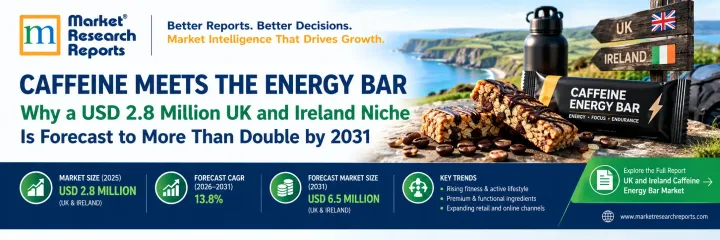
A snack bar with 65 to 175 mg of caffeine, roughly a strong coffee in bar form, is finding its place in the United Kingdom and Ireland. The market is USD 2.8 million today inside a USD 1.7 billion energy bar category, and our 2026-2031 forecast has it more than doubling to USD 6.3 million by 2031, about twice the growth rate of the energy bar market as a whole.
Executive Summary
Our study sizes the United Kingdom and Ireland caffeine energy bar market at USD 2.8 million in 2025, rising to USD 6.3 million by 2031 at a 14.5% CAGR, against 7.22% a year for the parent energy bar market. The United Kingdom accounts for about 89% of value (USD 2.5 million) and Ireland about 11% (USD 0.3 million). Ten caffeinated bar products are on sale across four formats, and seven companies are profiled, from specialist brands such as RYSE Chocolate, VOOM Nutrition and Veloforte to the confectionery major Mondelez International, Inc.
Why This Niche Is Taking Shape
The demand backdrop is strong. UK consumers drink about 98 million cups of coffee a day, 41% of working professionals have three or more caffeinated drinks daily, and the UK has 11.5 million gym memberships and GBP 5.7 billion of fitness-sector revenue (2024). Caffeinated bars sit within familiar serving sizes: an espresso shot is about 65 mg, and bars range from 65 mg (Naak) to 175 mg (VOOM). Natural-caffeine and clean-label positioning, endurance sport participation and the move toward functional snacking all point the same way, and the forecast reflects caffeinated bars gaining a larger share of bar listings as distribution deepens.
Three Structural Shifts to Watch
1. Ireland has shown the mainstream route to market
RYSE, an Irish-made chocolate bar at EUR 2.75 per 26 g bar, is listed in Daybreak and Spar, a pool of about 780 stores. That makes convenience a proven mainstream pathway for a caffeinated bar, and we found no UK convenience or forecourt equivalent yet, which points to a first-mover opening for a UK brand or retailer.
2. Four formats serve four different occasions
Oat, nut and fruit bars lead at 45% of 2025 value (USD 1.26 million, rising to USD 2.80 million by 2031), built on natural-ingredient positioning. Chocolate bars and sports-fuel jelly and chew bars each hold 20%, growing to USD 1.40 million and USD 1.17 million, and protein and pre-workout bars hold 15%, rising from USD 0.42 million to USD 0.93 million. Chocolate leans on indulgence and convenience availability, protein bars on gym users, and jellies and chews on endurance fuelling.
3. Supermarkets are the next frontier
Today 57.0% of value is online and direct-to-consumer and 39.6% is in specialist sports, health and other retail. Supermarkets hold 64.11% of the parent energy bar market and are the largest open door for the category. A major-brand or own-label supermarket launch, in the spirit of the April 2025 US launch of a caffeinated bar collection by a major brand, is our main upside scenario. Entry would bring HFSS rules into play, and caffeine-labelling requirements for foods other than drinks already apply, so product design, claims and age-appropriate marketing will matter from the start.
Competitive Positioning
| Company | Position | What the evidence shows |
|---|---|---|
| RYSE Chocolate | Irish-made chocolate bar with convenience-chain listings | 80 mg caffeine; EUR 2.75 per 26 g bar; listed in Daybreak and Spar |
| VOOM Nutrition | UK-made, high-dose performance bar | 175 mg caffeine, the highest in the census; own site and specialist retailers; a UK retailer lists a 20 x 47 g box at GBP 32.99 (about GBP 1.65 a bar) |
| Naak | Specialist running-retail listing in Dublin | 65 mg caffeine; EUR 3.50 per bar |
| Peeroton GmbH | Austrian import via mail order | Delivers to Ireland; reaches buyers through mail order |
| Veloforte | UK brand | 80 mg caffeine |
| Mondelez International, Inc. | Confectionery major among profiled companies | Its presence makes major-brand entry a credible scenario for the category |
Analyst Insight
The caffeinated bar is early, and early is where positions are won. Online and specialist channels give brands a low-cost route and a ready customer base today, Ireland has shown that a mainstream convenience retailer will range the product, and supermarkets remain the larger prize. Brands that build credible products and compliant claims now will be positioned when listings broaden.
Strategic Lessons
| Audience | Implication |
|---|---|
| Brands and own-label teams | Use online and specialist retail to build proof points, then target convenience and supermarket listings; keep claims and marketing conservative under HFSS and caffeine-labelling rules. |
| Retailers and distributors | Convenience is the proven mainstream pathway in Ireland; a UK convenience or forecourt range is an open first-mover opportunity. |
| Investors and consultants | A small, fast-forming category with a clear route to scale through distribution; a store-level listing audit would sharpen the picture further. |
Frequently Asked Questions
How big is the UK and Ireland caffeine energy bar market?
About USD 2.8 million in 2025, forecast to reach about USD 6.3 million by 2031 at a 14.5% CAGR. The United Kingdom is about 89% of value and Ireland about 11%.
Which channels matter most today?
Online and direct-to-consumer (57.0% of 2025 value) and specialist sports, health and other retail (39.6%). Convenience stores and forecourts are 3.4%, led by one Irish chocolate bar.
How was the market sized?
Top-down from the UK and Ireland energy bar market (about USD 1.7 billion), narrowed by channel, measured caffeinated listing share and a sales-velocity index, with an Irish convenience line added bottom-up. Because no direct sales series exists, the report gives low, base and high scenarios, and the forecast assumes caffeinated bars gain share of listings by 2031.
Does the report include unit volumes?
No. The report is value-only.
Related research: United Kingdom and Ireland Caffeine Energy Bar Market Strategic Research Report 2026-2031 covers the sizing, four bar types, three channels, UK nations and Ireland forecasts, a ten-product census and seven company profiles. For bespoke analysis of functional snack and sports nutrition markets, commission custom research.