


What Suja Life's IPO Actually Reveals About HPP Beverages
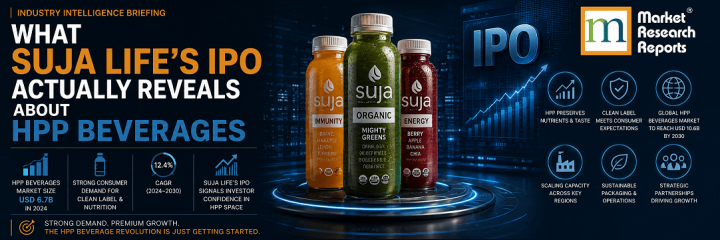
MRR® New Business Idea Analysis Market Research · HPP
For most of its life, high-pressure processing (HPP) — the non-thermal technique that lets a juice or beverage be labeled "cold-pressed" and still meet food-safety pathogen standards without cooking out its nutrients — has been a private-market and corporate-venturing story. Coca-Cola bought into Suja Life in 2015. Private equity took over in 2021. That changed in May 2026, when Suja Life priced an IPO on Nasdaq at $21 per share, raising roughly $186.7 million in gross proceeds and becoming the first pure-play HPP beverage company to trade publicly. For the first time, the category's growth, margins, and softness are now disclosed on a quarterly cadence, under SEC reporting requirements, by the company itself.
That change in disclosure regime is the real story here. It means the sizing question for this category no longer needs a market-research estimate — it can be answered from audited financials, management's own guidance, and the federal food-safety framework that makes HPP a distinct regulatory category in the first place.
The Regulatory Foundation: Why HPP Exists as a Category at All
HPP is not a marketing term — it's a specific answer to a specific FDA requirement. Under the Juice HACCP regulation, processors must achieve at least a 5-log (100,000-fold) reduction of the most resistant pathogen likely to occur in a given juice before it can be sold without a warning label. Historically, that standard was met with heat pasteurization. HPP lets a processor hit the same 5-log CFU/ml pathogen reduction the FDA's Juice HACCP regulations require using pressure instead of heat — which is what allows a bottle to legally carry "cold-pressed" or "never heated" claims while still being commercially shelf-stable.
That standard is actively enforced, not theoretical. FDA warning letters to HPP processors — public records — show the agency citing firms for failing to validate that their high-pressure process achieves a minimum 5-log reduction of the pertinent microorganism for all of their 100% juice products, under 21 CFR 120.24(a) and 120.11(b). In other words: the entire "cold-pressed, HPP-treated" claim on a bottle is a validated, auditable food-safety assertion, not a lifestyle descriptor — and that compliance burden is itself a real barrier that separates a handful of scaled processors from anyone who wants to put "cold-pressed" on a label without the underlying validation.
The Company Data: Suja Life's Own Numbers
Suja's SEC filings are now the single richest disclosed dataset this category has ever had. A few figures stand out directly from the company's own reporting:
- Fiscal 2025 revenue: Suja's core business — the Suja Organic cold-pressed juice line plus Vive Organic wellness shots — generated $319 million in revenue in 2025, up 24% year-over-year, with the growth rate itself accelerating, from +30% in 2024 to +46% in 2025 on the underlying core business.
- Profitability trajectory: Adjusted EBITDA on the core business reached $66 million in 2025, a 21% margin, up from $35 million in 2023 — nearly doubling in two years.
- Q1 2026 (post-filing, pre-IPO quarter): Net sales were $107.1 million, up 22.5% from $87.4 million a year earlier, with gross margin improving to 50.5% from 49.8% and the company swinging to net income of $7.7 million from a net loss of $0.8 million a year prior.
- Q2 2026, the first quarter reported as a public company: Net sales growth decelerated to 11.6%, reaching $83.9 million, though Adjusted EBITDA still grew 50% to $14.6 million, a 17.5% margin, up from 13% a year earlier.
- Updated full-year 2026 guidance: Following the Q2 slowdown, the company revised guidance to net sales of $360 million to $369 million, growth of 10.2% to 13.0% versus $326.6 million in fiscal 2025, and Adjusted EBITDA of $70 million to $72 million, growth of 72.8% to 77.7% versus $40.5 million in fiscal 2025.
The CEO Briefing: What Management Is Actually Saying
CEO Maria Stipp's own characterization of the quarter, from the company's Q2 2026 earnings call, is worth reading directly rather than summarized, because it names both the strength and the specific pressure point:
On performance: "Net sales grew 11.6% to $83.9 million, adjusted EBITDA grew 50% to $14.6 million, a 17.5% margin up from 13% a year ago. That's strong flow-through on our top line."
On the emerging softness: "We're seeing recent signs of softness in the third quarter, concentrated primarily in grocery," with management noting that beverage category growth slowed from 5% in the first quarter to 2% in the second quarter.
On where that softness is coming from, in more detail: bookings came off forecast in early July "specifically in the grocery channel, where bookings came off our forecast due to consumer compression at retail and pressures on grocers' foot traffic," even as the company said it was the top growth contributor in the natural healthy beverage category for the quarter.
On the channel mix behind that exposure: grocery represented roughly one-third of Suja's sales mix in the second quarter, compared with about 12% for mass channels — a concentration that explains why grocery-specific softness moved company-wide guidance.
On where growth is still accelerating: the company's newer Slice Dirty Soda line saw distribution grow 94% year-over-year, which management is leaning on as the offset to grocery-channel pressure in the back half of the year.
Data at a Glance
| Metric | Figure | Source |
|---|---|---|
| FDA pathogen reduction standard for juice (incl. HPP-treated) | 5-log (100,000-fold) reduction of pertinent pathogen | FDA Juice HACCP regulation, 21 CFR 120 |
| Suja core business revenue, FY2025 | $319M, +24% YoY (accelerating from +30% in 2024 to +46% in 2025) | Suja Life SEC filings (S-1) |
| Suja core Adjusted EBITDA, FY2025 | $66M, 21% margin (up from $35M in 2023) | Suja Life SEC filings (S-1) |
| Suja Q1 2026 net sales | $107.1M, +22.5% YoY; gross margin 50.5% | Suja Life 10-Q / earnings release |
| Suja Q2 2026 net sales | $83.9M, +11.6% YoY; Adj. EBITDA +50% to $14.6M | Suja Life 8-K / earnings call |
| IPO details | 8,888,889 Class A shares at $21.00; ~$186.7M gross / ~$173.6M net proceeds | Suja Life 424B4 prospectus, May 8, 2026 |
| Revised FY2026 guidance | Net sales $360M–$369M (+10.2% to 13.0% vs. FY2025's $326.6M) | Suja Life 8-K, August 2026 |
| Grocery channel share of Q2 2026 sales mix | ~33% (vs. ~12% for mass channel) | Suja Life earnings call, CEO commentary |
| Slice (Dirty Soda) distribution growth | +94% YoY | Suja Life earnings call |
 Navadhi Market Research · Food & Beverages
On demand
Global HPP Cold Pressed Juices Market Strategic Research Report
The global HPP (High Pressure Processing) cold pressed juices market has emerged as one of the most commercially compelling segments within the broader functional be…
▲ 8.2%CAGR2025–2032
$3,500.00 from
Forecast $3.2B by 2032
Navadhi Market Research · Food & BeveragesPublished
Europe HPP Cold Pressed Juices, Smoothies & Shots Market Strategic Research Report
The European High Pressure Processing (HPP) cold-pressed juices, smoothies, and shots market continues to evolve from a niche premium beverage category into a struct…
▲ 9.4%CAGR2025–2031
$3,500.00 from
Forecast $654.9 by 2031
Navadhi Market Research · Food & BeveragesOn demand
Global High Pressure Processing Equipment Market Strategic Research Report
The global high pressure processing (HPP) equipment market represents a critical node within the advanced food and beverage preservation technology sector, valued at…
▲ 9.5%CAGR2025–2032
$3,500.00 from
Forecast $1472.3B by 2032
Leading the Strategic Signal
1. The category's growth ceiling and its channel risk are now both disclosed, not estimated. Before this IPO, anyone sizing HPP beverage growth was working from syndicated retail-scan data or analyst inference. Now there is an audited, quarter-over-quarter trail showing exactly where growth is decelerating (grocery) and where it isn't (mass, emerging brands like Slice) — a level of granularity the category has never had in the public record before.
2. Regulatory compliance remains the entry barrier, and it's enforced. The FDA's active warning-letter history against HPP processors that failed to validate their 5-log pathogen reduction shows this isn't a passive standard — it's inspected and enforced. That keeps the category's supply side narrower than "anyone who buys an HPP machine," which is a structural feature, not a temporary one.
3. Margin expansion is outpacing top-line growth, and that's the more durable signal. Even as Suja's net sales growth decelerated from 22.5% in Q1 to 11.6% in Q2, Adjusted EBITDA growth held at 50%. A category that can expand margin while top-line growth normalizes is behaving like a maturing, structurally profitable segment — not a fad losing momentum.
4. Channel concentration is the single biggest disclosed risk. With roughly a third of sales running through a grocery channel that management itself flagged as softening due to "consumer compression at retail," the near-term read on this category depends more on general grocery-channel health than on demand for cold-pressed beverages specifically. That's a useful distinction the earnings call makes explicit and a market-sizing report would likely have missed.
The Bottom Line
The HPP cold-pressed beverage category has quietly moved from a private, corporate-venture story to a publicly disclosed, quarterly-audited one. What that disclosure shows is a business with real structural entry barriers (an enforced FDA pathogen-reduction standard), accelerating historical growth (from 30% to 46% at the core-business level through 2025), and a very specific, named near-term risk (grocery-channel softness) rather than a vague demand slowdown. For anyone tracking this space, the company's own SEC filings and earnings calls are now a better primary source than any external market estimate — because for the first time, the numbers are legally required to be accurate.