


World's Top 10 Fertilizer Companies
MRR® Global Rankings by Revenue 2026 Edition · Competitive Intelligence
The global fertilizer industry remains one of the most strategically critical sectors in the world economy, underpinning food security for over 8 billion people. In 2024, the global fertilizer market was valued at approximately USD 195–210 billion and is projected to grow at a CAGR of 3.5–4.2% through 2030, driven by rising global food demand, shrinking arable land per capita, and the accelerating adoption of precision agriculture. Asia-Pacific continues to dominate consumption, accounting for roughly 55–60% of global fertilizer demand, led by India and China — both of which are also significant domestic producers.
As per
Global Fertilizer Market Strategic Research Report 2026-2031 Report by Navadhi Market Research
The ranking period of 2023–2025 was defined by significant price volatility following the post-Ukraine conflict commodity spike of 2022. Most major producers saw revenues decline from their 2022 peaks as nitrogen, phosphate, and potash prices normalized. Nutrien, the world's largest integrated fertilizer company, reported 2024 revenues of USD 25.02 billion, retaining its #1 position comfortably. Yara International confirmed its status as the world's largest pure nitrogen producer with USD 13.9 billion in 2024 revenues.
A notable ranking correction versus previous estimates is the placement of OCP Group at #4, with verified 2024 revenues of USD 9.76 billion — materially above some third-party estimates. OCP's position reflects its unrivalled phosphate resource base: the company controls over 70% of the world's phosphate rock reserves and holds approximately 31% of global phosphate product market share. Meanwhile, EuroChem Group — a large private Swiss-domiciled producer — is included at an estimated USD 7–8 billion, consistent with its ~10 million tonne annual production scale.
SQM of Chile is included at #9 on a conditional basis: while its total 2024 revenues are estimated at approximately USD 4.6 billion, a significant portion (55–60%) derives from lithium rather than fertilizers. Its specialty plant nutrition and potassium segments represent genuine fertilizer revenue, but users should note this qualification when interpreting the ranking.
Top 10 Companies at a Glance
Rank | Company | Headquarters | Est. Revenue (USD) |
|---|---|---|---|
| 1 | Nutrien Ltd. | Saskatoon, Canada | ~$25.0B (2024, SEC) |
| 2 | Yara International | Oslo, Norway | ~$13.9B (2024, verified) |
| 3 | Mosaic Company | Tampa, USA | ~$11.1B (2024, SEC) |
| 4 | OCP Group | Casablanca, Morocco | ~$9.8B (2024, verified) |
| 5 | EuroChem Group | Zug, Switzerland | ~$7–8B (est., pvt) |
| 6 | ICL Group | Tel Aviv, Israel | ~$6.8B (2024, SEC) |
| 7 | PhosAgro | Moscow, Russia | ~$5,5B (2024, est.) |
| 8 | CF Industries | Deerfield, USA | ~$5.9B (2024, SEC) |
| 9 | SQM | Santiago, Chile | ~$4.6B total (conditional) |
| 10 | K+S AG | Kassel, Germany | ~$4.0B (2024, verified) |
* All revenue figures are estimates based on publicly reported annual results, company filings, and verified third-party sources. Figures represent full group revenue unless noted as segment-specific. Currency is USD; non-USD revenues are converted at the approximate 2024 average exchange rates. Private company figures (EuroChem) are estimates and should be treated as indicative only.
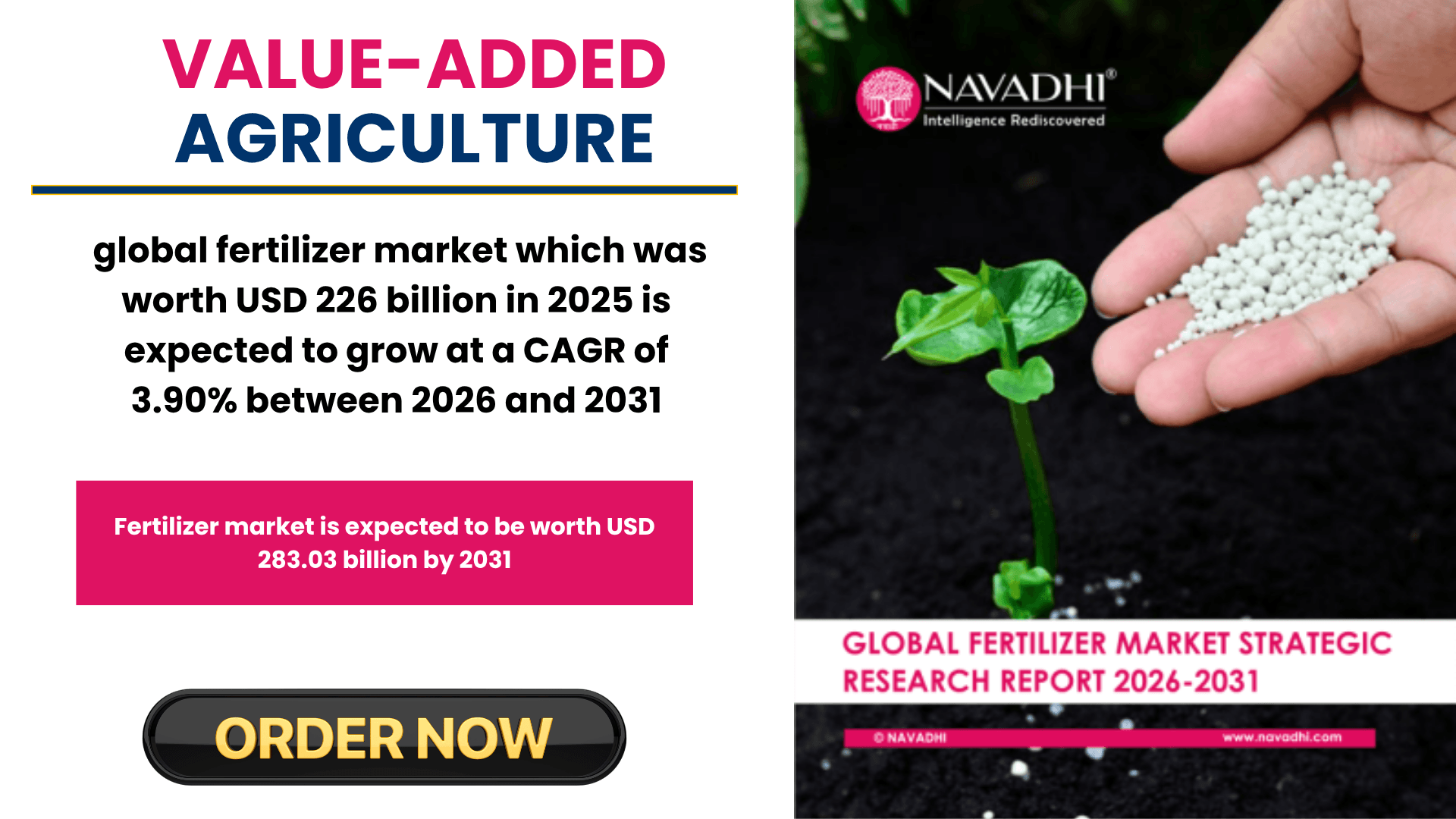
Featured Report: “Global Fertilizer Market Strategic Research Report 2026-2031"provides global fertilizer market size, industry status and forecast, competition landscape and growth opportunities.
Global Fertilizer Market Statistics
- Global fertilizer market size (2024): approximately USD 195–210 billion
- Projected CAGR (2024–2030): 3.5–4.2%
- Projected market size by 2030: approximately USD 255–280 billion
- Asia-Pacific share of global consumption: ~55–60% (led by India and China)
- Nitrogen fertilizers: largest segment by volume, ~57% of global fertilizer use
- Phosphate fertilizers: ~24% of global fertilizer use; dominated by OCP and Mosaic
- Potash fertilizers: ~19% of global use; Nutrien and Mosaic control the majority of Western supply
- Top 10 companies combined estimated revenue: approximately USD 88–95 billion
- OCP Group phosphate market share: ~31% of world phosphate products (2024)
- Nutrien is the world's largest potash producer and the only company with a mine-to-retail integrated network (Nutrien Ag Solutions retail network)

Company Profiles
1. Nutrien Ltd.
Nutrien Ltd. was formed in 2018 through the merger of Potash Corporation of Saskatchewan (PotashCorp) and Agrium, creating the world's largest producer of potash and the largest crop nutrient company by revenue. Headquartered in Saskatoon, Canada, Nutrien operates the largest potash mine network globally (six mines in Saskatchewan) alongside nitrogen and phosphate production facilities across North America and internationally. The company's retail division, Nutrien Ag Solutions, is the world's largest agricultural retailer with over 2,000 locations across North America, Australia, and South America — giving Nutrien a unique mine-to-field integrated business model that no competitor has replicated.
In 2024, Nutrien reported annual revenues of USD 25.02 billion, verified through SEC filings, cementing its position as the industry's clear #1 by revenue. This represented a decline from the peak 2022 revenue of approximately USD 37.8 billion, reflecting the normalization of potash prices following the post-Ukraine conflict spike. Despite lower prices, Nutrien maintained strong cash generation, investing in mine capacity expansions and advancing its digital agriculture platform. The company serves customers in over 40 countries and produces approximately 27 million tonnes of potash, nitrogen, and phosphate products annually.
- HQ: Saskatoon, Saskatchewan, Canada
- 2024 Revenue: USD 25.0B (verified, SEC filing)
- Key Products: Potash (MOP), nitrogen (urea, ammonia, UAN), phosphate, retail crop inputs
- Segments: Potash, Nitrogen, Phosphate, Retail (Ag Solutions)
- 2026 Update: Continued potash mine expansion; advancing digital agriculture and sustainability programs
2. Yara International ASA
Yara International ASA, headquartered in Oslo, Norway, is the world's largest producer of nitrogen fertilizers and a leading provider of crop nutrition solutions. Founded in 1905 as Norsk Hydro's fertilizer division and spun off as an independent company in 2004, Yara operates production facilities across Europe, the Americas, Africa, and the Middle East. Its product range spans ammonia, urea, nitrates, NPK blends, and specialty plant nutrition products sold under premium brands including YaraVita, YaraBela, and YaraMila. Yara also has a significant industrial chemicals business serving environmental and industrial applications.
Yara reported 2024 revenues of USD 13.9 billion, broadly in line with estimates and representing a continuation of the post-2022 price normalization trend. The company has been executing a major strategic restructuring under its 'Yara Improved' program, targeting USD 150 million in annual savings through operational efficiencies, portfolio optimization, and headcount reductions. In 2024–2025, Yara advanced several clean ammonia and green hydrogen projects, positioning itself as a leader in the transition toward lower-carbon fertilizers. Yara's global distribution network — spanning over 60 countries — remains a key competitive differentiator.
- HQ: Oslo, Norway
- 2024 Revenue: USD 13.9B (verified)
- Key Products: Ammonia, urea, nitrates (CAN, AN), NPK blends, specialty crop nutrition
- Segments: Crop Nutrition, Industrial Solutions, Clean Ammonia
- 2026 Update: Yara Improved restructuring, advancing green/clean ammonia production projects globally
3. The Mosaic Company
The Mosaic Company, headquartered in Tampa, Florida, is the world's largest combined producer of potash and phosphate crop nutrients, with operations in the United States, Canada, and Brazil (through its Mosaic Fertilizantes subsidiary). Mosaic was formed in 2004 through the combination of Cargill's crop nutrition business and IMC Global, and has since grown through acquisitions including the 2018 purchase of Vale Fertilizantes (rebranded Mosaic Fertilizantes), which made it the largest fertilizer distributor in Brazil. The company operates potash mines in Saskatchewan and New Mexico and phosphate mines in Florida and Peru.
Mosaic reported full-year 2024 revenues of USD 11.1 billion, a decline of approximately 19% year-over-year, primarily reflecting lower selling prices in the Potash and Mosaic Fertilizantes segments. Despite the revenue decline, Mosaic maintained its position as the world's largest phosphate producer by volume. The company continued to invest in its MicroEssentials specialty product line — a value-added phosphate product that commands premium pricing — and advanced its Jansen potash mine project in Saskatchewan in partnership considerations. Mosaic's Brazilian distribution network of ~35 distribution centers gives it unrivalled access to one of the world's fastest-growing agricultural markets.
- HQ: Tampa, Florida, USA
- 2024 Revenue: USD 11.1B (verified, SEC filing)
- Key Products: DAP, MAP, MicroEssentials (phosphate), MOP potash, fertilizer blends
- Segments: Phosphates, Potash, Mosaic Fertilizantes (Brazil)
- 2026 Update: Continued MicroEssentials expansion; optimization of Brazilian distribution network
4. OCP Group
OCP Group (Office Chérifien des Phosphates), headquartered in Casablanca, Morocco, is the world's largest phosphate producer and exporter, controlling over 70% of the world's known phosphate rock reserves. Founded in 1920, OCP is a state-owned enterprise majority-owned by the Moroccan government, with a minority stake publicly listed. The company operates integrated operations spanning phosphate mining (primarily in the Khouribga and Gantour basins), phosphoric acid production, and finished fertilizer manufacturing (DAP, MAP, TSP, NPK). OCP holds approximately 31% of the global phosphate product market share, making it the single most dominant player in phosphate fertilizers worldwide.
OCP generated revenues of approximately USD 9.76 billion in 2024 — a figure verified through company disclosures and significantly above some third-party estimates that had placed OCP as low as #7 in the global ranking. This correction to #4 reflects OCP's actual commercial scale. In 2024–2025, OCP advanced its 'OCP Africa' strategy — partnering with African governments to build local fertilizer manufacturing capacity and supply tailored fertilizer blends for African soil types. The company has committed USD 13 billion in investments through 2027 to expand production capacity to over 20 million tonnes per year of finished fertilizers.
- HQ: Casablanca, Morocco
- 2024 Revenue: USD 9.76B (verified)
- Key Products: DAP, MAP, TSP, NPK blends, phosphoric acid, phosphate rock
- Segments: Phosphate Mining, Phosphoric Acid, Fertilizers, OCP Africa
- 2026 Update: Advancing USD 13B investment plan; major African market expansion underway
5. EuroChem Group
EuroChem Group is one of the world's largest fertilizer producers, headquartered in Zug, Switzerland, with production operations primarily in Russia, Belgium, Lithuania, Kazakhstan, and the United States. Founded in 2001 through the consolidation of Russian chemical assets by Andrey Melnichenko, EuroChem is privately held and does not publish audited public financial statements. The company operates across the full fertilizer spectrum — nitrogen (urea, ammonia, AN), phosphate (MAP, DAP), and potash — with a combined annual production capacity exceeding 10 million tonnes. Its integrated Russian production assets include the large Kovdorskiy mining complex and several major nitrogen plants.
EuroChem's estimated 2024 revenues of USD 7–8 billion are consistent with its ~10 million tonne annual production scale at prevailing 2024 fertilizer prices, though the absence of public filings means this figure carries inherent uncertainty. The company has been navigating significant geopolitical headwinds since 2022 due to sanctions-related complications stemming from its Russian operations and the ownership background of its founder. EuroChem has sought to operationally distance its Western European and North American assets from its Russian operations, but the company's overall strategic posture remains heavily influenced by its Russian production base. It is included in this ranking on the basis of production scale and strategic importance.
- HQ: Zug, Switzerland (operations in Russia, Belgium, Lithuania, Kazakhstan, USA)
- 2024 Revenue: USD 7–8B (estimated; private company, undisclosed)
- Key Products: Urea, ammonia, ammonium nitrate, MAP, DAP, potash
- Segments: Nitrogen, Phosphates, Potash, Distribution
- 2026 Update: Navigating geopolitical/sanctions environment; separating Western and Russian operational assets
6. ICL Group
ICL Group (Israel Chemicals Ltd.), headquartered in Tel Aviv, Israel, is a global specialty minerals company with strong positions in potash, phosphates, and specialty fertilizers. Listed on the Tel Aviv and New York stock exchanges, ICL operates mines and production facilities in Israel, Spain (through its Iberpotash subsidiary), the United Kingdom, Germany, the Netherlands, and the United States. ICL is the world's sixth-largest potash producer and a leader in specialty fertilizers, industrial phosphates, and flame retardants. Its Specialty Ag Solutions segment — including Polysulphate, controlled-release fertilizers, and micronutrient products — is a key differentiator in the premium crop nutrition market.
ICL reported 2024 annual sales of USD 6.8 billion, verified through SEC filings. While this represented a decline from the elevated 2022 peak of approximately USD 10.6 billion, the company's specialty businesses contributed approximately 70% of EBITDA — demonstrating the resilience and higher-margin nature of its value-added portfolio versus commodity fertilizer producers. In 2024, ICL completed the integration of its strategic acquisitions in specialty nutrition and advanced its digital agriculture capabilities. The company also announced continued development of its Polysulphate operations in the UK — a unique multi-nutrient mineral with strong agronomic credentials in low-sulfur soils.
- HQ: Tel Aviv, Israel
- 2024 Revenue: USD 6.8B (verified, SEC filing)
- Key Products: Potash (MOP, SOP), phosphates, Polysulphate, controlled-release fertilizers, flame retardants
- Segments: Mineral Fertilizers, Growing Solutions, Industrial Products, Phosphate Solutions
- 2026 Update: Specialty segment driving ~70% of EBITDA; advancing Polysulphate expansion in UK
7. PhosAgro
PhosAgro (Public Joint Stock Company PhosAgro), headquartered in Moscow, Russia, is one of the world's largest producers of phosphate-based fertilizers and the leading producer of high-grade phosphate rock (apatite concentrate) globally. The company operates vertically integrated production at Cherepovets (nitrogen and phosphate fertilizers) and Apatity (phosphate mining in the Khibiny Mountains). PhosAgro's product range covers the full phosphate value chain: apatite concentrate, phosphoric acid, DAP, MAP, NPS, and nitrogen fertilizers (urea, UAN). It is the world's largest producer of high-grade phosphate rock, providing a consistent quality advantage over lower-grade phosphate sources.
PhosAgro reported 2024 revenues of RUB 507.7 billion, an increase of approximately 15.3% year-on-year in ruble terms. At the approximate 2024 average RUB/USD exchange rate of ~0.011, this converts to approximately USD 5.5 billion — significantly above some external estimates that placed the company at USD 4.0 billion. Note that currency conversion is inherently imprecise given ruble volatility. Since 2022, PhosAgro has been listed on the Moscow Exchange following its withdrawal from the London Stock Exchange. The company has continued to benefit from its strong domestic Russian demand base and has expanded exports through non-sanctioned trade corridors, particularly to Asia, the Middle East, and Latin America.
- HQ: Moscow, Russia
- 2024 Revenue: ~USD 5.5B (estimated from RUB 507.7B at ~0.011 RUB/USD; Nasdaq-reported)
- Key Products: DAP, MAP, NPS, apatite concentrate, phosphoric acid, urea, UAN
- Segments: Phosphate fertilizers, Nitrogen fertilizers, Feed phosphates
- 2026 Update: Revenue grew ~15% YoY in RUB terms (2024); expanded Asian/LatAm export routes post-2022
8. CF Industries Holdings
CF Industries Holdings, headquartered in Deerfield, Illinois, is the world's largest producer of ammonia outside China and one of North America's leading nitrogen fertilizer producers. The company operates eight nitrogen complexes across the United States, Canada, and the United Kingdom, with a combined annual production capacity of approximately 10 million tonnes of ammonia. CF Industries' competitive advantage stems from its access to low-cost North American natural gas — a critical feedstock for nitrogen fertilizer production — giving it a structural cost edge over European producers who face significantly higher energy costs. The company serves agricultural customers throughout North America as well as industrial customers globally.
CF Industries reported full-year 2024 net sales of approximately USD 5.9 billion, verified through SEC filings, with full-year net earnings of USD 1.22 billion and adjusted EBITDA of USD 2.28 billion — demonstrating the high-margin, capital-efficient nature of its U.S. gas-advantaged production. CF Industries has been a frontrunner in the clean ammonia transition, announcing major blue and green ammonia projects at its Donaldsonville, Louisiana complex. In 2024, the company advanced its partnership with Mitsui & Co. for clean ammonia supply to Japan, and progressed its carbon capture and sequestration project to decarbonize ammonia production. CF is increasingly positioned as a hydrogen/clean energy company alongside its fertilizer core.
- HQ: Deerfield, Illinois, USA
- 2024 Revenue: ~USD 5.9B (verified, SEC filing); Adjusted EBITDA: USD 2.28B
- Key Products: Ammonia, urea, UAN (urea ammonium nitrate), AN, DEF
- Segments: Ammonia, Granular Urea, UAN, AN, Other Nitrogen Products
- 2026 Update: Advancing clean ammonia projects (Donaldsonville CCS); Mitsui partnership for Japan supply
9. SQM (Sociedad Química y Minera de Chile) — Conditional
SQM (Sociedad Química y Minera de Chile), headquartered in Santiago, Chile, is a diversified specialty chemicals and mining company with operations in the Atacama Desert. While SQM is best known globally as one of the world's largest lithium producers, it also has significant fertilizer-related businesses including specialty plant nutrition (potassium nitrate, sodium nitrate, potassium sulfate, sodium potassium nitrate), potassium chloride, and commodity fertilizers. SQM is the world's largest producer of potassium nitrate and iodine, and its specialty plant nutrition products command premium pricing in high-value agricultural segments including fruits, vegetables, and flowers.
SQM reported nine-month 2024 revenues of USD 3.45 billion, implying a full-year figure of approximately USD 4.6 billion. However, a critical qualification applies: SQM's lithium segment has accounted for approximately 55–60% of total revenues in recent years, reflecting the lithium price boom. Its actual fertilizer-relevant revenue (specialty plant nutrition + potassium + commodity fertilizers) is estimated at approximately USD 1.5–2.0 billion — which would place SQM well outside the top 10 fertilizer companies if ranked purely on fertilizer revenue. SQM is included here on the basis of total company revenues and its strategic importance in specialty potassium and nitrate fertilizers, but this dual-revenue-stream caveat is material.
- HQ: Santiago, Chile
- 2024 Revenue: ~USD 4.6B total (estimated from 9-month figure; ~40–45% fertilizer-attributable)
- Key Products: Potassium nitrate, SOP, potassium chloride, iodine, lithium, specialty plant nutrition
- Segments: Lithium, Specialty Plant Nutrition, Potassium, Iodine & Derivatives, Industrial Chemicals
- 2026 Update: Conditional ranking — majority of revenue from lithium; fertilizer segment ~USD 1.5–2B
10. K+S AG
K+S AG, headquartered in Kassel, Germany, is Europe's largest potash producer and one of the world's leading suppliers of potash and magnesium fertilizers. Founded in 1889, the company operates potash and rock salt mines in Germany (Werra and Zielitz mines) and the Bethune potash mine in Saskatchewan, Canada — one of the largest and most cost-competitive solution-mining potash operations in the world, which opened in 2017. K+S produces a broad range of potassium-based fertilizers under the KALI and ESTA brands, as well as salt products under the Esco brand. The company divested its Americas salt business (Morton Salt) in 2021 for USD 3.2 billion to focus on its European core and potash.
K+S reported 2024 revenues of approximately EUR 3.7 billion, with EBITDA of EUR 557.7 million — a significant decline from the 2022 peak revenues of approximately EUR 5.8 billion. At the approximate 2024 average EUR/USD rate of 1.08, this equates to roughly USD 4.0 billion. The decline reflects the broader potash price normalization post-2022. K+S has been focusing on cost reduction, debottlenecking production at Bethune, and advancing its circular economy strategy around potash tailings reprocessing and reduced waste outputs. Despite lower revenues, the company's Bethune mine gives it a competitive cost position in North American markets that offsets the higher-cost legacy German mines.
- HQ: Kassel, Germany
- 2024 Revenue: ~USD 4.0B (EUR 3.7B at ~1.08 EUR/USD; company press release)
- Key Products: Potassium chloride (MOP), potassium sulfate (SOP), kieserite, salt
- Segments: Agriculture (Potash), Industry (Salt/Esco)
- 2026 Update: Bethune mine optimization underway; EBITDA EUR 557.7M (2024); Morton Salt divested 2021
Key Changes vs. Previous Rankings
- OCP Group re-ranked from #7 to #4: Verified 2024 revenues of USD 9.76B — some prior estimates (ChatGPT: $7.9B) significantly understated OCP's scale. Correct placement reflects OCP's 31% global phosphate market share.
- Mosaic drops to #3: At USD 11.1B (verified, SEC), Mosaic now correctly ranks below OCP when OCP's actual figure is used.
- PhosAgro revenue corrected upward: Prior estimates of USD 4.0B understated; RUB-to-USD conversion of FY2024 results implies ~USD 5.5B, moving PhosAgro from estimated ~#9 to confirmed #7.
- SQM flagged as conditional #9: SQM's inclusion is contingent on its total revenue basis; pure fertilizer revenue is ~USD 1.5–2B, which would exclude it from the ranking on fertilizer-only basis.
- Nutrien revenue note: ChatGPT's prior estimate of USD 25.9B was the 2023 figure; correct 2024 verified figure is USD 25.02B (SEC filing).
- EuroChem remains estimated: No public filings available; USD 7–8B estimate consistent with ~10Mt production at 2024 average prices; ranked #5 on scale/strategic importance.
- K+S revenue corrected: ChatGPT's $4.3B was based on 2023 EUR figure; 2024 EUR 3.7B at 2024 FX rates equates to ~USD 4.0B.
Key Industry Trends
1. Post-Ukraine Price Normalization
The fertilizer price supercycle triggered by Russia's invasion of Ukraine in February 2022 — which caused nitrogen prices to triple and potash prices to more than double — had largely normalized by 2024. Benchmark urea prices, which peaked at over USD 900/tonne in mid-2022, stabilized in the USD 280–380/tonne range through 2024. This normalization is reflected in the revenue declines seen across virtually all major producers from their 2022 peaks. Producers with the lowest cost structures — particularly those with U.S. natural gas access (CF Industries) or low-cost mines (Nutrien's Saskatchewan potash, OCP's Moroccan phosphate) — have navigated the cycle most resiliently.
2. Clean and Green Ammonia as Strategic Pivot
Nitrogen fertilizer producers globally are investing heavily in 'clean' (carbon-capture-based blue ammonia) and 'green' (electrolysis-based) ammonia production to decarbonize their operations and access new clean energy markets. CF Industries is the industry leader, with active blue ammonia CCS projects at Donaldsonville, Louisiana, and a supply agreement with Mitsui & Co. for the Japanese market. Yara is advancing green ammonia projects in Norway using renewable hydropower. The clean ammonia addressable market extends beyond agriculture into maritime fuel, power generation, and hydrogen carriers — making this a strategic transformation rather than a simple product line extension.
3. Africa as the Battleground for Fertilizer Market Share
Sub-Saharan Africa represents the most significant untapped fertilizer growth market globally, with some of the world's lowest fertilizer application rates (average ~20 kg/ha vs. global average of ~140 kg/ha) and the fastest agricultural land expansion. OCP Group has made Africa its central strategic priority, committing to supply tailored fertilizer blends for specific African soil types and partnering with governments to develop local blending and distribution capacity. Yara, CF Industries, and several Chinese producers are also investing in African market development. The 'soil health' framing — moving from commodity fertilizers to soil-type-specific products — is expected to be a key commercial differentiator in this market.
4. Consolidation and M&A Reshaping the Competitive Landscape
The fertilizer industry has seen significant M&A activity reshaping competitive positions. Recent deals include: Nutrien's ongoing bolt-on acquisitions in its Ag Solutions retail network; K+S's 2021 divestiture of Morton Salt for USD 3.2 billion to refocus on potash; and EuroChem's structural separation of Western and Russian assets. Looking ahead, the Jansen potash mine development in Saskatchewan (BHP's project, not Nutrien-owned) is expected to add significant global potash supply when operational, potentially creating pricing pressure on existing producers. Consolidation among mid-tier phosphate and nitrogen producers is also expected as margins compress.
5. Precision and Specialty Fertilizers Driving Margin Premium
Commodity fertilizer producers are increasingly investing in specialty and precision fertilizer products that command premium pricing and are less exposed to commodity price cycles. ICL's controlled-release fertilizers and Polysulphate products contribute approximately 70% of EBITDA despite being a fraction of total volume. Nutrien's retail division sells value-added crop nutrition programs that generate higher margins than commodity product sales. SQM's potassium nitrate and specialty plant nutrition products serve high-value horticultural markets. The structural shift toward specialty products is expected to accelerate as precision agriculture adoption increases and growers demand products with verifiable agronomic outcomes.
Sources
- Global Fertilizer Market Strategic Research Report 2026-2031 Report by Navadhi Market Research
- Nutrien Ltd. Annual Report 2024 / SEC Form 40-F (verified; petrochemexpert.com cross-reference)
- Yara International ASA Annual Report 2024 (verified)
- The Mosaic Company Annual Report 2024 / SEC Form 10-K (verified; 19% YoY revenue decline, $11.1B)
- OCP Group Annual Report 2024 / Skyquestt Research: OCP revenue USD 9.76B; 31% global phosphate market share
- ICL Group Annual Report 2024 / SEC Form 20-F (USD 6.8B; specialty 70% EBITDA; SABIC cross-ref)
- CF Industries Holdings Annual Report 2024 / SEC Form 10-K (USD 5.9B net sales; USD 2.28B adj. EBITDA)
- PhosAgro FY2024 Results (Nasdaq press release; RUB 507.7B, +15.3% YoY; converted at ~0.011 RUB/USD)
- K+S AG Annual Report 2024 / Company press release (EUR 3.7B revenues; EBITDA EUR 557.7M; converted at 1.08 EUR/USD)
- EuroChem Group: estimated from production volumes (~10Mt) at 2024 average fertilizer prices; private company, no public filing
- SQM 9-Month 2024 Results (implied FY2024 ~USD 4.6B; conditional ranking due to lithium revenue dominance)
- FAO Agricultural Statistics: Regional fertilizer consumption shares; Asia-Pacific ~55–60% of global demand