


Top 25 Medical Device Companies in the World by Revenue 2026

MRR® Medical Device Industry Analysis Market Research · Competitive Intelligence
The Medical Devices Growth-Share Matrix: Mapping 25 Global MedTech Leaders Through a Year of Robotics Expansion, Spinoffs, and Take-Privates
The global medical devices market reached $581.1 billion in 2025 and is projected to grow to $824.3 billion by 2031, a roughly 6.0% CAGR that gently accelerates year over year — from 4.8% in 2026 to 6.7% by 2031 — reflecting compounding structural demand rather than any single event-driven surge. Even the industry's largest player, Medtronic, holds only an estimated 3.1% global share, making this one of the least concentrated major healthcare categories: competitive strategy here centers on category-specific leadership rather than broad market dominance.
Two themes dominate this year's disclosures across the 25 companies profiled. First, surgical robotics has become the industry's clearest arena of direct, converging competition — Intuitive Surgical's da Vinci franchise remains dominant. Still, Medtronic's Hugo, Stryker's Mako RPS, and Abbott's expanding electrophysiology robotics are all scaling in parallel. Second, corporate structure itself is in unusually active motion: Becton Dickinson completed a Reverse Morris Trust spinoff combining its Biosciences unit with Waters Corporation; Hologic went private in an $18.3 billion Blackstone/TPG buyout; and Medline Industries, formerly one of the largest private medical supply companies, completed 2025's biggest IPO. This briefing applies the growth-share framework to all 25 companies named in the underlying report, using only what each has disclosed in 2026 earnings releases, regulatory filings, and public statements.
Market Sizing Snapshot, 2025–2031
| Metric | Figure |
|---|---|
| Base market size (2025) | US$581.1 Billion |
| Forecast market size (2031) | US$824.3 Billion (report states $825.5B in one section) |
| CAGR (2025–2031) | ~6.0%, accelerating from 4.8% (2026) to 6.7% (2031) |
| Fastest-growing device category | Surgical & Minimally Invasive/Robotic Devices |
| Largest single company's global share | Medtronic, ~3.1% |
| Fastest-growing end-use setting | Ambulatory Surgical Centers |
Source: Global Medical Devices Industry Strategic Research Report, Market Research Reports Inc.
The Growth-Share Lens, Applied to Medical Devices
Four dynamics define competitive position across the 25 majors profiled:
- Surgical robotics — the report's explicitly named fastest-growing category, where Medtronic, Stryker, Intuitive Surgical, and Abbott are all actively expanding platforms.
- Connected, home-managed chronic disease technology — continuous glucose monitoring, insulin delivery, and sleep/respiratory devices, several with an emerging GLP-1 co-therapy angle.
- Diagnostics and imaging — a genuinely bifurcated category this year, with China-driven weakness at Siemens Healthineers and Roche contrasting against strength in U.S. cancer and cardiovascular diagnostics.
- Corporate structure and ownership — spinoffs, take-privates, and IPOs reshaping which entities even compete in this space going forward.
Company-by-Company Positioning
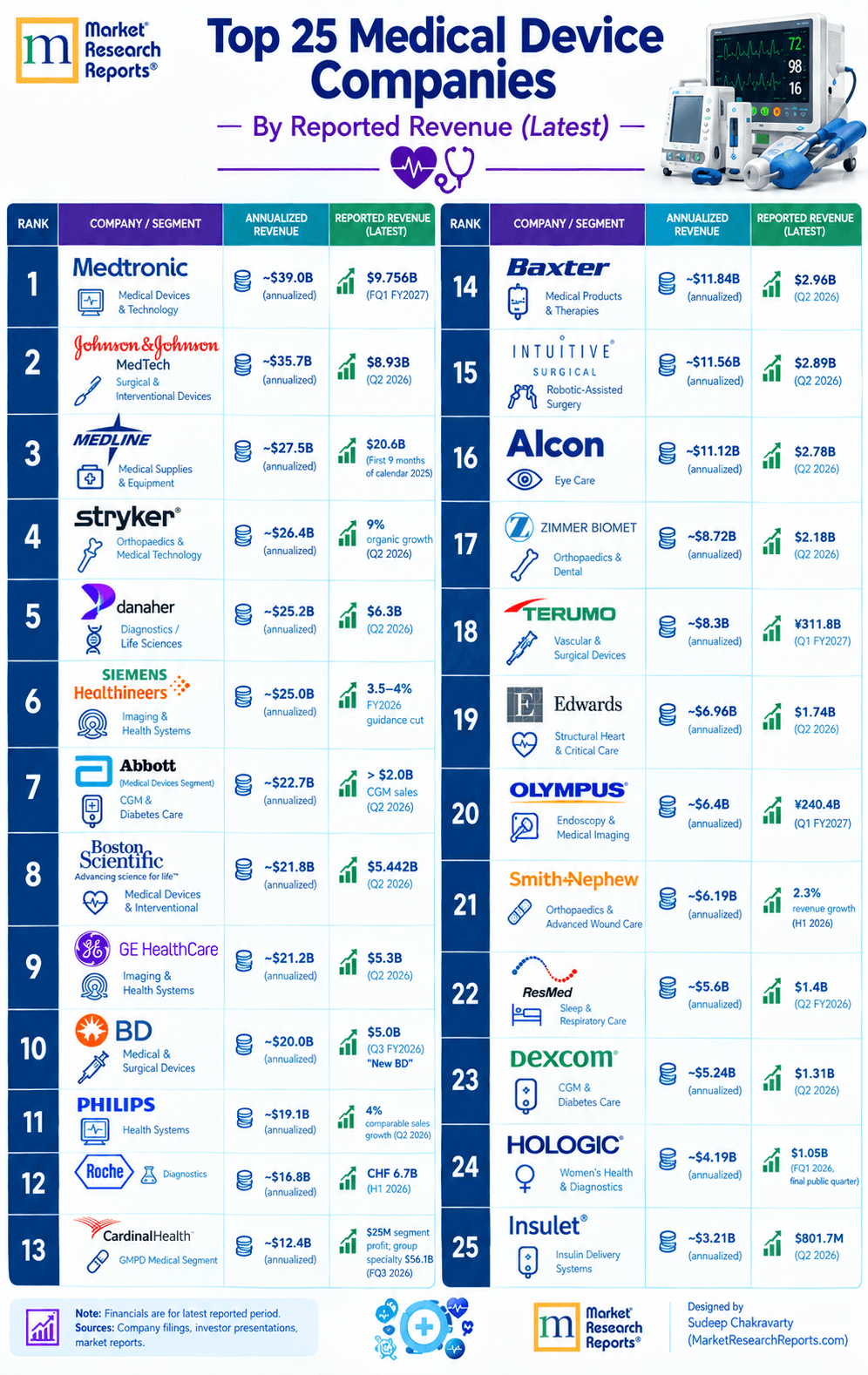
Companies below are ordered by disclosed revenue, largest first. Each figure is the most recently reported quarterly or half-year revenue annualized (×4 for a quarter, ×2 for a half-year) on a currency-as-reported basis; where the underlying report names a specific segment rather than the whole company (Abbott Medical Devices, J&J MedTech, Roche Diagnostics, Cardinal Health's Medical Segment), that segment's revenue is used rather than total company revenue, matching how each entity is actually named as a "key player." These are rough, single-period approximations, not audited annual figures, and are intended only to order the list — not to stand in for each company's own full-year guidance discussed below.
1. Medtronic (~$39.0B annualized) delivered FQ1 fiscal 2027 revenue of $9.756 billion, up 13.7%, and announced $780 million in strategic investments including a $700 million stake in Cornerstone Robotics to extend its Hugo ecosystem internationally via the Sentire platform; Hugo is expected to surpass 50,000 completed procedures this fiscal year, with U.S. urology FDA approval expected in the back half.
MRR Read: Medtronic's PFA/Affera cardiac ablation and Hugo robotics franchises are clear Stars; the broader portfolio functions as a Cash Cow funding that expansion, with the pending MiniMed diabetes separation freeing capital for the growth platforms.
2. Johnson & Johnson MedTech (~$35.7B annualized, segment) posted Q2 2026 sales of $8.93 billion, up 4.5%, with growth in cardiovascular (Shockwave), wound closure/biosurgery, and Vision, while Abiomed's Heart Recovery business saw moderated expectations after new clinical data increased physician caution.
MRR Read: J&J MedTech's electrophysiology and Shockwave-driven cardiovascular lines are Stars; Abiomed's Heart Recovery segment is a Question Mark whose near-term trajectory management itself has now tempered.
3. Medline Industries (~$27.5B annualized), historically one of the largest privately held medical supply companies, completed the largest IPO of 2025 in December, raising $6.26 billion at a valuation above $50 billion; for the first nine months of calendar 2025 it reported $20.6 billion in revenue and $1.0 billion in net income, competing directly with Cardinal Health and McKesson in medical-supply distribution.
MRR Read: Medline's newly public status is itself the notable event here — a formerly private-equity-owned distribution giant now subject to the same public disclosure and growth-share scrutiny as its public-company peers in this matrix, and its IPO pop (41% on debut) suggests public markets view its distribution scale as a Cash Cow with room to re-rate.
4. Stryker (~$26.4B annualized) delivered Q2 2026 organic sales growth of 9%, with record Mako installations and an elevated capital equipment backlog, recovering from a March 2026 cybersecurity incident; the newly launched handheld Mako RPS robotic partial knee system drew what CEO Kevin Lobo called "outstanding" surgeon feedback.
MRR Read: Mako and its RPS extension are a clear Star, with the broader MedSurg and Orthopaedics base functioning as a resilient Cash Cow that absorbed a genuine operational shock without lasting share damage.
5. Danaher (Diagnostics/Life Sciences) (~$25.2B annualized) reported Q2 2026 revenue of $6.3 billion, up 5.5%, with Life Sciences posting its strongest quarter in several years and the $9.8 billion Masimo acquisition completed ahead of schedule; it is worth noting that Danaher's historical water-quality diagnostics assets were spun into the separately traded Veralto Corporation in 2023, so the entity profiled here today is primarily a life sciences and diagnostics instruments company.
MRR Read: Life Sciences, boosted by the Masimo integration, is a Star; the broader Diagnostics segment (excluding respiratory testing headwinds) is a stable Cash Cow.
6. Siemens Healthineers (~$25.0B annualized) cut fiscal 2026 revenue growth guidance to 3.5–4% from 4.5–5%, citing continued Diagnostics weakness tied to structural market rebasing in China (down roughly 40% from two years ago) and legacy platform dilution, even as Imaging and Precision Therapy performed in line and an equipment book-to-bill of 1.27 signaled strong underlying order demand.
MRR Read: Siemens Healthineers' Imaging and Precision Therapy "Synergetic Core" is a Cash Cow performing to plan; Diagnostics, specifically its China-exposed business, is the clearest Dog disclosed anywhere in this matrix.
7. Abbott Laboratories (Medical Devices) (~$22.7B annualized, segment) — Abbott's largest segment — posted Q2 2026 comparable sales growth of 8.4%, led by electrophysiology (+13.4%) and continuous glucose monitoring sales exceeding $2 billion (+9.5%), with management noting only 15 million of a realistic 75–80 million CGM-eligible population currently using the technology.
MRR Read: Abbott's electrophysiology and diabetes care franchises are unambiguous Stars, with the CGM total addressable market comment underscoring how much runway management believes remains.
8. Boston Scientific (~$21.8B annualized) posted Q2 2026 revenue of $5.442 billion, up 7.5%, but cut full-year organic growth guidance to 5–6% from a prior 5–7% range after a sharp, unexpected U.S. competitive slowdown in both its WATCHMAN and electrophysiology franchises — two of the company's most important recent growth drivers.
MRR Read: WATCHMAN and U.S. electrophysiology have shifted from Stars to Question Marks in this matrix specifically because of disclosed, sudden U.S. competitive share loss, a notable divergence from J&J's and Abbott's continued EP strength in the same category.
9. GE HealthCare (~$21.2B annualized) reported Q2 2026 revenue of $5.3 billion, up 5.7%, with record organic orders growth of 11.1% and a record $23.9 billion backlog, driven by Pharmaceutical Diagnostics and the newly combined Advanced Imaging Solutions segment, while Patient Care Solutions remained challenged and is now under strategic review for potential divestiture.
MRR Read: Advanced Imaging Solutions and Pharmaceutical Diagnostics are Stars; Patient Care Solutions, now explicitly under strategic review, is a Dog the company appears to be actively repositioning out of rather than continuing to fund indefinitely.
10. Becton Dickinson (BD) (~$20.0B annualized) completed the spin-off of its former Biosciences and Diagnostic Solutions business, combined with Waters Corporation, on February 9, 2026, and reported Q3 fiscal 2026 "New BD" revenue of $5.0 billion, up 4.4%, with more than 90% of the remaining portfolio growing at high-single-digit rates or better, led by biologic drug delivery and advanced patient monitoring.
MRR Read: Post-spinoff BD is a leaner, more focused Cash Cow-to-Star transition story — management's own framing of "a more focused MedTech company" is corroborated by the breadth of double-digit growth across the retained portfolio.
11. Philips (Health Systems) (~$19.1B annualized) delivered Q2 2026 comparable sales growth of 4% across all segments, with Personal Health leading at 8%, while reiterating full-year guidance of 3–4.5% despite continued weakness in China's hospital equipment market.
MRR Read: Philips's diversified Connected Care and Personal Health lines function as a steady Cash Cow, with China-exposed Diagnosis & Treatment sales representing the segment's relative Question Mark.
12. Roche Diagnostics (~$16.8B annualized, segment) posted H1 2026 sales of CHF 6.7 billion, up 3% (up 6% excluding China's healthcare pricing reform impact), with pathology lab sales up 11%, driven by advanced staining and companion diagnostics growth of 24%.
MRR Read: Roche's core lab and pathology businesses are Stars once China's disclosed, quantified policy headwind is excluded — a useful reminder that the region's impact here is regulatory rather than a genuine demand problem.
13. Cardinal Health (Medical Segment) (~$12.4B annualized, GMPD segment only) — distinct from Cardinal's much larger pharmaceutical distribution business — saw its Global Medical Products and Distribution (GMPD) segment profit fall 36% to $25 million in fiscal Q3 2026 on tariff pressure, even as Cardinal Health-branded products posted a fifth consecutive quarter of over 5% U.S. growth. Group-wide, Cardinal's Pharmaceutical & Specialty Solutions segment grew revenue 11% to $56.1 billion in the same quarter, with GLP-1 products contributing roughly 6 percentage points of that growth.
MRR Read: GMPD, the segment actually comparable to this report's medical-devices peer set, is a Cash Cow under real near-term margin pressure; the company's much larger specialty pharmaceutical distribution business (outside this report's scope) is the clear Star carrying group results.
14. Baxter International (~$11.84B annualized) delivered Q2 2026 revenue of $2.96 billion, up 5%, with strong double-digit growth in drug compounding and 12% growth in Advanced Surgery, raising full-year organic sales guidance to 2–3% as part of its ongoing turnaround focused on stabilization and balance sheet strength.
MRR Read: Advanced Surgery and drug compounding are Baxter's clear Stars within an overall business management itself now frames as low-single-digit growth — an honest, incremental Cash Cow turnaround rather than a dramatic reacceleration story.
15. Intuitive Surgical (~$11.56B annualized) reported Q2 2026 revenue of $2.89 billion, up 19%, with worldwide procedures up 16% (da Vinci +15%, Ion +36%) and 468 da Vinci systems placed, though U.S. da Vinci procedure growth decelerated to 12% from 14% in Q1, which management attributed partly to expiring ACA premium subsidies affecting elective procedure deferrals.
MRR Read: Intuitive remains the category-defining Star in surgical robotics by scale and recurring-revenue share (85% of total revenue), even as the U.S. deceleration is a genuine, disclosed data point worth monitoring rather than dismissing.
16. Alcon (~$11.12B annualized) raised full-year 2026 core EPS growth guidance to 12–15% after Q2 2026 sales of $2.78 billion, up 8%, with both Surgical and Vision Care growing 7-8%, even as the company took a $402 million charge to discontinue its PowerVision accommodative lens program following disappointing clinical outcomes.
MRR Read: Alcon's UNITY surgical platform and Ocular Health dry-eye franchise are Stars; the discontinued PowerVision program is a disclosed, self-corrected Dog the company exited proactively rather than continuing to fund.
17. Zimmer Biomet (~$8.72B annualized) raised full-year 2026 guidance to 3.9–4.9% reported sales growth after Q2 2026 revenue of $2.18 billion, up 4.8%, with hip performance driven by its Z1 triple-taper stem (now over 40% of U.S. stems) and AI-based OrthoGrid navigation adoption more than doubling first-half case volume versus all of 2025.
MRR Read: Zimmer Biomet's hip franchise and new technology platform are a Star; the broader orthopedic base is a Cash Cow benefiting from a genuinely healthy 4–5% procedural market.
18. Terumo (~$8.3B annualized) posted Q1 fiscal 2027 (April–June 2026) revenue of ¥311.8 billion, up 19.9%, with real revenue growth excluding currency and one-time items still reaching 9.4%, led by its Cardiac and Vascular Company (TIS and neurovascular products) and a roughly 30% surge in its newly acquired Organ Technologies business (OrganOx).
MRR Read: Cardiac and Vascular, plus the newly consolidated Organ Technologies segment, are Stars; Terumo's Medical Care Solutions segment, growing but with declining profit margin, is a Cash Cow facing genuine cost and pricing pressure.
19. Edwards Lifesciences (~$6.96B annualized) raised full-year 2026 sales guidance to 10–11% after Q2 2026 sales of $1.74 billion, up 12.5%, with TMTT (mitral and tricuspid therapies) up 44.8% and TAVR guidance raised to 8–9% growth on durability data and a competitor's market exit.
MRR Read: TMTT is the clearest Star in this entire matrix by growth rate, with management targeting $2 billion in TMTT revenue by 2030; TAVR itself is a Cash Cow reaccelerating toward Star status.
20. Olympus Corporation (~$6.4B annualized) reported Q1 fiscal 2027 revenue of ¥240.4 billion, up 16% (5% constant currency), with its Gastrointestinal Solutions division — roughly 70% of consolidated revenue — driving growth while Surgical and Interventional Solutions was constrained by voluntary product ship holds tied to FDA compliance commitments.
MRR Read: Gastrointestinal Solutions (GI Endoscopy specifically, +20% in the prior quarter) is a clear Star; Surgical and Interventional Solutions is a Question Mark whose growth is currently being actively suppressed by the company's own quality-compliance program rather than by underlying demand weakness.
21. Smith+Nephew (~$6.19B annualized) cut full-year 2026 underlying revenue growth guidance from around 6% to around 4% after H1 2026 revenue growth of just 2.3%, with U.S. Knee Implants down 7.2% and Advanced Wound Bioactives (including SANTYL) down 7.7%, even as it reaffirmed trading profit, free cash flow, and ROIC targets through an additional $50 million in disclosed efficiency savings.
MRR Read: Sports Medicine & ENT (+10.2% in H1) is Smith+Nephew's clear Star; U.S. Orthopaedics and Advanced Wound Bioactives are the matrix's other genuine Dogs, though management's reaffirmed profit targets suggest the company views the revenue softness as addressable through new product launches rather than structural.
22. ResMed (~$5.6B annualized) delivered Q2 fiscal 2026 revenue of $1.4 billion, up 11%, with management actively expanding physician outreach to capture patients newly motivated toward sleep apnea diagnosis and treatment amid rising GLP-1 medication awareness, alongside 16% U.S. mask market growth.
MRR Read: ResMed's core device and mask franchise is a Star, with the GLP-1-adjacent patient-education strategy representing a deliberate, disclosed attempt to convert a broader wellness trend into incremental sleep-therapy demand.
23. Dexcom (~$5.24B annualized) reported Q2 2026 revenue of $1.31 billion, up 13%, raising full-year guidance to $5.18–$5.25 billion, with gross margin expanding to 64.1% and a CMS coverage decision for type 2 non-insulin CGM use now expected around mid-2027.
MRR Read: Dexcom's core CGM franchise is a Star, with the delayed CMS coverage decision representing a Question Mark on the timing (not the likelihood) of a significant incremental addressable-market unlock.
24. Hologic (~$4.19B annualized, last public quarter) completed its $18.3 billion take-private acquisition by Blackstone and TPG on April 7, 2026, with former Baxter International CEO José (Joe) Almeida installed as CEO; as a private company, Hologic no longer issues public financial guidance, but its final public quarter (fiscal Q1 2026) showed revenue of $1.05 billion, up 2.5%.
MRR Read: With Hologic now under private ownership, it sits outside this matrix's public-market growth-share framework entirely — a useful reminder that not every "top player" in a named report remains a directly comparable public entity, and that its women's-health diagnostics and breast health franchise was judged undervalued enough by its new owners to command a 46% premium.
25. Insulet (~$3.21B annualized) delivered Q2 2026 revenue of $801.7 million, up 23.5%, but lowered U.S. Omnipod growth guidance to 17–19% after Type 2 diabetes customer retention and utilization trends came in weaker than expected in the critical first 90 days of use — an issue CEO Ashley McEvoy took direct accountability for identifying too late.
MRR Read: International Omnipod, raised to 30–32% growth guidance, is a clear Star; U.S. Type 2 Omnipod is a Question Mark the company is actively re-engineering onboarding and sales compensation to address.
Consolidated Growth-Share Matrix — Medical Devices, 2026
| High Relative Share | Low Relative Share | |
|---|---|---|
| High Market Growth | STARS — Intuitive Surgical (da Vinci); Stryker (Mako/Mako RPS); Medtronic (Hugo, PFA/Affera); Abbott (electrophysiology, CGM); Edwards Lifesciences (TMTT, TAVR); Dexcom & Insulet International (CGM/insulin delivery); Alcon (UNITY, Ocular Health); ResMed; Terumo (Cardiac & Vascular) | QUESTION MARKS — Boston Scientific (WATCHMAN, U.S. electrophysiology); Insulet U.S. Type 2 Omnipod; Olympus Surgical & Interventional Solutions (ship-hold constrained); Dexcom Medicare/CMS-pending indication; Philips Diagnosis & Treatment (China-exposed) |
| Low Market Growth | CASH COWS — J&J MedTech broad base; GE HealthCare Advanced Imaging/Pharmaceutical Diagnostics; Roche Diagnostics core lab (ex-China); Baxter turnaround; Cardinal Health/Medline distribution scale; Zimmer Biomet broad orthopedic base; BD "New BD" post-spinoff portfolio | DOGS — Siemens Healthineers Diagnostics (China rebasing); GE HealthCare Patient Care Solutions (under strategic review); Smith+Nephew U.S. Orthopaedics and Advanced Wound Bioactives; Alcon's discontinued PowerVision program |
Unlike several of the industry reports in this series, medical devices in 2026 shows a genuinely populated Dogs quadrant — a reflection of a sector where corporate structure itself is actively reorganizing (BD's spinoff, GE HealthCare's Patient Care Solutions review, Alcon's proactive program discontinuation) rather than simply waiting for underperforming segments to recover on their own.
Strategic Imperatives for 2026–2031
- Surgical robotics competition has moved from single-platform dominance to genuine multi-company contest. Intuitive Surgical remains the category leader by scale, but Medtronic's Hugo, Stryker's Mako RPS, and continued investment from all three suggests the "fastest-growing category" the report identifies will be increasingly shaped by direct platform-versus-platform competition rather than one company's uncontested lead.
- China-linked headwinds are now a distinct, quantifiable risk factor separable from company execution. Siemens Healthineers, Roche Diagnostics, and GE HealthCare's China commentary all independently point to structural pricing reform and market rebasing as the driver — worth distinguishing from company-specific competitive or execution failures when evaluating any single quarter's results.
- Corporate structure is now a live strategic lever, not a background event. BD's Waters spinoff, Hologic's take-private, and Medline's IPO within roughly six months of each other suggest 2026 will likely be remembered as a year when ownership and portfolio-structure decisions moved markets as much as underlying clinical or commercial performance did.
- GLP-1 adjacency is emerging as a cross-category demand driver beyond diabetes devices alone. ResMed's explicit physician-education push tied to GLP-1-driven sleep apnea awareness, alongside Cardinal Health's GLP-1 distribution contribution, both point to the same broader pharmaceutical trend reshaping demand patterns in device categories that were not originally built around it.
Outlook
With the underlying market forecast to reach $824.3 billion by 2031 and every one of the 25 companies profiled navigating some combination of robotics expansion, China-linked diagnostics headwinds, or active corporate restructuring, the central strategic question for 2026–2031 is which companies convert this year's structural moves — spinoffs, take-privates, robotics platform investments — into durable competitive position by the time the market's growth rate reaches its projected 6.7% peak in 2031. On the disclosed evidence, Intuitive Surgical, Edwards Lifesciences, and Abbott have the clearest quantified momentum today, while Boston Scientific, Smith+Nephew, and Siemens Healthineers face the most genuine, company-acknowledged near-term headwinds to work through.
This analysis draws on company-reported earnings releases, investor presentations, and public regulatory filings from Medtronic, Johnson & Johnson MedTech, Abbott Laboratories, Medline Industries, Siemens Healthineers, Stryker Corporation, Becton Dickinson, GE HealthCare, Philips, Boston Scientific, Roche Diagnostics, Baxter International, Cardinal Health, Danaher, Zimmer Biomet, Intuitive Surgical, Terumo Corporation, Olympus Corporation, Smith+Nephew, Edwards Lifesciences, Dexcom, Hologic, Insulet Corporation, Alcon, and ResMed, current through September 2026, together with the market-sizing framework of the Global Medical Devices Industry Strategic Research Report.