


Global Top 10 Food Safety Testing Leaders
MRR®Food Tech Industry Analysis Market Research · Competitive Intelligence
The global food safety testing market is valued at approximately $26.08 billion in 2026 and is projected to grow at an 8.25% CAGR to roughly $38.8–$41.96 billion by 2031. This is a mature, well-established sub-sector of the broader testing, inspection, and certification (TIC) industry, anchored by a small number of large, diversified, publicly listed global players alongside a long tail of specialized food-safety-focused laboratories.
The single most structurally important development shaping this market is now fully closed: Bureau Veritas has completed the sale of its worldwide food testing business to Mérieux NutriSciences, a transaction first announced in October 2024, closed in stages through 2025, and fully finalized worldwide by September 2025. The deal, valued at an enterprise value of €360 million against roughly €133 million of 2023 food-testing revenue, creates a combined Mérieux NutriSciences business with approximately $1 billion in revenue, doubling its footprint in Asia Pacific and Canada. Bureau Veritas remains one of the world's largest TIC companies overall, but is no longer an active competitor in food safety testing specifically — a distinction this matrix treats carefully throughout.
This briefing applies the growth-share framework to all 10 companies named in the underlying report, using only what each has disclosed in 2025–2026 earnings releases, regulatory filings, and public statements.
Market Sizing Snapshot, 2026–2031
| Metric | Figure |
|---|---|
| Base market size (2026) | $26.08 Billion |
| Forecast market size (2031) | $38.8–$41.96 Billion |
| CAGR (2026–2031) | 8.25% |
| Defining 2025 structural event | Bureau Veritas's completed exit from food testing via sale to Mérieux NutriSciences |
| Combined Mérieux NutriSciences scale post-deal | ~$1 Billion revenue |
| Regions covered | Asia Pacific, Latin America, MEA, Europe, North America |
Source: Global Food Safety Testing Market Strategic Research Report, Market Research Reports Inc.
The Growth-Share Lens, Applied to Food Safety Testing
Three dynamics define competitive position across the 10 majors profiled:
- Rapid and molecular testing technology adoption — PCR, LFIA, ELISA, and molecular methods are structurally displacing traditional culture-based testing, and combined rapid/molecular share now exceeds traditional methods industry-wide per the underlying report.
- Consolidation-driven scale — the Bureau Veritas/Mérieux NutriSciences transaction is the clearest example, but reflects a broader pattern of larger, diversified TIC groups acquiring or divesting food-specific capability to sharpen portfolio focus.
- Regional regulatory tightening, especially in Asia-Pacific — cited independently by Eurofins as a driver of double-digit Food & Feed testing growth in the region.
Company-by-Company Positioning
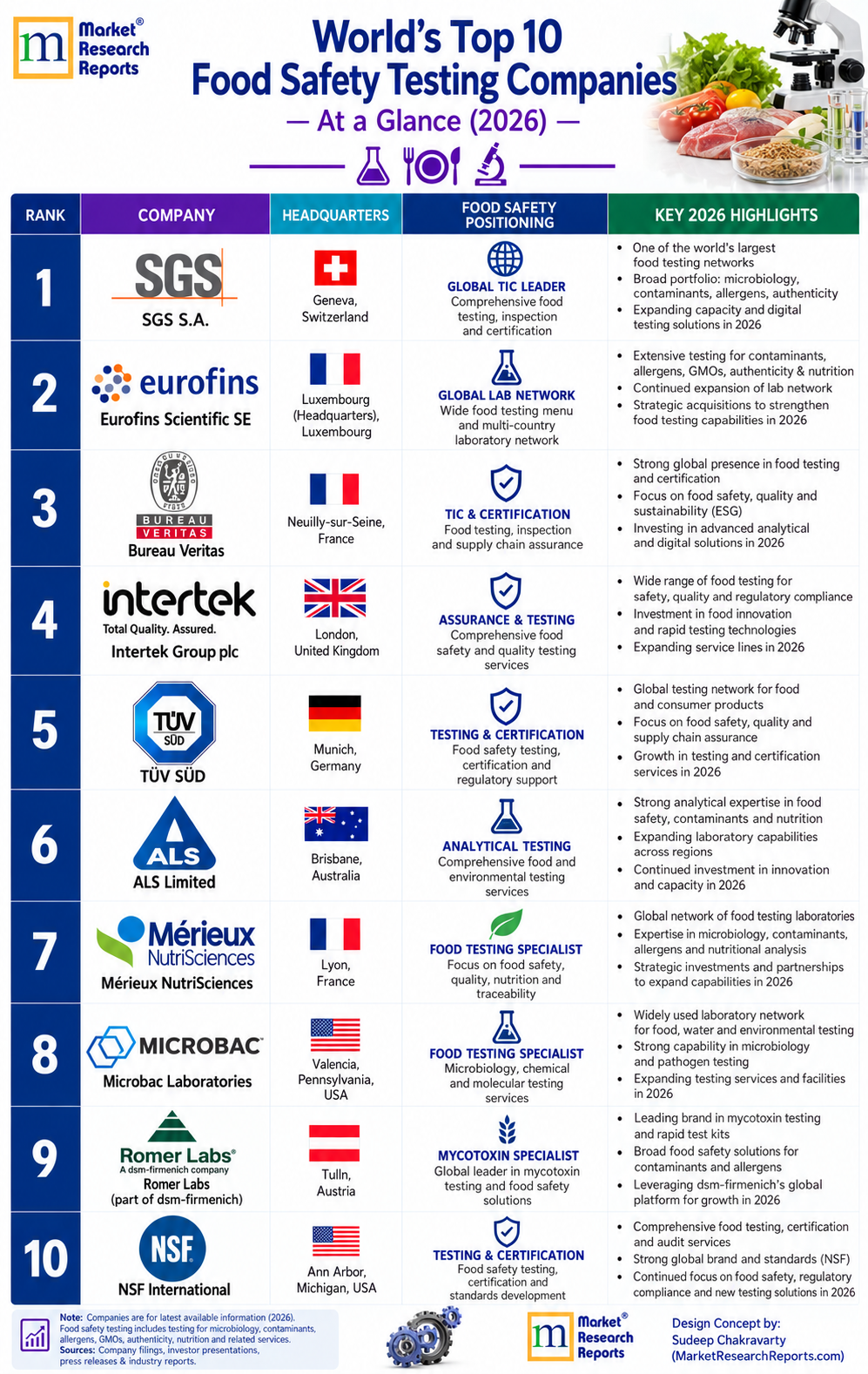
SGS S.A. (~$8.7B annualized) posted FY2025 revenue of CHF 6.945 billion, up 5.6% organically, confirmed as part of the underlying report's real, current competitive intelligence baseline, making it the largest company by revenue among the 10 profiled, though its Agri-Food business represents one segment within a much broader diversified TIC portfolio spanning minerals, industrial, and certification services.
MRR's Take: SGS's Agri-Food segment is a Cash Cow within a much larger diversified platform — its overall organic growth confirms a healthy underlying testing business, though food safety specifically is one contributor among several to the group total rather than a standalone growth driver.
Eurofins Scientific SE (~$7.95B annualized) reported FY2025 revenue of €7.296 billion, up 3.7% organically, with confirmed double-digit Food & Feed testing growth in Asia-Pacific — the report's own FAQ explicitly names Eurofins as the widely regarded largest pure-play food testing specialist among the major TIC groups.
MRR's Take: Eurofins's Food & Feed testing division is the clearest Star among the pure-play specialists in this matrix — its status as the largest dedicated food-testing player, combined with confirmed double-digit Asia-Pacific growth, makes it the most direct beneficiary of the regulatory-tightening trend the underlying report identifies as a structural driver.
Bureau Veritas (~$7.05B annualized, whole company) posted FY2025 revenue of €6.4664 billion, remaining one of the world's largest TIC companies overall across building/infrastructure, agri-food and commodities, marine/offshore, industry, and certification — but, critically, its food testing business specifically was sold to Mérieux NutriSciences, with the global transaction fully completed by September 2025 across all countries including Africa, Asia-Pacific, and Latin America.
MRR's Take: With its food testing business now fully divested, Bureau Veritas's remaining agri-food and commodities exposure is a Cash Cow operating in adjacent but distinct categories (agricultural commodity inspection rather than laboratory food safety testing); it is excluded from this matrix's food-safety-specific growth-share quadrant entirely, consistent with the underlying report's own explicit finding that Bureau Veritas is "no longer a current competitor in food safety testing specifically."
Intertek Group plc (~$4.36B annualized) reported FY2025 revenue of £3.432 billion, up 4.3% at constant currency, confirmed as part of the report's real, current competitive intelligence baseline alongside Eurofins and SGS.
MRR's Take: Intertek's Products segment, which includes food testing capability, functions as a Cash Cow within its broader Assurance, Testing, Inspection, and Certification portfolio — steady, diversified growth without the concentrated food-safety specialization that defines Eurofins's or Mérieux NutriSciences's positioning.
TÜV SÜD (~$3.92B annualized) reported 2025 revenue of €3.6 billion, up 6.1% year-over-year, with EBIT of approximately €216 million, driven by continued investment in laboratories, testing facilities, and technical infrastructure worldwide, alongside expanded capabilities in cybersecurity, AI-related services, and decarbonization-linked testing.
MRR's Take: TÜV SÜD's food safety and quality testing offering is a Cash Cow within a much broader industrial and product-certification portfolio — its overall 6.1% growth reflects strength across its full TIC business rather than a food-specific growth signal, distinguishing it from the more concentrated food-safety specialists in this matrix.
ALS Limited (~$2.19B annualized) delivered a record FY26 result with revenue of AUD 3.32 billion, up 10.7%, with its Life Sciences division — which includes Food, Environmental, and Pharmaceutical testing businesses — growing revenue 6.0% to AUD 2,025.9 million and underlying EBIT up 10.2% to AUD 296.5 million; management is targeting AUD 3.3 billion group revenue and AUD 600 million EBIT by FY27, alongside continued mid-single-digit organic growth guidance specifically for Life Sciences.
MRR's Take: ALS's Life Sciences division, with Food as one of three named sub-businesses growing steadily but more modestly than the company's booming Commodities segment, is best read as a Cash Cow — solid, EBIT-margin-expanding, and strategically important, but currently growing at roughly half the rate of ALS's mineral-exploration-driven Commodities business.
Mérieux NutriSciences (~$1.0B annualized, post-acquisition) has completed the worldwide integration of Bureau Veritas's food testing business as of September 2025, creating a combined entity with approximately $1 billion in revenue — extending operations to 32 countries and doubling its presence in Canada and the Asia-Pacific region, backed by parent company Institut Mérieux.
MRR's Take: Mérieux NutriSciences is the clearest Star in this entire matrix by trajectory — a company that has essentially doubled its scale through disciplined, strategically targeted acquisition of exactly the food-testing capability the market's own regulatory-tightening and consolidation trends favor, emerging as the report's own named leading pure-play food testing specialist alongside Eurofins.
Microbac Laboratories (revenue estimates range widely, from roughly $119 million to $500 million depending on source) is described by independent industry sources as the largest privately held third-party laboratory network in the U.S., delivering testing across environmental, food, and life sciences industries from a network of laboratories nationwide, with continued smaller-scale acquisitions expanding regional testing capacity.
MRR's Take: With no audited public financials and third-party revenue estimates varying by more than 4x, Microbac's food testing business is best read as a Question Mark — its scale and market position are genuinely difficult to pin down precisely from public sources, though its consistent inclusion among competitor lists alongside Eurofins, SGS, and Bureau Veritas across independent industry studies suggests a meaningful, if unquantified, regional U.S. presence.
Romer Labs is a private subsidiary of DSM-Firmenich (via the 2023 DSM/Firmenich merger), specializing specifically in mycotoxin, food allergen, GMO, and microbial contamination diagnostics; the company co-develops the long-running, widely cited dsm-firmenich World Mycotoxin Survey — its most recent edition covering January–June 2026 drew on 10,410 samples and 59,180 analyses across 78 countries — and continues to expand its rapid-testing product line, including updated LC-MS/MS methods and mobile flow cytometry platforms.
MRR's Take: As a specialized diagnostics arm embedded within a much larger parent company with no separately disclosed revenue, Romer Labs cannot be classified by scale on this matrix; its sustained investment in proprietary rapid-testing technology and its role as co-author of the industry's most cited mycotoxin surveillance dataset both point toward a Star-like technical leadership position within its narrow specialty, independent of its unquantified revenue base.
NSF International is a not-for-profit, non-governmental public health and safety organization serving approximately 40,000 clients in 110 countries and recognized as a World Health Organization Collaborating Center on Food Safety and Water Quality; in 2026 alone, NSF launched its new P525 Safe Food Packaging certification protocol, expanded its OSHA-recognized electrical safety testing and certification scope to commercial food equipment, and introduced NSF 538 certification for food-grade lubricants against newly regulated EU mineral oil contaminant limits.
MRR's Take: As a not-for-profit with no disclosed revenue figures, NSF cannot be classified by financial scale on this matrix; its 2026 pattern of launching new certification protocols in direct response to emerging regulatory requirements (food packaging chemicals, food-grade lubricants) nonetheless indicates active, continued growth in scope and relevance, functioning as a Cash Cow-like steady standards-setting institution rather than a fast-scaling commercial competitor.
Consolidated Growth-Share Matrix — Food Safety Testing, 2026
| High Relative Share | Low Relative Share | |
|---|---|---|
| High Market Growth | STARS — Mérieux NutriSciences (post-Bureau Veritas integration); Eurofins Scientific Food & Feed testing (Asia-Pacific double-digit growth); Romer Labs (mycotoxin/molecular technical leadership within DSM-Firmenich) | QUESTION MARKS — Microbac Laboratories (unquantified but consistently cited regional U.S. presence) |
| Low Market Growth | CASH COWS — SGS Agri-Food (within diversified TIC portfolio); Intertek Products/food testing capability; TÜV SÜD food safety offering; ALS Life Sciences (Food sub-segment); NSF International (standards-setting institution) | DOGS — none disclosed among the 10 majors specifically within food safety testing — Bureau Veritas's former food testing business is excluded from this matrix entirely rather than classified as declining, since it has been fully and deliberately divested rather than left to underperform |
The matrix's defining feature is the Bureau Veritas exit itself: rather than a company's food-testing business declining into Dog status, an entire competitor voluntarily removed itself from the category through a clean, strategic divestiture — the clearest possible evidence that active portfolio management, not competitive failure, is reshaping this market's structure.
Strategic Imperatives for 2026–2031
- Consolidation through targeted acquisition, not organic buildout, is now the fastest route to food-testing scale. Mérieux NutriSciences's near-doubling of revenue through the Bureau Veritas transaction, completed globally within roughly 11 months of the original announcement, demonstrates how quickly market position can shift through disciplined M&A in this sector.
- Diversified TIC groups increasingly treat food testing as one portfolio line among several, not a standalone strategic priority. SGS, Intertek, TÜV SÜD, and ALS all report food-safety-relevant results embedded within broader segments (Agri-Food, Products, Life Sciences) — a structural contrast to the pure-play specialists (Eurofins, Mérieux NutriSciences, Romer Labs) for whom food testing is the core business.
- Rapid and molecular technology adoption is a genuine, ongoing displacement of traditional culture-based methods. The underlying report's own finding that combined rapid and molecular testing share now exceeds traditional methods, together with Romer Labs's continued investment in updated LC-MS/MS and mobile flow cytometry platforms, points to technology transition as an active, present-tense driver rather than a future consideration.
- Asia-Pacific regulatory tightening is independently confirmed as a growth driver by multiple sources. Eurofins's own confirmed double-digit Asia-Pacific Food & Feed growth, alongside the report's broader Asia-Pacific expansion opportunity framing, suggests this region will likely be the primary battleground for share gains through 2031.
Outlook
With the underlying market forecast to grow at a healthy 8.25% CAGR toward roughly $39–42 billion by 2031, and the sector having just absorbed its most significant structural consolidation event in years, the food safety testing market in 2026 enters a genuinely new competitive configuration rather than a simple continuation of prior trends. On the disclosed evidence, Mérieux NutriSciences and Eurofins Scientific represent the clearest concentrated bets on food-testing growth specifically, while the diversified TIC majors — SGS, Intertek, TÜV SÜD, and ALS — continue to treat the category as a stable, valuable, but secondary contributor within much larger global testing and certification platforms.
This analysis draws on company-reported earnings releases, investor presentations, and public regulatory filings from Eurofins Scientific SE, SGS S.A., Intertek Group plc, Mérieux NutriSciences, Bureau Veritas, ALS Limited, TÜV SÜD, NSF International, Romer Labs, and Microbac Laboratories, current through September 2026, together with the market-sizing framework of the Global Food Safety Testing Market Strategic Research Report.