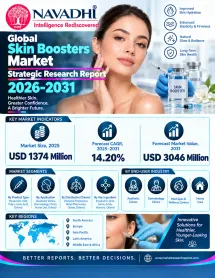
Global Skin Boosters Market Strategic Research Report
By Type: Hyaluronic Acid (HA) Skin Boosters, Polynucleotide (PN/PDRN) Skin Boosters, Poly-L-Lactic Acid (PLLA) and Poly-DL-Lactic Acid (PDLLA) Skin Boosters, Recombinant Collagen Skin Boosters, Diluted Calcium Hydroxylapatite (CaHA) Skin Boosters, Other Injectable Skin Boosters (Polycaprolactone-Based and Combination Products)
By Application: Dermatology Clinics, Medspas and Aesthetic Clinics, Hospitals and Other Settings
Regional Forecast: Asia Pacific, Latin America, MEA, Europe, North America
Key Players: Galderma, AbbVie (Allergan Aesthetics), PharmaResearch Co. Ltd., Imeik Technology Development Co. Ltd., Bloomage Biotechnology Corporation Limited, Medytox Inc., Merz Aesthetics, Huadong Medicine Co. Ltd., IBSA Group, Evolus Inc., Dexlevo Co. Ltd., Shanxi Jinbo Bio-Pharmaceutical Co. Ltd.
Overview
The global skin boosters market is estimated at approximately USD 1,374 million in 2025 and is projected to reach USD 3,046 million by 2031, a compound annual growth rate (CAGR) of 14.3% over 2026–2031 (14.2% over 2025–2031). Asia Pacific is the largest region at about 55% of 2025 value and the fastest-growing at about 16.2% a year; Europe follows at about 24% and North America at about 12%. Values are analyst estimates built bottom-up, because no company reports skin booster sales as a separate line; every estimate carries its stated method and reason, and verified company and regulatory data are disclosed where available.
A skin booster is an injectable placed into or just under the skin and sold through licensed practitioners to improve skin quality (hydration, elasticity, texture and tone), not to restore volume. The report covers hyaluronic acid (HA), polynucleotide and polydeoxyribonucleotide (PN/PDRN), poly-L-lactic acid and poly-DL-lactic acid (PLLA/PDLLA), recombinant collagen, diluted calcium hydroxylapatite (CaHA) and other injectable boosters (polycaprolactone-based and combination products). Volumising fillers, botulinum toxin, topical products, raw-material and cosmetic-ingredient sales, PRP and unregistered products are excluded. Bear and bull cases are USD 2,627 million (11.4% CAGR) and USD 3,519 million (17.0% CAGR) by 2031.
Verified market context
- SKINVIVE by Juvederm received US FDA approval on 15 May 2023 for improving skin smoothness of the cheeks, the first HA intradermal microdroplet injection in the US.
- A leading global filler maker reported fillers and biostimulators sales of USD 1,101 million in 2025, up 8.0%, with biostimulators growing double digits.
- A leading Chinese HA injectable maker reported 2025 revenue of RMB 2,453 million, down 18.94%, as approved competing products multiplied.
- A leading Korean PN maker reported first-quarter 2026 revenue of KRW 146.1 billion, with exports about 40% of revenue.
- A recombinant humanised type III collagen injection was approved in China in October 2023.
- Profhilo has been licensed for the US, with commercialisation planned for 2030.
Scope of the Global Skin Boosters Market Strategic Research Report 2026-2031
This report provides market sizing in value (USD million) and 2026–2031 forecasts, with 2025 as the base year, by ingredient type, application, region and country. It includes a regional outlook across 5 regions and 25 country lines including China, South Korea, the United States and Europe, growth drivers and inhibitors, a competitive landscape, Porter's Five Forces, PESTLE and SWOT analysis, future trends, and profiles of 12 key companies.
Segment by Type
- Hyaluronic Acid (HA) Skin Boosters
- Polynucleotide (PN/PDRN) Skin Boosters
- Poly-L-Lactic Acid (PLLA) and Poly-DL-Lactic Acid (PDLLA) Skin Boosters
- Recombinant Collagen Skin Boosters
- Diluted Calcium Hydroxylapatite (CaHA) Skin Boosters
- Other Injectable Skin Boosters (Polycaprolactone-Based and Combination Products)
Segment by Application
- Dermatology Clinics
- Medspas and Aesthetic Clinics
- Hospitals and Other Settings
Key Companies Profiled
Galderma, AbbVie (Allergan Aesthetics), PharmaResearch Co., Ltd., Imeik Technology Development Co., Ltd., Bloomage Biotechnology Corporation Limited, Medytox Inc., Merz Aesthetics, Huadong Medicine Co., Ltd., IBSA Group, Evolus, Inc., Dexlevo Co., Ltd., Shanxi Jinbo Bio-Pharmaceutical Co., Ltd..
Who Can Use This Report?
Aesthetic injectable manufacturers and licensors, distributors and clinic groups, investors and corporate development teams, regulatory and market-access teams planning China, Korea, US and European filings, and consultants who need a defined, sourced view of the skin booster market.
Market snapshot
Global Skin Boosters Market Strategic Research Report snapshot, 2025–2031
 © MarketResearchReports.comDisclaimer: The actual data may vary in the final report which undergoes verification check post order confirmation.
Segments covered in this report
Table of contents
01Executive Summary
- 1.1 Market Definition and Scope
- 1.2 Headline Market Size and Growth Trajectory
- 1.3 Principal Growth Drivers
- 1.4 Segment Highlights
- 1.5 Regional and Country Highlights
- 1.6 Competitive Structure and Key Corporate Developments
- 1.7 Principal Risks to the Outlook
- 1.8 Closing Outlook
02Industry Overview & Forecast
- 2.1.1 Market Definition and Scope
- 2.1.2 Market Size and Historical Performance
- 2.1.3 Forecast and Growth Logic
- 2.1.4 Volume and Procedure Context
- 2.1.5 Value Chain and Pricing Considerations
03Market Segmentation by Type
- 3.1 Overview of the Ingredient Landscape
- 3.1.1 Hyaluronic Acid Skin Boosters
- 3.1.2 Polynucleotide (PN/PDRN) Skin Boosters
- 3.1.3 Poly-L-Lactic Acid (PLLA) and Poly-DL-Lactic Acid (PDLLA) Skin Boosters
- 3.1.4 Recombinant Collagen Skin Boosters
- 3.1.5 Diluted Calcium Hydroxylapatite (CaHA) Skin Boosters
- 3.1.6 Other Injectable Skin Boosters (Polycaprolactone-Based and Combination Products)
- 3.2 Comparative Mix Shift and Segment Trajectory
04Market Segmentation by Application
- 4.1 Overview and Structural Framework
- 4.1.1 Dermatology Clinics
- 4.1.2 Medspas and Aesthetic Clinics
- 4.1.3 Hospitals and Other Settings
- 4.1.4 Comparative Assessment of Application Segments
05Regional Market Forecast
- North America
- Europe
- Asia Pacific
- Middle East and Africa
- Latin America
06Country-Level Market Forecast
- 6.1 North America
- 6.1.1 United States
- 6.1.2 Canada
- 6.1.3 Mexico
- 6.1.4 Rest of North America
- 6.2 Europe
- 6.2.1 Germany
- 6.2.2 France
- 6.2.3 United Kingdom
- 6.2.4 Italy
- 6.2.5 Russia
- 6.2.6 Rest of Europe
- 6.3 Asia Pacific
- 6.3.1 China
- 6.3.2 Japan
- 6.3.3 South Korea
- 6.3.4 Southeast Asia
- 6.3.5 India
- 6.3.6 Australia
- 6.3.7 Rest of Asia Pacific
- 6.4 Middle East and Africa
- 6.4.1 Egypt
- 6.4.2 South Africa
- 6.4.3 Israel
- 6.4.4 Turkey
- 6.4.5 GCC Countries
- 6.4.6 Rest of Middle East and Africa
- 6.5 Latin America
- 6.5.1 Brazil
- 6.5.2 Rest of Latin America
07Growth Drivers & Inhibitors
- 7.1 Growth Drivers
- 7.1.1 Rising Practitioner Demand and Medspa Channel Proliferation
- 7.1.2 Regulatory Approvals Unlocking New Country-Level Markets
- 7.1.3 Ingredient Innovation and Portfolio Differentiation
- 7.1.4 Anti-Ageing Demographic Momentum and Premiumisation of Skin Health
- 7.1.5 Growing Scientific Validation and Clinical Evidence Accumulation
- 7.1.6 Asia Pacific Market Deepening and South Korean Export Expansion
- 7.2 Growth Inhibitors
- 7.2.1 Price Compression in the Chinese Market Following Product Proliferation
- 7.2.2 Absence of US Regulatory Approval for Polynucleotide Injectables
- 7.2.3 Grey-Market Products Distorting Market Integrity and Volume Visibility
- 7.2.4 Thin Company Disclosure and Estimation Uncertainty Constraining Investment Confidence
- 7.2.5 Regulatory Complexity and Classification Inconsistency Across Jurisdictions
- 7.3 Impact Assessment Summary
- 7.4 Integrated Force Assessment
08Key Company Profiles
- 8.1 Galderma
- 8.1.1 Company Overview
- 8.1.2 Key Products & Segments
- 8.1.3 Financial Performance (2023–2025)
- 8.1.4 Business Strategy
- 8.1.5 SWOT Analysis
- 8.1.6 Strategic Implications (2025–2031)
- 8.2 AbbVie (Allergan Aesthetics)
- 8.2.1 Company Overview
- 8.2.2 Key Products & Segments
- 8.2.3 Financial Performance (2023–2025)
- 8.2.4 Business Strategy
- 8.2.5 SWOT Analysis
- 8.2.6 Strategic Implications (2025–2031)
- 8.3 PharmaResearch Co., Ltd.
- 8.3.1 Company Overview
- 8.3.2 Key Products & Segments
- 8.3.3 Financial Performance (2023–2025)
- 8.3.4 Business Strategy
- 8.3.5 SWOT Analysis
- 8.3.6 Strategic Implications (2025–2031)
- 8.4 Imeik Technology Development Co., Ltd.
- 8.4.1 Company Overview
- 8.4.2 Key Products & Segments
- 8.4.3 Financial Performance (2023–2025)
- 8.4.4 Business Strategy
- 8.4.5 SWOT Analysis
- 8.4.6 Strategic Implications (2025–2031)
- 8.5 Bloomage Biotechnology Corporation Limited
- 8.5.1 Company Overview
- 8.5.2 Key Products & Segments
- 8.5.3 Financial Performance (2023–2025)
- 8.5.4 Business Strategy
- 8.5.5 SWOT Analysis
- 8.5.6 Strategic Implications (2025–2031)
- 8.6 Medytox Inc.
- 8.6.1 Company Overview
- 8.6.2 Key Products & Segments
- 8.6.3 Financial Performance (2023–2025)
- 8.6.4 Business Strategy
- 8.6.5 SWOT Analysis
- 8.6.6 Strategic Implications (2025–2031)
- 8.7 Merz Aesthetics
- 8.7.1 Company Overview
- 8.7.2 Key Products & Segments
- 8.7.3 Financial Performance (2023–2025)
- 8.7.4 Business Strategy
- 8.7.5 SWOT Analysis
- 8.7.6 Strategic Implications (2025–2031)
- 8.8 Huadong Medicine Co., Ltd.
- 8.8.1 Company Overview
- 8.8.2 Key Products & Segments
- 8.8.3 Financial Performance (2023–2025)
- 8.8.4 Business Strategy
- 8.8.5 SWOT Analysis
- 8.8.6 Strategic Implications (2025–2031)
- 8.9 IBSA Group
- 8.9.1 Company Overview
- 8.9.2 Key Products & Segments
- 8.9.3 Financial Performance (2023–2025)
- 8.9.4 Business Strategy
- 8.9.5 SWOT Analysis
- 8.9.6 Strategic Implications (2025–2031)
- 8.10 Evolus, Inc.
- 8.10.1 Company Overview
- 8.10.2 Key Products & Segments
- 8.10.3 Financial Performance (2023–2025)
- 8.10.4 Business Strategy
- 8.10.5 SWOT Analysis
- 8.10.6 Strategic Implications (2025–2031)
- 8.11 Dexlevo Co., Ltd.
- 8.11.1 Company Overview
- 8.11.2 Key Products & Segments
- 8.11.3 Financial Performance (2023–2025)
- 8.11.4 Business Strategy
- 8.11.5 SWOT Analysis
- 8.11.6 Strategic Implications (2025–2031)
- 8.12 Shanxi Jinbo Bio-Pharmaceutical Co., Ltd.
- 8.12.1 Company Overview
- 8.12.2 Key Products & Segments
- 8.12.3 Financial Performance (2023–2025)
- 8.12.4 Business Strategy
- 8.12.5 SWOT Analysis
- 8.12.6 Strategic Implications (2025–2031)
09Competitive Landscape
- 9.1 Competitive Landscape Overview
- 9.1.1 Market Concentration and Structure
- 9.1.2 Leading Players and Disclosed Anchors (2025)
- 9.1.3 Competitive Intensity and HHI Assessment
- 9.1.4 Competitive Asymmetries by Geography
- 9.1.5 Strategic Implications for Competitive Positioning
- 9.2 Competitive Intensity Assessment
- 9.2.1 Tier Structure and Revenue Positioning
- 9.2.2 Tier 1: Global Incumbent Dominance With Structural Blind Spots
- 9.2.3 Tier 2: Regional Champions Driving Category Intensity
- 9.2.4 Tier 3
- 9.2.5 Pricing Environment: Premium, Value, and Emerging Commoditisation
- 9.2.6 Barriers to Entry and Exit
- 9.3 Key Player Strategies & Positioning
- 9.3.1 Strategic Group Map Narrative
- 9.3.2 Differentiation Strategies Across Major Players
- 9.3.3 Geographic Strongholds
- 9.3.4 M&A and Partnership Activity, 2022–Present
- 9.3.5 R&D and Technology Investment Trends
- 9.4 Competitive Dynamics & Strategic Outlook
- 9.4.1 The Competitive Landscape in Context
- 9.4.2 Emerging Competitive Threats
- 9.4.3 Consolidation versus Fragmentation Outlook
- 9.4.4 Competitive Response Matrix
- 9.4.5 Strategic Recommendations for 2025–2031
- 9.4.6 Conclusion
10Porter's Five Forces Analysis
- 10.1 Threat of New Entrants
- 10.2 Bargaining Power of Buyers
- 10.3 Bargaining Power of Suppliers
- 10.4 Threat of Substitutes
- 10.5 Competitive Rivalry
11PESTLE Analysis
- 11.1 Political
- 11.2 Economic
- 11.3 Sociocultural
- 11.4 Technological
- 11.5 Legal
- 11.6 Environmental
- 11.7 PESTLE Summary Assessment Table
12SWOT Analysis
- 12.1.1 Detailed Analysis
- 12.1.1.1 Strengths
- 12.1.1.2 Weaknesses
- 12.1.1.3 Opportunities
- 12.1.1.4 Threats
- 12.1.2 Strategic Implications
13Future Trends & Outlook
- 13.1 Overview
- 13.2 Trend Analysis
- 13.2.1 Polynucleotide Ascendancy Displacing Hyaluronic Acid as the High-Growth Standard of Care
- 13.2.2 Recombinant Collagen Emerging as the Next Disruptive Ingredient Paradigm
- 13.2.3 Asia Pacific's Structural Dominance and the South Korea-to-China Innovation Corridor
- 13.2.4 North American Market Activation Through FDA Regulatory Milestones
- 13.2.5 Biostimulator Convergence and the Blurring Boundary Between Skin Quality and Volumisation
- 13.2.6 Medspa and Aesthetic Clinic Channel Ascendancy Reshaping Distribution Dynamics
- 13.2.7 Price Compression in Mature Formulations and the Premium Positioning Imperative
- 13.2.8 Geographic Expansion of PN Regulatory Approvals as a Near-Term Market Unlocking Event
- 13.3 Summary Trend Table
- 13.4 Forward Outlook
Tables and figures
- 2.1 Exhibit 2.1: Forecast of Global Market YoY Growth Rate & CAGR Summary (in %)
- 2.2 Exhibit 2.2: Forecast of Global (in USD Bn)
- 2.3 Exhibit 2.3: Forecast of North America (in USD Bn)
- 2.4 Exhibit 2.4: Forecast of Europe (in USD Bn)
- 2.5 Exhibit 2.5: Forecast of Asia Pacific (in USD Bn)
- 2.6 Exhibit 2.6: Forecast of Middle East and Africa (in USD Bn)
- 2.7 Exhibit 2.7: Forecast of Latin America (in USD Bn)
- 3.8 Exhibit 3.8: Forecast of Hyaluronic Acid (HA) Skin Boosters (in USD Bn)
- 3.9 Exhibit 3.9: Forecast of Polynucleotide (PN/PDRN) Skin Boosters (in USD Bn)
- 3.10 Exhibit 3.10: Forecast of Recombinant Collagen Skin Boosters (in USD Bn)
- 3.11 Exhibit 3.11: Forecast of Diluted Calcium Hydroxylapatite (CaHA) Skin Boosters (in USD Bn)
- 3.12 Exhibit 3.12: Forecast of Segment Type (in USD Bn)
- 3.13 Exhibit 3.13: Forecast of Segment Type (in USD Bn)
- 4.14 Exhibit 4.14: Forecast of Dermatology Clinics (in USD Bn)
- 4.15 Exhibit 4.15: Forecast of Medspas and Aesthetic Clinics (in USD Bn)
- 4.16 Exhibit 4.16: Forecast of Hospitals and Other Settings (in USD Bn)
- 6.17 Exhibit 6.17: Forecast of North America (in USD Bn)
- 6.18 Exhibit 6.18: Forecast of United States (in USD Bn)
- 6.19 Exhibit 6.19: Forecast of Europe (in USD Bn)
- 6.20 Exhibit 6.20: Forecast of Germany (in USD Bn)
- 6.21 Exhibit 6.21: Forecast of France (in USD Bn)
- 6.22 Exhibit 6.22: Forecast of United Kingdom (in USD Bn)
- 6.23 Exhibit 6.23: Forecast of Italy (in USD Bn)
- 6.24 Exhibit 6.24: Forecast of Rest of Europe (in USD Bn)
- 6.25 Exhibit 6.25: Forecast of Asia Pacific (in USD Bn)
- 6.26 Exhibit 6.26: Forecast of China (in USD Bn)
- 6.27 Exhibit 6.27: Forecast of Japan (in USD Bn)
- 6.28 Exhibit 6.28: Forecast of South Korea (in USD Bn)
- 6.29 Exhibit 6.29: Forecast of Southeast Asia (in USD Bn)
- 6.30 Exhibit 6.30: Forecast of Australia (in USD Bn)
- 6.31 Exhibit 6.31: Forecast of Middle East and Africa (in USD Bn)
- 6.32 Exhibit 6.32: Forecast of Latin America (in USD Bn)
- 6.33 Exhibit 6.33: Forecast of Brazil (in USD Bn)
- 6.34 Exhibit 6.34: Forecast of Rest of Latin America (in USD Bn)
Frequently asked questions
What is the size of the global skin boosters market?
What counts as a skin booster in this report?
How is the market segmented?
Which ingredient is the largest and which is growing fastest?
Which region is the largest and which is growing fastest?
Does the report cover China and South Korea?
Are the figures reported or estimated?
Which companies are profiled?
What does the report cover in terms of scope and format?
Research Methodology
All MarketResearchReports.com strategic research reports follow a rigorous, multi-stage methodology combining AI-assisted data synthesis with expert analyst validation.
Systematic collection from 500+ verified sources including SEC filings, industry databases (Bloomberg, Statista, OECD), regulatory filings, trade publications, patent databases, and company annual reports. AI-assisted extraction identifies relevant data points across 10,000+ documents per report.
Dual-validation approach: bottom-up sizing aggregates segment-level production, consumption, and trade data; top-down sizing cross-validates against macroeconomic indicators and total addressable market estimates. Discrepancies >5% trigger analyst review.
Company profiles built from public financial disclosures, product launches, M&A activity, job postings (as capability proxies), and supply chain mapping. Market share estimates triangulated across revenue, capacity, and shipment data.
CAGR projections use time-series regression on 5-10 years of historical data, adjusted for identified demand drivers (technology adoption curves, regulatory catalysts, demographic shifts) and demand inhibitors (cost barriers, substitution risk). Scenario modeling covers base, optimistic, and conservative cases.
All quantitative outputs reviewed by a domain-specialist analyst before publication. Data triangulation requires minimum 3 independent sources for every key figure. Reports undergo a structured peer review against our 47-point quality checklist covering methodology, data citations, logical consistency, and formatting standards.
On-demand reports are generated at time of purchase, incorporating the most recent available data. Static reports are republished when underlying market conditions shift by >10% from baseline assumptions. Purchasers receive update notifications for 12 months.
Related reports
 Navadhi Market Research · Pharmaceuticals
Global Peptide Market Strategic Intelligence Suite
The Global Peptide Market Strategic Intelligence Suite 2026–2031 is Navadhi Market Research's most comprehensive intelligence offering on the global peptide industry…
Navadhi Market Research · PharmaceuticalsGlobal Oncology Market Strategic Research Report
The global oncology market is undergoing a historic structural transformation driven by three simultaneous pharmaceutical supercycles - the immunotherapy/checkpoint …
Navadhi Market Research · PharmaceuticalsGlobal Peptide Therapy Market Strategic Research Report
The global peptide therapy market is undergoing an unprecedented structural transformation driven by the GLP-1 revolution - the extraordinary commercial success of G…
Need a customized version?
Get country-, segment- or company-specific intelligence tailored to your exact requirements.
Request custom research →Request a free sample
Receive a sample of Global Skin Boosters Market Strategic Research Report before you buy.
Customize This Report
Describe your specific requirements and our analysts will scope and deliver a tailored version.
Request Invoice
We will email a proforma invoice within 24 hours. Report access is granted upon payment confirmation.
Leading Brands in This Industry