

Global Telecommunications & Wireless Industry Strategic Research Report
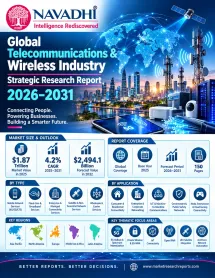
By Type: Mobile Network Services (4G/5G/LTE), Fixed-Line & Broadband Services, Enterprise & Managed Connectivity Services, Satellite & Non-Terrestrial Network Services, Wholesale & Carrier Services
By Application: Consumer & Residential Connectivity, Enterprise & Corporate Networking, IoT & Machine-to-Machine Communications, Government & Public Safety Networks, Media, Entertainment & Cloud Gaming Connectivity
Regional Forecast: Asia Pacific, Latin America, MEA, Europe, North America
Key Players: AT&T Inc., Verizon Communications Inc., Deutsche Telekom AG, China Mobile Limited, Comcast Corporation, SoftBank Group Corp., Bharti Airtel Limited, Telefónica S.A., T-Mobile US Inc., Vodafone Group Plc, Orange S.A., América Móvil, MTN Group Limited, Saudi Telecom Company (stc), Emirates Telecommunications Group (e&), Nippon Telegraph and Telephone Corporation (NTT), Telstra Group Limited, Rogers Communications Inc., Reliance Jio Infocomm Limited, Telecom Italia S.p.A. (TIM), Telecom Argentina S.A.
Overview
The global telecommunications and wireless market is valued at approximately USD 1.87 trillion in 2025 and is projected to grow at a 4.2% CAGR through 2031, reaching an estimated USD 2.39 trillion. This mother report spans the full value chain, from mobile network services through satellite and non-terrestrial networks, across five major end-use applications, and profiles 21 companies across 17 countries in five global regions.
Real, Current Competitive Intelligence
AT&T completed a real USD 23 billion acquisition of wireless spectrum licenses from EchoStar (announced August 26, 2025; FCC-approved May 12, 2026; closed July 28, 2026) -- one of the largest spectrum transactions in the industry's recent history. This is part of a genuine, current, global wave of consolidation: Verizon completed a real acquisition of Frontier Communications' fiber assets; Orange acquired exclusive control of MasOrange, reshaping the Spanish market; MTN Group posted a real, dramatic swing from a 2024 net loss to a 2025 net profit; Telefónica divested its Argentina subsidiary to Telecom Argentina; and Telecom Italia sold its network infrastructure business to KKR for approximately EUR 18.8 billion. This is real, current evidence of active, well-capitalized restructuring across multiple major markets simultaneously, not an isolated development.
Scope of the Global Telecommunications & Wireless Industry Strategic Research Report
This mother report provides market sizing (value) across service type and end-use application segments, and regional/country splits, through 2031, grounded in real, current competitive intelligence spanning 21 profiled operators across every major producing region.
Segment by Type
- Mobile Network Services (4G/5G/LTE)
- Fixed-Line & Broadband Services
- Enterprise & Managed Connectivity Services
- Satellite & Non-Terrestrial Network Services
- Wholesale & Carrier Services
Segment by Application
- Consumer & Residential Connectivity
- Enterprise & Corporate Networking
- IoT & Machine-to-Machine Communications
- Government & Public Safety Networks
- Media, Entertainment & Cloud Gaming Connectivity
Who Can Use This Report?
This mother report is ideal for people who need a broad, foundational view of the global telecommunications and wireless industry grounded in real, current company-level developments. Some of the intended users are:
- Corporate strategy teams evaluating network investment and spectrum acquisition decisions
- Investment analysts modeling operator free cash flow and spectrum portfolio value amid real, current consolidation activity
- M&A advisors assessing further consolidation opportunities across multiple concurrently-active markets
- Procurement managers benchmarking equipment and managed-service sourcing strategies across a globally diverse operator base
Market snapshot
Global Telecommunications & Wireless Industry Strategic Research Report snapshot, 2025–2031
 © MarketResearchReports.comDisclaimer: The actual data may vary in the final report which undergoes verification check post order confirmation.
Segments covered in this report
Table of contents
01Executive Summary
- 1.1 Market Synopsis
- 1.2 Key Findings
- 1.3 Methodology Transparency Note — Real 2025–2026 Consolidati…
02Industry Overview & Forecast
- 2.1 Market Definition & Scope
- 2.2 Market Value Forecast, 2026–2031
- 2.2.1 Regional Forecast Trajectories
- 2.3 Historical Market Review, 2022–2025
- 2.4 Scenario Analysis
- 2.5 Structural Context
03Market Segmentation by Type
- 3.1 Market by Type Overview
- 3.2 Mobile Network Services (4G/5G/LTE)
- 3.3 Fixed-Line & Broadband Services
- 3.4 Enterprise & Managed Connectivity Services
- 3.5 Satellite & Non-Terrestrial Network Services
- 3.6 Wholesale & Carrier Services
- 3.7 Synthesised Type Segmentation Outlook
04Market Segmentation by Application
- 4.1 Market by Application Overview
- 4.2 Consumer & Residential Connectivity
- 4.3 Enterprise & Corporate Networking
- 4.4 IoT & Machine-to-Machine Communications
- 4.5 Government & Public Safety Networks
- 4.6 Media, Entertainment & Cloud Gaming Connectivity
- 4.7 Cross-Segment Analysis and Forecast Synthesis
05Regional Market Forecast
- 5.1 Asia Pacific
- 5.1.1 Regional Overview
- 5.1.2 Key Growth Drivers
- 5.1.3 Regulatory & Infrastructure Landscape
- 5.1.4 Country-Level Analysis
- 5.1.5 Market Forecast 2025–2031
- 5.2 North America
- 5.2.1 Regional Overview
- 5.2.2 Key Growth Drivers
- 5.2.3 Regulatory & Infrastructure Landscape
- 5.2.4 Country-Level Analysis
- 5.2.5 Market Forecast 2025–2031
- 5.3 Europe
- 5.3.1 Regional Overview
- 5.3.2 Key Growth Drivers
- 5.3.3 Regulatory & Infrastructure Landscape
- 5.3.4 Country-Level Analysis
- 5.3.5 Market Forecast 2025–2031
- 5.4 Latin America
- 5.4.1 Regional Overview
- 5.4.2 Key Growth Drivers
- 5.4.3 Regulatory & Infrastructure Landscape
- 5.4.4 Country-Level Analysis
- 5.4.5 Market Forecast 2025–2031
- 5.5 Middle East & Africa
- 5.5.1 Regional Overview
- 5.5.2 Key Growth Drivers
- 5.5.3 Regulatory & Infrastructure Landscape
- 5.5.4 Country-Level Analysis
- 5.5.5 Market Forecast 2025–2031
06Country-Level Market Forecast
- 6.1 Asia Pacific
- 6.1.1 China
- 6.1.2 Japan
- 6.1.3 India
- 6.1.4 South Korea
- 6.1.5 Australia
- 6.1.6 Rest of Asia-Pacific
- 6.2 North America
- 6.2.1 United States
- 6.2.2 Canada
- 6.2.3 Rest of North America
- 6.3 Europe
- 6.3.1 Germany
- 6.3.2 United Kingdom
- 6.3.3 France
- 6.3.4 Italy
- 6.3.5 Rest of Europe
- 6.4 Latin America
- 6.4.1 Brazil
- 6.4.2 Mexico
- 6.4.3 Argentina
- 6.4.4 Rest of Latin America
- 6.5 Middle East & Africa
- 6.5.1 Saudi Arabia
- 6.5.2 United Arab Emirates
- 6.5.3 South Africa
- 6.5.4 Nigeria
- 6.5.5 Rest of Middle East & Africa
07Growth Drivers & Inhibitors
- 7.2 Chapter Introduction
- 7.3 Global 5G Network Rollout & Spectrum Monetization
- 7.3.1 Scale and Trajectory of 5G Deployment
- 7.3.2 Spectrum as a Monetizable Strategic Asset
- 7.4 Real 2025–2026 Spectrum and Fiber Consolidation Activity
- 7.4.1 Fiber-Broadband Infrastructure as a Competitive Moat
- 7.4.2 Strategic Rationale and Competitive Implications
- 7.5 Enterprise Private Wireless & SD-WAN Adoption
- 7.5.1 Enterprise Demand-Side Dynamics
- 7.5.2 SD-WAN and Managed Connectivity
- 7.6 Market Restraints & Regulatory Approval Complexity
- 7.6.1 Capital Expenditure Intensity and Free Cash Flow Compression
- 7.6.2 Regulatory Approval Timelines
- 7.6.3 Legacy Service Revenue Decline
- 7.7 Opportunities & White-Space Analysis
- 7.7.1 Spectrum Portfolio Consolidation as a Replicable Model
- 7.7.2 Fiber-Broadband Convergence and Fixed-Mobile Integration
- 7.7.3 Enterprise Private Wireless White Space
- 7.8 Structural Challenges
- 7.8.1 Return-on-Investment Assessment for Large-Scale Spectrum Trans…
- 7.8.2 Distinguishing Structural from Promotional Subscriber Growth
- 7.8.3 Managing the Legacy-to-Advanced Connectivity Transition
- 7.9 Chapter Summary
08Key Company Profiles
- 8.1 AT&T Inc.
- 8.1.1 Company Overview
- 8.1.2 Key Products & Segments
- 8.1.3 Financial Performance (2023–2025)
- 8.1.4 Business Strategy
- 8.1.5 SWOT Analysis
- 8.1.6 Strategic Implications (2025–2031)
- 8.2 Verizon Communications Inc.
- 8.2.1 Company Overview
- 8.2.2 Key Products & Segments
- 8.2.3 Financial Performance (2023–2025)
- 8.2.4 Business Strategy
- 8.2.5 SWOT Analysis
- 8.2.6 Strategic Implications (2025–2031)
- 8.3 Deutsche Telekom AG
- 8.3.1 Company Overview
- 8.3.2 Key Products & Segments
- 8.3.3 Financial Performance (2023–2025)
- 8.3.4 Business Strategy
- 8.3.5 SWOT Analysis
- 8.3.6 Strategic Implications (2025–2031)
- 8.4 China Mobile Limited
- 8.4.1 Company Overview
- 8.4.2 Key Products & Segments
- 8.4.3 Financial Performance (2023–2025)
- 8.4.4 Business Strategy
- 8.4.5 SWOT Analysis
- 8.4.6 Strategic Implications (2025–2031)
- 8.5 Comcast Corporation
- 8.5.1 Company Overview
- 8.5.2 Key Products & Segments
- 8.5.3 Financial Performance (2023–2025)
- 8.5.4 Business Strategy
- 8.5.5 SWOT Analysis
- 8.5.6 Strategic Implications (2025–2031)
- 8.6 SoftBank Group Corp.
- 8.6.1 Company Overview
- 8.6.2 Key Products & Segments
- 8.6.3 Financial Performance (2023–2025)
- 8.6.4 Business Strategy
- 8.6.5 SWOT Analysis
- 8.6.6 Strategic Implications (2025–2031)
- 8.7 Bharti Airtel Limited
- 8.7.1 Company Overview
- 8.7.2 Key Products & Segments
- 8.7.3 Financial Performance (2023–2025)
- 8.7.4 Business Strategy
- 8.7.5 SWOT Analysis
- 8.7.6 Strategic Implications (2025–2031)
- 8.8 Telefónica S.A.
- 8.8.1 Company Overview
- 8.8.2 Key Products & Segments
- 8.8.3 Financial Performance (2023–2025)
- 8.8.4 Business Strategy
- 8.8.5 SWOT Analysis
- 8.8.6 Strategic Implications (2025–2031)
- 8.9 T-Mobile US Inc.
- 8.9.1 Company Overview
- 8.9.2 Key Products & Segments
- 8.9.3 Financial Performance (2023–2025)
- 8.9.4 Business Strategy
- 8.9.5 SWOT Analysis
- 8.9.6 Strategic Implications (2025–2031)
- 8.10 Vodafone Group Plc
- 8.10.1 Company Overview
- 8.10.2 Key Products & Segments
- 8.10.3 Financial Performance (2023–2025)
- 8.10.4 Business Strategy
- 8.10.5 SWOT Analysis
- 8.10.6 Strategic Implications (2025–2031)
- 8.11 Orange S.A.
- 8.11.1 Company Overview
- 8.11.2 Key Products & Segments
- 8.11.3 Financial Performance (2023–2025)
- 8.11.4 Business Strategy
- 8.11.5 SWOT Analysis
- 8.11.6 Strategic Implications (2025–2031)
- 8.12 América Móvil, S.A.B. de C.V.
- 8.12.1 Company Overview
- 8.12.2 Key Products & Segments
- 8.12.3 Financial Performance (2023–2025)
- 8.12.4 Business Strategy
- 8.12.5 SWOT Analysis
- 8.12.6 Strategic Implications (2025–2031)
- 8.13 MTN Group Limited
- 8.13.1 Company Overview
- 8.13.2 Key Products & Segments
- 8.13.3 Financial Performance (2023–2025)
- 8.13.4 Business Strategy
- 8.13.5 SWOT Analysis
- 8.13.6 Strategic Implications (2025–2031)
- 8.14 Saudi Telecom Company (stc)
- 8.14.1 Company Overview
- 8.14.2 Key Products & Segments
- 8.14.3 Financial Performance (2023–2025)
- 8.14.4 Business Strategy
- 8.14.5 SWOT Analysis
- 8.14.6 Strategic Implications (2025–2031)
- 8.15 Emirates Telecommunications Group Company (e&)
- 8.15.1 Company Overview
- 8.15.2 Key Products & Segments
- 8.15.3 Financial Performance (2023–2025)
- 8.15.4 Business Strategy
- 8.15.5 SWOT Analysis
- 8.15.6 Strategic Implications (2025–2031)
- 8.16 Nippon Telegraph and Telephone Corporation (NTT)
- 8.16.1 Company Overview
- 8.16.2 Key Products & Segments
- 8.16.3 Financial Performance (2023–2025)
- 8.16.4 Business Strategy
- 8.16.5 SWOT Analysis
- 8.16.6 Strategic Implications (2025–2031)
- 8.17 Telstra Group Limited
- 8.17.1 Company Overview
- 8.17.2 Key Products & Segments
- 8.17.3 Financial Performance (2023–2025)
- 8.17.4 Business Strategy
- 8.17.5 SWOT Analysis
- 8.17.6 Strategic Implications (2025–2031)
- 8.18 Rogers Communications Inc.
- 8.18.1 Company Overview
- 8.18.2 Key Products & Segments
- 8.18.3 Financial Performance (2023–2025)
- 8.18.4 Business Strategy
- 8.18.5 SWOT Analysis
- 8.18.6 Strategic Implications (2025–2031)
- 8.19 Reliance Jio Infocomm Limited
- 8.19.1 Company Overview
- 8.19.2 Key Products & Segments
- 8.19.3 Financial Performance (2023–2025)
- 8.19.4 Business Strategy
- 8.19.5 SWOT Analysis
- 8.19.6 Strategic Implications (2025–2031)
- 8.20 Telecom Italia S.p.A. (TIM)
- 8.20.1 Company Overview
- 8.20.2 Key Products & Segments
- 8.20.3 Financial Performance (2023–2025)
- 8.20.4 Business Strategy
- 8.20.5 SWOT Analysis
- 8.20.6 Strategic Implications (2025–2031)
- 8.21 Telecom Argentina S.A.
- 8.21.1 Company Overview
- 8.21.2 Key Products & Segments
- 8.21.3 Financial Performance (2023–2025)
- 8.21.4 Business Strategy
- 8.21.5 SWOT Analysis
- 8.21.6 Strategic Implications (2025–2031)
09Competitive Landscape
- 9.1 Competitive Landscape Overview
- 9.2 Competitive Intensity Assessment
- 9.2.1 Tier Structure and Revenue Positioning
- 9.2.2 Capacity versus Demand Dynamics
- 9.2.3 Pricing Environment
- 9.2.4 Barriers to Entry and Exit
- 9.3 Key Player Strategies & Positioning
- 9.3.1 Strategic Group Mapping: Three Distinct Competitive Tiers
- 9.3.2 Differentiation Strategies Across Major Players
- 9.3.3 Geographic Strongholds
- 9.3.4 M&A and Partnership Activity (2022–Present)
- 9.3.5 R&D and Technology Investment Trends
- 9.4 Competitive Dynamics & Strategic Outlook
- 9.4.1 Emerging Competitive Threats and Adjacent-Player Disruption
- 9.4.2 Consolidation vs. Fragmentation Outlook
- 9.4.3 Competitive Response Matrix
- 9.4.4 Strategic Recommendations for 2025–2031
10Porter's Five Forces Analysis
- 10.1 Threat of New Entrants
- 10.2 Bargaining Power of Buyers
- 10.3 Bargaining Power of Suppliers
- 10.4 Threat of Substitutes
- 10.5 Competitive Rivalry
11PESTLE Analysis
- 11.1 Political Factors
- 11.1.1 Spectrum Policy and Government Allocation Authority
- 11.1.2 National Security and Foreign Investment Scrutiny
- 11.1.3 Industrial Policy and Digital Sovereignty
- 11.1.4 Geopolitical Fragmentation and Supply Chain Bifurcation
- 11.2 Economic Factors
- 11.2.1 Macroeconomic Growth and Consumer Spending
- 11.2.2 Capital Markets Conditions and Cost of Capital
- 11.2.3 Currency and Inflation Dynamics
- 11.2.4 Enterprise Digitalisation Tailwinds
- 11.2.5 Investment in Emerging Market Infrastructure
- 11.3 Social and Demographic Factors
- 11.3.1 Urbanisation and the Digital Divide
- 11.3.2 Generational Shifts in Consumption Patterns
- 11.3.3 Rising Data Consumption and Mobile-First Lifestyles
- 11.3.4 Workforce Transformation and Future Skills
- 11.4 Technological Factors
- 11.4.1 5G Deployment Maturation and the Path to Advanced 5G
- 11.4.2 Open RAN and Network Architecture Transformation
- 11.4.3 Fibre Infrastructure and Fixed-Mobile Convergence
- 11.4.4 Artificial Intelligence and Autonomous Network Operations
- 11.4.5 Low Earth Orbit Satellite Integration
- 11.5 Legal and Regulatory Factors
- 11.5.1 Spectrum Licensing and Auction Frameworks
- 11.5.2 Mergers, Acquisitions, and Competition Law
- 11.5.3 Data Protection and Privacy Regulation
- 11.5.4 Cybersecurity Regulation and Network Resilience
- 11.5.5 Consumer Protection and Net Neutrality
- 11.6 Environmental Factors
- 11.6.1 Energy Consumption and the Carbon Footprint of Networks
- 11.6.2 E-Waste and the Circular Economy
- 11.6.3 Climate Risk and Physical Infrastructure Resilience
- 11.6.4 Green Network Innovation and Energy Efficiency
12SWOT Analysis
- 12.1 Introduction
- 12.2 Market-Level Strengths
- 12.2.1 Unrivalled Scale and Recurring Revenue Architecture
- 12.2.2 5G Infrastructure Deployment as a Multi-Year Growth Catalyst
- 12.2.3 Spectrum Holdings as Durable, Appreciating Strategic Assets
- 12.2.4 Global Operator Scale and Geographic Diversification
- 12.2.5 Strong Free Cash Flow Generation Supporting Capital Returns an…
- 12.3 Market-Level Weaknesses
- 12.3.1 Persistent Capital Intensity and Return-on-Investment Pressure
- 12.3.2 Revenue Growth Constraints in Saturated Developed Markets
- 12.3.3 High Debt Loads Constraining Strategic Flexibility
- 12.3.4 Talent Acquisition and Retention Challenges in a Technology-In…
- 12.3.5 Legacy Infrastructure and Network Complexity
- 12.4 Strategic Opportunities
- 12.4.1 Fixed Wireless Access as a Broadband Market Expansion Vector
- 12.4.2 Enterprise Digital Transformation and Private Network Demand
- 12.4.3 AI-Driven Network Optimisation and Operational Efficiency
- 12.4.4 Low Earth Orbit Satellite Integration and Non-Terrestrial Netw…
- 12.4.5 Emerging Market Subscriber Growth and ARPU Expansion
- 12.4.6 Spectrum Auction Opportunities and Network Modernisation Inves…
- 12.5 External Threats
- 12.5.1 Intensifying Price Competition and Structural ARPU Erosion
- 12.5.2 Hyperscale Technology Company Encroachment on the Connectivity…
- 12.5.3 Regulatory and Spectrum Policy Uncertainty
- 12.5.4 Cybersecurity Threats and Critical Infrastructure Vulnerability
- 12.5.5 Macroeconomic Headwinds and Currency Risk in Emerging Markets
- 12.5.6 Technology Disruption from Non-Traditional Connectivity Providers
- 12.6 Synthesis and Strategic Implications
13Future Trends & Outlook
- 13.1 Open RAN Architecture Adoption & Vendor Disaggregation
- 13.1.1 Current State and Momentum
- 13.1.2 Vendor Disaggregation Dynamics
- 13.1.3 Outlook Through 2031
- 13.2 Low Earth Orbit Satellite Integration into Terrestrial Networks
- 13.2.1 Market Context and Strategic Relevance
- 13.2.2 Integration Pathways with Terrestrial Networks
- 13.2.3 Competitive and Regulatory Implications
- 13.2.4 Outlook Through 2031
- 13.3 AI-Driven Network Automation & Autonomous Network Operations
- 13.3.1 From Operational Tool to Strategic Differentiator
- 13.3.2 Key Application Domains
- 13.3.3 Workforce and Organizational Implications
- 13.3.4 Outlook Through 2031
- 13.4 Long-Term Market Outlook (2032–2035)
- 13.4.1 Structural Growth Drivers Beyond the Forecast Period
- 13.4.2 Market Size Trajectory Post-2031
- 13.5 Investment & M&A Activity Outlook Post-EchoStar/Frontier
- 13.5.1 Precedent-Setting Transactions and Their Market Signaling Value
- 13.5.2 Investment Themes Likely to Dominate 2026–2031 M&A Activity
- 13.5.3 Capital Allocation Discipline and Shareholder Return Considera…
- 13.5.4 Regulatory Oversight and Transaction Risk
Tables and figures
- 2.1 Exhibit 2.1: Forecast of Global (in USD Bn)
- 2.2 Exhibit 2.2: Forecast of Global Market YoY Growth Rate & CAGR Summary (in %)
- 2.3 Exhibit 2.3: Forecast of Asia Pacific (in USD Bn)
- 2.4 Exhibit 2.4: Forecast of North America (in USD Bn)
- 2.5 Exhibit 2.5: Forecast of Europe (in USD Bn)
- 2.6 Exhibit 2.6: Forecast of Latin America (in USD Bn)
- 2.7 Exhibit 2.7: Forecast of Middle East & Africa (in USD Bn)
- 3.8 Exhibit 3.8: Forecast of Mobile Network Services (4G/5G/LTE) (in USD Bn)
- 3.9 Exhibit 3.9: Forecast of Fixed-Line & Broadband Services (in USD Bn)
- 3.10 Exhibit 3.10: Forecast of Enterprise & Managed Connectivity Services (in USD Bn)
- 3.11 Exhibit 3.11: Forecast of Satellite & Non-Terrestrial Network Services (in USD Bn)
- 3.12 Exhibit 3.12: Forecast of Wholesale & Carrier Services (in USD Bn)
- 4.13 Exhibit 4.13: Forecast of Consumer & Residential Connectivity (in USD Bn)
- 4.14 Exhibit 4.14: Forecast of Enterprise & Corporate Networking (in USD Bn)
- 4.15 Exhibit 4.15: Forecast of IoT & Machine-to-Machine Communications (in USD Bn)
- 4.16 Exhibit 4.16: Forecast of Government & Public Safety Networks (in USD Bn)
- 4.17 Exhibit 4.17: Forecast of Media, Entertainment & Cloud Gaming Connectivity (in USD Bn)
- 6.18 Exhibit 6.18: Forecast of Asia Pacific (in USD Bn)
- 6.19 Exhibit 6.19: Forecast of China (in USD Bn)
- 6.20 Exhibit 6.20: Forecast of Japan (in USD Bn)
- 6.21 Exhibit 6.21: Forecast of India (in USD Bn)
- 6.22 Exhibit 6.22: Forecast of South Korea (in USD Bn)
- 6.23 Exhibit 6.23: Forecast of Australia (in USD Bn)
- 6.24 Exhibit 6.24: Forecast of Rest of Asia-Pacific (in USD Bn)
- 6.25 Exhibit 6.25: Forecast of North America (in USD Bn)
- 6.26 Exhibit 6.26: Forecast of United States (in USD Bn)
- 6.27 Exhibit 6.27: Forecast of Canada (in USD Bn)
- 6.28 Exhibit 6.28: Forecast of Rest of North America (in USD Bn)
- 6.29 Exhibit 6.29: Forecast of Europe (in USD Bn)
- 6.30 Exhibit 6.30: Forecast of Germany (in USD Bn)
- 6.31 Exhibit 6.31: Forecast of United Kingdom (in USD Bn)
- 6.32 Exhibit 6.32: Forecast of France (in USD Bn)
- 6.33 Exhibit 6.33: Forecast of Italy (in USD Bn)
- 6.34 Exhibit 6.34: Forecast of Rest of Europe (in USD Bn)
- 6.35 Exhibit 6.35: Forecast of Latin America (in USD Bn)
- 6.36 Exhibit 6.36: Forecast of Brazil (in USD Bn)
- 6.37 Exhibit 6.37: Forecast of Mexico (in USD Bn)
- 6.38 Exhibit 6.38: Forecast of Argentina (in USD Bn)
- 6.39 Exhibit 6.39: Forecast of Rest of Latin America (in USD Bn)
- 6.40 Exhibit 6.40: Forecast of Middle East & Africa (in USD Bn)
- 6.41 Exhibit 6.41: Forecast of Saudi Arabia (in USD Bn)
- 6.42 Exhibit 6.42: Forecast of United Arab Emirates (in USD Bn)
- 6.43 Exhibit 6.43: Forecast of South Africa (in USD Bn)
- 6.44 Exhibit 6.44: Forecast of Nigeria (in USD Bn)
- 6.45 Exhibit 6.45: Forecast of Rest of Middle East & Africa (in USD Bn)
Frequently asked questions
What is the size of the global telecommunications and wireless market?
Has the competitive landscape changed materially in 2025-2026?
How many companies and countries does this report cover?
Which region dominates the telecommunications and wireless market?
Who are the key operators?
Research Methodology
All MarketResearchReports.com strategic research reports follow a rigorous, multi-stage methodology combining AI-assisted data synthesis with expert analyst validation.
Systematic collection from 500+ verified sources including SEC filings, industry databases (Bloomberg, Statista, OECD), regulatory filings, trade publications, patent databases, and company annual reports. AI-assisted extraction identifies relevant data points across 10,000+ documents per report.
Dual-validation approach: bottom-up sizing aggregates segment-level production, consumption, and trade data; top-down sizing cross-validates against macroeconomic indicators and total addressable market estimates. Discrepancies >5% trigger analyst review.
Company profiles built from public financial disclosures, product launches, M&A activity, job postings (as capability proxies), and supply chain mapping. Market share estimates triangulated across revenue, capacity, and shipment data.
CAGR projections use time-series regression on 5-10 years of historical data, adjusted for identified demand drivers (technology adoption curves, regulatory catalysts, demographic shifts) and demand inhibitors (cost barriers, substitution risk). Scenario modeling covers base, optimistic, and conservative cases.
All quantitative outputs reviewed by a domain-specialist analyst before publication. Data triangulation requires minimum 3 independent sources for every key figure. Reports undergo a structured peer review against our 47-point quality checklist covering methodology, data citations, logical consistency, and formatting standards.
On-demand reports are generated at time of purchase, incorporating the most recent available data. Static reports are republished when underlying market conditions shift by >10% from baseline assumptions. Purchasers receive update notifications for 12 months.
Related reports
 Navadhi Market Research · Telecom & Wireless
Global Telco Edge Computing Infrastructure and Micro-Data Centers Market Strategic Research Report
The global telco edge computing infrastructure and micro-data centers market has emerged as one of the most strategically consequential segments within the broader t…
Navadhi Market Research · Telecom & WirelessGlobal Sovereign AI Cloud Infrastructure for Telecommunications Operators Market Strategic Research Report
The global sovereign AI cloud infrastructure market for telecommunications operators has emerged as one of the most consequential intersections of national digital p…
Navadhi Market Research · Telecom & WirelessGlobal Zero-Trust Network Architecture for Telecom Carrier Infrastructures Market Strategic Research Report
The global Zero-Trust Network Architecture (ZTNA) for Telecom Carrier Infrastructures market represents one of the most consequential security investment categories …
Need a customized version?
Get country-, segment- or company-specific intelligence tailored to your exact requirements.
Request custom research →Request a free sample
Receive a sample of Global Telecommunications & Wireless Industry Strategic Research Report before you buy.
Customize This Report
Describe your specific requirements and our analysts will scope and deliver a tailored version.
Request Invoice
We will email a proforma invoice within 24 hours. Report access is granted upon payment confirmation.
Leading Brands in This Industry



