United States and Canada Batten Seam Metal Panel Market Strategic Research Report
By Type: Steel, Aluminum, Copper, Zinc
By Application: Residential, Commercial, Institutional, Industrial and Agricultural
Regional Forecast: South (US), Midwest (US), West (US), Northeast (US), Canada
Key Players: McElroy Metal, Cornerstone Building Brands, ATAS International, Berridge Manufacturing, Petersen Aluminum, Englert, Drexel Metals, Bridger Steel, Western States Metal Roofing, Vicwest
Overview
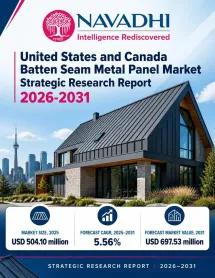
The United States and Canada batten seam metal panel market is estimated at USD 504.1 million in 2025 and is projected to reach USD 697.5 million by 2031, a compound annual growth rate (CAGR) of 5.6% over 2025-2031. Volume is estimated at 155.4 million square feet of installed area in 2025, rising to 204.1 million square feet by 2031. The 2031 bear and bull cases are USD 653.4 million and USD 744.2 million. The base year blends a bottom-up channel build (area x price per square foot) with a top-down estimate scaled from published figures.
Batten seam metal panels are concealed-fastener roofing and wall cladding systems with a raised batten rib, made from steel, aluminum, copper and zinc and sold to residential, commercial, institutional, industrial and agricultural buildings in the United States and Canada, valued at manufacturer selling price.
Scope of the United States and Canada Batten Seam Metal Panel Market Strategic Research Report
This report covers market value (USD million) and volume (million square feet) for 2022-2031, with 2025 as the base year and 2026-2031 as the forecast period. It analyses material-type and application segments, four US regions and Canada, twelve modelled states and provinces, ten profiled manufacturers, competitive structure, Porter's Five Forces, PESTLE, SWOT and future trends. Regional, state and province figures are analyst allocations of the combined total (population multiplied by a regional intensity index) and are labelled as such. No company market shares are presented because no manufacturer discloses batten seam sales.
Segment by Type
- Steel
- Aluminum
- Copper
- Zinc
Segment by Application
- Residential
- Commercial
- Institutional
- Industrial and Agricultural
Who Can Use This Report?
- Metal panel manufacturers, roll-forming equipment suppliers and coil coaters sizing the batten seam opportunity
- Distributors, contractors and building-products companies planning product ranges for the United States and Canada
- Investors and corporate development teams assessing consolidation in metal building products
- Architects, specifiers and procurement teams benchmarking panel types and pricing
Market snapshot
United States and Canada Batten Seam Metal Panel Market Strategic Research Report snapshot, 2025–2031
 © MarketResearchReports.comDisclaimer: The actual data may vary in the final report which undergoes verification check post order confirmation.
Segments covered in this report
Table of contents
01Executive Summary
- 1.1 United States and Canada Batten Seam Metal Panel Market Strate…
- 1.2 Market Definition and Headline Sizing
- 1.3 Key Growth Drivers
- 1.4 Segment Highlights
- 1.5 Regional and Country Highlights
- 1.6 Competitive Structure and Key Corporate Activity
- 1.7 Principal Risks and Restraints
- 1.8 Closing Outlook
02Industry Overview & Forecast
- 2.1.1 Market Definition and Scope
- 2.1.2 Market Size and Historical Performance
- 2.1.3 Forecast and Growth Logic
- 2.1.4 Volume Analysis
- 2.1.5 Value Chain and Pricing Context
03Market Segmentation by Type
- 3.1 Overview of the Type Segmentation Framework
- 3.2 Volume Analysis
- 3.2.1 Combined Market Volume Trajectory
- 3.3 Steel
- 3.3.1 Definition, Applications, and Market Position
- 3.3.2 Market Size and Share
- 3.3.3 Forecast and Growth Dynamics
- 3.4 Aluminum
- 3.4.1 Definition, Applications, and Market Position
- 3.4.2 Market Size and Share
- 3.4.3 Forecast and Growth Dynamics
- 3.5 Copper
- 3.5.1 Definition, Applications, and Market Position
- 3.5.2 Market Size and Share
- 3.5.3 Forecast and Growth Dynamics
- 3.6 Zinc
- 3.6.1 Definition, Applications, and Market Position
- 3.6.2 Market Size and Share
- 3.6.3 Forecast and Growth Dynamics
- 3.7 Material Mix Shift
04Market Segmentation by Application
- 4.1 Overview of the Application Framework
- 4.1.1 Residential
- 4.1.2 Commercial
- 4.1.3 Institutional
- 4.1.4 Industrial and Agricultural
- 4.1.5 Comparative Segment Analysis
05Regional Market Forecast
- South (US)
- Midwest (US)
- West (US)
- Northeast (US)
- Canada
06State and Province Market Forecast
- 6.1 State and Province Market Forecast: United States and Canada
- 6.1.1 State and Province Market Overview
- 6.1.2 California
- 6.1.2.1 Market Size and Allocation
- 6.1.2.2 Growth Outlook 2026–2031
- 6.1.3 Texas
- 6.1.3.1 Market Size and Allocation
- 6.1.3.2 Growth Outlook 2026–2031
- 6.1.4 Florida
- 6.1.4.1 Market Size and Allocation
- 6.1.4.2 Growth Outlook 2026–2031
- 6.1.5 New York
- 6.1.5.1 Market Size and Allocation
- 6.1.5.2 Growth Outlook 2026–2031
- 6.1.6 Georgia, Illinois, Ohio, and Pennsylvania
- 6.1.7 Ontario
- 6.1.7.1 Market Size and Allocation
- 6.1.7.2 Growth Outlook 2026–2031
- 6.1.8 Quebec
- 6.1.8.1 Market Size and Allocation
- 6.1.8.2 Growth Outlook 2026–2031
- 6.1.9 British Columbia and Alberta
- 6.1.10 Rest of United States and Rest of Canada
- 6.1.10.1 Rest of United States
- 6.1.10.2 Rest of Canada
- 6.1.11 State and Province Summary
- 6.1.11.1 The Allocation Framework Revisited
- 6.1.11.2 Largest Individually Modelled Geographies
- 6.1.11.3 United States Versus Canada Split
- 6.1.11.4 Growth Uniformity Across All Geographies
07Growth Drivers & Inhibitors
- 7.1 United States and Canada Batten Seam Metal Panel Market — St…
- 7.2 Market Growth Drivers
- 7.2.1 Escalating Homeowner Demand for Premium Roofing and Architectu…
- 7.2.2 Rapid Acceleration of the Board-and-Batten Siding Aesthetic in…
- 7.2.3 Re-Roofing Activity as a Structurally Resilient Replacement De…
- 7.2.4 Commercial, Institutional, and Agricultural Sector Specificati…
- 7.2.5 Material Diversification Driving Premium Segment Expansion
- 7.2.6 Canadian Market Expansion and Regional Diversification
- 7.3 Market Restraints and Inhibitors
- 7.3.1 Subdued US Housing Start Activity Constraining New-Build Chann…
- 7.3.2 Steel Input Cost Volatility and Supply Chain Price Transmissio…
- 7.3.3 Installed Cost Premium Relative to Exposed-Fastener and Asphal…
- 7.3.4 Stagnation in Broader Metal Panel Manufacturing Sector Value
- 7.3.5 Data Opacity and Benchmark Uncertainty Limiting Strategic Inve…
- 7.4 Impact Assessment Summary
- 7.5 Integrated Force Assessment
08Key Company Profiles
- 8.1 McElroy Metal
- 8.1.1 Company Overview
- 8.1.2 Key Products & Segments
- 8.1.3 Financial Performance (2023–2025)
- 8.1.4 Business Strategy
- 8.1.5 SWOT Analysis
- 8.1.6 Strategic Implications (2025–2031)
- 8.2 Cornerstone Building Brands
- 8.2.1 Company Overview
- 8.2.2 Key Products & Segments
- 8.2.3 Financial Performance (2023–2025)
- 8.2.4 Business Strategy
- 8.2.5 SWOT Analysis
- 8.2.6 Strategic Implications (2025–2031)
- 8.3 ATAS International
- 8.3.1 Company Overview
- 8.3.2 Key Products & Segments
- 8.3.3 Financial Performance (2023–2025)
- 8.3.4 Business Strategy
- 8.3.5 SWOT Analysis
- 8.3.6 Strategic Implications (2025–2031)
- 8.4 Berridge Manufacturing
- 8.4.1 Company Overview
- 8.4.2 Key Products & Segments
- 8.4.3 Financial Performance (2023–2025)
- 8.4.4 Business Strategy
- 8.4.5 SWOT Analysis
- 8.4.6 Strategic Implications (2025–2031)
- 8.5 Petersen Aluminum
- 8.5.1 Company Overview
- 8.5.2 Key Products & Segments
- 8.5.3 Financial Performance (2023–2025)
- 8.5.4 Business Strategy
- 8.5.5 SWOT Analysis
- 8.5.6 Strategic Implications (2025–2031)
- 8.6 Englert
- 8.6.1 Company Overview
- 8.6.2 Key Products & Segments
- 8.6.3 Financial Performance (2023–2025)
- 8.6.4 Business Strategy
- 8.6.5 SWOT Analysis
- 8.6.6 Strategic Implications (2025–2031)
- 8.7 Drexel Metals
- 8.7.1 Company Overview
- 8.7.2 Key Products & Segments
- 8.7.3 Financial Performance (2023–2025)
- 8.7.4 Business Strategy
- 8.7.5 SWOT Analysis
- 8.7.6 Strategic Implications (2025–2031)
- 8.8 Bridger Steel
- 8.8.1 Company Overview
- 8.8.2 Key Products & Segments
- 8.8.3 Financial Performance (2023–2025)
- 8.8.4 Business Strategy
- 8.8.5 SWOT Analysis
- 8.8.6 Strategic Implications (2025–2031)
- 8.9 Western States Metal Roofing
- 8.9.1 Company Overview
- 8.9.2 Key Products & Segments
- 8.9.3 Financial Performance (2023–2025)
- 8.9.4 Business Strategy
- 8.9.5 SWOT Analysis
- 8.9.6 Strategic Implications (2025–2031)
- 8.10 Vicwest
- 8.10.1 Company Overview
- 8.10.2 Key Products & Segments
- 8.10.3 Financial Performance (2023–2025)
- 8.10.4 Business Strategy
- 8.10.5 SWOT Analysis
- 8.10.6 Strategic Implications (2025–2031)
09Competitive Landscape
- 9.1.1 Competitive Landscape Overview
- 9.1.1.1 Market Structure and Concentration
- 9.1.1.2 Key Participants and Estimated Positioning
- 9.1.1.3 Concentration Metrics
- 9.1.1.4 Corporate Activity Reshaping the Competitive Map
- 9.1.1.5 Competitive Intensity Rating
- 9.1.2 Competitive Intensity Assessment
- 9.1.2.1 Tier Classification and Revenue Context
- 9.1.2.2 Tier 1: Cornerstone Building Brands and the Consolidation Dynamic
- 9.1.2.3 Tier 2: Specialist Architectural Metal Fabricators
- 9.1.2.4 Tier 3: Regional Specialists and Channel-Focused Operators
- 9.1.2.5 Capacity vs. Demand Dynamics
- 9.1.2.6 Pricing Environment: Premium, Value, and Commoditised Segments
- 9.1.2.7 Barriers to Entry and Exit
- 9.1.3 Key Player Strategies & Positioning
- 9.1.3.1 Strategic Group Map Narrative
- 9.1.3.2 Differentiation Strategies Across Major Players
10Porter's Five Forces Analysis
- 10.1 Threat of New Entrants
- 10.2 Bargaining Power of Buyers
- 10.3 Bargaining Power of Suppliers
- 10.4 Threat of Substitutes
- 10.5 Competitive Rivalry
11PESTLE Analysis
- 11.1 Overview
- 11.2 Political
- 11.3 Economic
- 11.4 Sociocultural
- 11.5 Technological
- 11.6 Legal
- 11.7 Environmental
- 11.8 PESTLE Summary Table
12SWOT Analysis
- 12.1 SWOT Summary Matrix
- 12.1.1 Detailed Analysis
- 12.1.1.1 Strengths
- 12.1.1.2 Weaknesses
- 12.1.1.3 Opportunities
- 12.1.1.4 Threats
- 12.1.2 Strategic Implications
13Future Trends & Outlook
- 13.1 Defining Market Trends
- 13.1.1 Sustained Residential Re-Roofing and New Construction Momentum
- 13.1.2 Accelerating Commercial and Institutional Specification
- 13.1.3 Material Premiumization and Substrate Diversification
- 13.1.4 Digital Distribution, E-Commerce Pricing Transparency, and Spe…
- 13.1.5 Consolidation Activity Reshaping Competitive Structure
- 13.1.6 Sustainability Mandates and Green Building Code Integration
- 13.1.7 Regional Market Divergence and Geographic Demand Concentration
- 13.1.8 Innovation in Coatings, Finishes, and Performance Warranties
- 13.2 Trend Summary Table
- 13.3 Forward Outlook
Tables and figures
- 2.1 Exhibit 2.1: Forecast of Global Market YoY Growth Rate & CAGR Summary (in %)
- 2.2 Exhibit 2.2: Forecast of United States and Canada Batten Seam Metal Panel (in USD Mn)
- 2.3 Exhibit 2.3: Forecast of South (US) (in USD Mn)
- 2.4 Exhibit 2.4: Forecast of Midwest (US) (in USD Mn)
- 2.5 Exhibit 2.5: Forecast of West (US) (in USD Mn)
- 2.6 Exhibit 2.6: Forecast of Northeast (US) (in USD Mn)
- 2.7 Exhibit 2.7: Forecast of Canada (in USD Mn)
- 3.8 Exhibit 3.8: Forecast of Steel (in USD Mn)
- 3.9 Exhibit 3.9: Forecast of Steel (in M sq ft)
- 3.10 Exhibit 3.10: Forecast of Aluminum (in USD Mn)
- 3.11 Exhibit 3.11: Forecast of Aluminum (in M sq ft)
- 3.12 Exhibit 3.12: Forecast of Copper (in USD Mn)
- 3.13 Exhibit 3.13: Forecast of Copper (in M sq ft)
- 3.14 Exhibit 3.14: Forecast of Zinc (in USD Mn)
- 3.15 Exhibit 3.15: Forecast of Zinc (in M sq ft)
- 4.16 Exhibit 4.16: Forecast of Residential (in USD Mn)
- 4.17 Exhibit 4.17: Forecast of Residential (in M sq ft)
- 4.18 Exhibit 4.18: Forecast of Commercial (in USD Mn)
- 4.19 Exhibit 4.19: Forecast of Commercial (in M sq ft)
- 4.20 Exhibit 4.20: Forecast of Institutional (in USD Mn)
- 4.21 Exhibit 4.21: Forecast of Institutional (in M sq ft)
- 4.22 Exhibit 4.22: Forecast of Industrial and Agricultural (in USD Mn)
- 4.23 Exhibit 4.23: Forecast of Industrial and Agricultural (in M sq ft)
- 6.24 Exhibit 6.24: Forecast of United States (in M sq ft)
- 6.25 Exhibit 6.25: Forecast of Canada (in M sq ft)
- 6.26 Exhibit 6.26: Forecast of Canada (in USD Mn)
- 6.27 Exhibit 6.27: Forecast of Rest of Canada (in USD Mn)
- 6.28 Exhibit 6.28: Forecast of Canada (in M sq ft)
- 6.29 Exhibit 6.29: Forecast of Rest of Canada (in M sq ft)
- 6.30 Exhibit 6.30: Forecast of Texas (in USD Mn)
- 6.31 Exhibit 6.31: Forecast of Texas (in M sq ft)
- 6.32 Exhibit 6.32: Forecast of Florida (in USD Mn)
- 6.33 Exhibit 6.33: Forecast of Florida (in M sq ft)
- 6.34 Exhibit 6.34: Forecast of Georgia (in USD Mn)
- 6.35 Exhibit 6.35: Forecast of Georgia (in M sq ft)
- 6.36 Exhibit 6.36: Forecast of Illinois (in USD Mn)
- 6.37 Exhibit 6.37: Forecast of Illinois (in M sq ft)
- 6.38 Exhibit 6.38: Forecast of Pennsylvania (in USD Mn)
- 6.39 Exhibit 6.39: Forecast of Pennsylvania (in M sq ft)
- 6.40 Exhibit 6.40: Forecast of California (in USD Mn)
- 6.41 Exhibit 6.41: Forecast of California (in M sq ft)
- 6.42 Exhibit 6.42: Forecast of New York (in USD Mn)
- 6.43 Exhibit 6.43: Forecast of New York (in M sq ft)
- 6.44 Exhibit 6.44: Forecast of Ontario (in USD Mn)
- 6.45 Exhibit 6.45: Forecast of Ontario (in M sq ft)
- 6.46 Exhibit 6.46: Forecast of Quebec (in USD Mn)
- 6.47 Exhibit 6.47: Forecast of Quebec (in M sq ft)
- 6.48 Exhibit 6.48: Forecast of British Columbia (in USD Mn)
- 6.49 Exhibit 6.49: Forecast of Alberta (in USD Mn)
- 6.50 Exhibit 6.50: Forecast of British Columbia (in M sq ft)
- 6.51 Exhibit 6.51: Forecast of Alberta (in M sq ft)
- 6.52 Exhibit 6.52: Forecast of South (US) (in M sq ft)
- 6.53 Exhibit 6.53: Forecast of Midwest (US) (in M sq ft)
- 6.54 Exhibit 6.54: Forecast of West (US) (in M sq ft)
- 6.55 Exhibit 6.55: Forecast of Northeast (US) (in M sq ft)
- 6.56 Exhibit 6.56: Forecast of South (US) (in USD Mn)
- 6.57 Exhibit 6.57: Forecast of Rest of South (US) (in USD Mn)
- 6.58 Exhibit 6.58: Forecast of South (US) (in M sq ft)
- 6.59 Exhibit 6.59: Forecast of Rest of South (US) (in M sq ft)
- 6.60 Exhibit 6.60: Forecast of Midwest (US) (in USD Mn)
- 6.61 Exhibit 6.61: Forecast of Ohio (in USD Mn)
- 6.62 Exhibit 6.62: Forecast of Rest of Midwest (US) (in USD Mn)
- 6.63 Exhibit 6.63: Forecast of Midwest (US) (in M sq ft)
- 6.64 Exhibit 6.64: Forecast of Ohio (in M sq ft)
- 6.65 Exhibit 6.65: Forecast of Rest of Midwest (US) (in M sq ft)
- 6.66 Exhibit 6.66: Forecast of West (US) (in USD Mn)
- 6.67 Exhibit 6.67: Forecast of Rest of West (US) (in USD Mn)
- 6.68 Exhibit 6.68: Forecast of West (US) (in M sq ft)
- 6.69 Exhibit 6.69: Forecast of Rest of West (US) (in M sq ft)
- 6.70 Exhibit 6.70: Forecast of Northeast (US) (in USD Mn)
- 6.71 Exhibit 6.71: Forecast of Rest of Northeast (US) (in USD Mn)
- 6.72 Exhibit 6.72: Forecast of Northeast (US) (in M sq ft)
- 6.73 Exhibit 6.73: Forecast of Rest of Northeast (US) (in M sq ft)
Frequently asked questions
What is the size of the United States and Canada batten seam metal panel market?
How much area does the market cover?
How is the market split between the United States and Canada?
Which region is largest?
Which states and provinces does the report cover?
Does the report give company market shares?
Which companies are profiled?
How reliable are the figures?
Research Methodology
All MarketResearchReports.com strategic research reports follow a rigorous, multi-stage methodology combining AI-assisted data synthesis with expert analyst validation.
Systematic collection from 500+ verified sources including SEC filings, industry databases (Bloomberg, Statista, OECD), regulatory filings, trade publications, patent databases, and company annual reports. AI-assisted extraction identifies relevant data points across 10,000+ documents per report.
Dual-validation approach: bottom-up sizing aggregates segment-level production, consumption, and trade data; top-down sizing cross-validates against macroeconomic indicators and total addressable market estimates. Discrepancies >5% trigger analyst review.
Company profiles built from public financial disclosures, product launches, M&A activity, job postings (as capability proxies), and supply chain mapping. Market share estimates triangulated across revenue, capacity, and shipment data.
CAGR projections use time-series regression on 5-10 years of historical data, adjusted for identified demand drivers (technology adoption curves, regulatory catalysts, demographic shifts) and demand inhibitors (cost barriers, substitution risk). Scenario modeling covers base, optimistic, and conservative cases.
All quantitative outputs reviewed by a domain-specialist analyst before publication. Data triangulation requires minimum 3 independent sources for every key figure. Reports undergo a structured peer review against our 47-point quality checklist covering methodology, data citations, logical consistency, and formatting standards.
On-demand reports are generated at time of purchase, incorporating the most recent available data. Static reports are republished when underlying market conditions shift by >10% from baseline assumptions. Purchasers receive update notifications for 12 months.
Related reports
 Navadhi Market Research · Construction & Real Estate
Global Automated Property Lease Extraction and Management AI Market Strategic Research Report
The global automated property lease extraction and management AI market has emerged as a strategically critical segment within the broader real estate technology eco…
Navadhi Market Research · Construction & Real EstateGlobal Prefabricated Bathroom Pods Residential Construction Market Strategic Research Report
The global prefabricated bathroom pods residential construction-industry-strategic-research-report" title="Global Construction Industry Strategic Research Report">…
Navadhi Market Research · Construction & Real EstateGlobal Rainwater Harvesting and Greywater Smart Recycling Buildings Market Strategic Research Report
The global rainwater harvesting and greywater smart recycling buildings market sits at the intersection of water scarcity, urbanization, and the accelerating push to…
Need a customized version?
Get country-, segment- or company-specific intelligence tailored to your exact requirements.
Request custom research →Request a free sample
Receive a sample of United States and Canada Batten Seam Metal Panel Market Strategic Research Report before you buy.
Customize This Report
Describe your specific requirements and our analysts will scope and deliver a tailored version.
Request Invoice
We will email a proforma invoice within 24 hours. Report access is granted upon payment confirmation.
Leading Brands in This Industry