


Global Defense Industry: Why Europe and Korea Are Outgrowing the US Primes

MRR® Industry Intelligence Briefing Defense Industry · Prime Contractors · Munitions · Defense Electronics
Rheinmetall grew sales 28.8% and Hanwha Aerospace 136.7% in 2025, while the largest US primes grew between 2% and 10% and several services contractors shrank. The USD 730 billion defense industry is moving at three different speeds.
Executive Summary
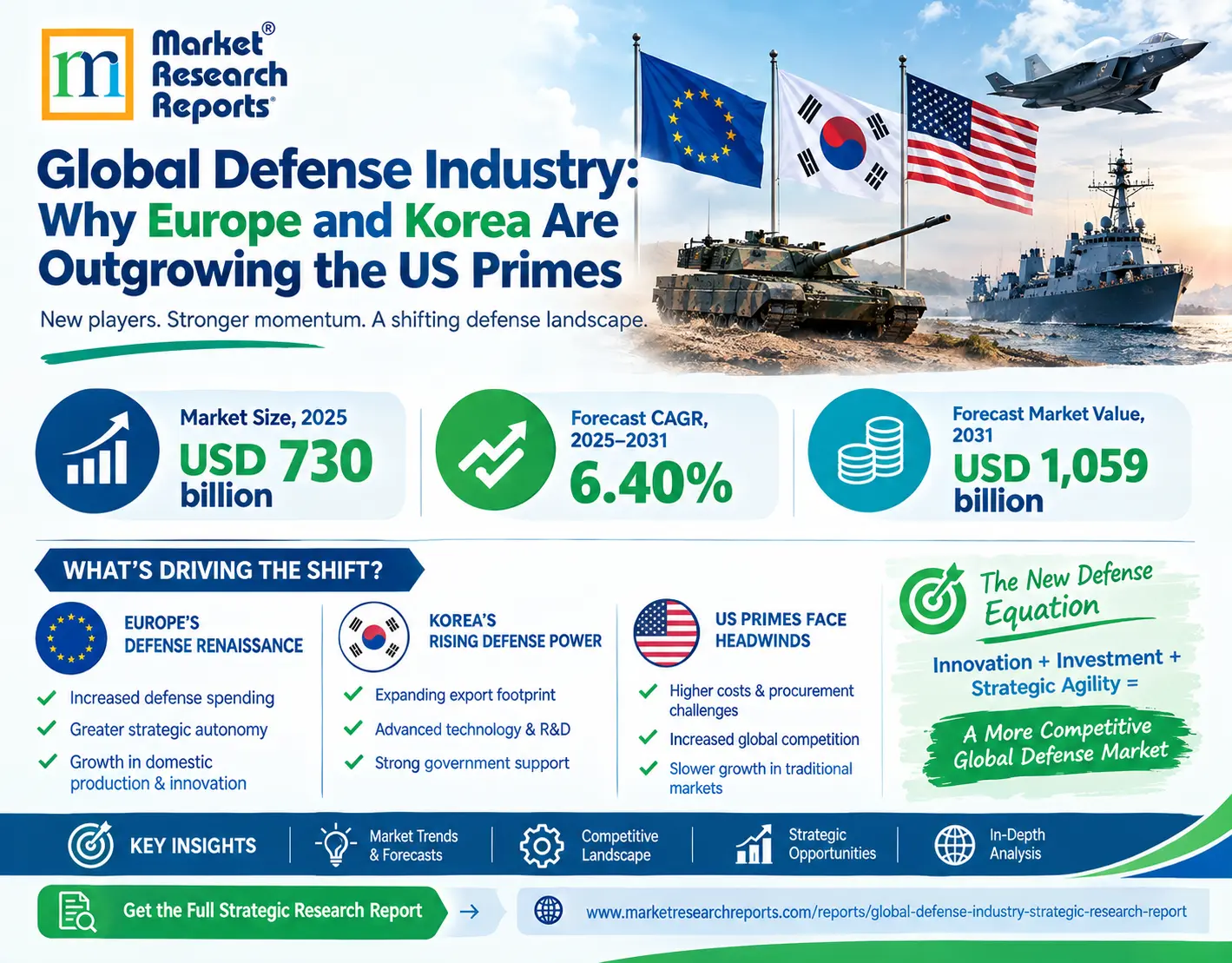
The global defense industry is estimated at approximately USD 730 billion in 2025 and is projected to grow at a 6.4% CAGR through 2031, reaching approximately USD 1,059 billion. The figure measures revenue earned by prime and sub-tier contractors and suppliers for defense platforms, systems, software and services. It is not a measure of national defense budgets. Company-level results for 2025 show that growth is far from uniform: European and Korean suppliers expanded at rates well above the industry average, the largest US primes grew steadily from a very large base, and parts of the services and vehicle supply chain contracted.
Three Speeds, One Market
Europe and Korea: Growth Well Above the Industry Average
Rheinmetall reported 2025 sales of EUR 9,935 million, up 28.8% from EUR 7,715 million, with an operating result of EUR 1,841 million. Its order backlog rose to EUR 63.8 billion from EUR 46.9 billion, an increase of 36%, which is more than six times its 2025 sales. Hanwha Aerospace reported revenue of KRW 26.61 trillion, up 136.7%, with operating profit of KRW 3.03 trillion and a ground defense backlog of about KRW 37.2 trillion. LIG Nex1 grew revenue 31.5% to about KRW 4.3 trillion, and Dassault Aviation grew net sales 19.1% to EUR 7,420 million, delivering 26 Rafale aircraft against 21 a year earlier. European suppliers hold about 27.9% of 2025 industry value, and the report models them as the fastest-growing supplier region.
The US Primes: Steady Growth, Record Scale
Lockheed Martin reported 2025 net sales of USD 75,048 million, up 5.6%, and a backlog of USD 193,622 million, up 10.0%. RTX grew 9.7% to USD 88,603 million and General Dynamics grew 10.1% to USD 52,550 million. Northrop Grumman grew 2.2% to USD 41,954 million, and L3Harris grew 3% to USD 21.9 billion with a book-to-bill ratio of 1.3x. Growth of 2% to 10% is broadly in line with the 6.4% industry CAGR, achieved on a base far larger than any European or Korean supplier, and North American suppliers still account for about 48.5% of 2025 industry value.
Services and Vehicle Suppliers: Pressure Beneath the Headline
Not every defense supplier is growing. Booz Allen Hamilton reported fiscal 2026 revenue of USD 11,217 million, down 6.4%, and SAIC reported fiscal 2026 revenue of USD 7,262 million, down 2.9%. Oshkosh's defense segment sales fell 20.6% to USD 1,628.0 million from USD 2,051.5 million. Rising budgets do not reach every part of the supply chain at the same time: platform, munitions and sensor suppliers with long-cycle programs of record have captured the early growth, while services and legacy vehicle programs have not.
Competitive Landscape
| Company | 2025 Development | Analyst Note |
|---|---|---|
| Rheinmetall | Sales EUR 9,935 million, up 28.8%; backlog EUR 63.8 billion, up from EUR 46.9 billion | Backlog is more than six times annual sales, which gives multi-year revenue visibility |
| Hanwha Aerospace | Revenue KRW 26.61 trillion, up 136.7%; operating profit KRW 3.03 trillion | Among the fastest-growing companies in the report's profiled set |
| Lockheed Martin | Net sales USD 75,048 million, up 5.6%; backlog USD 193,622 million, up 10.0% | Backlog is growing faster than sales, which supports continued growth from a very large base |
| Dassault Aviation | Net sales EUR 7,420 million, up 19.1%; order intake EUR 10,941 million; 26 Rafale delivered | Order intake is well above annual sales |
| Booz Allen Hamilton | Fiscal 2026 revenue USD 11,217 million, down 6.4% | Defense services contractors are not benefiting from platform-led growth |
| Oshkosh | Defense segment sales USD 1,628.0 million, down 20.6% | Legacy vehicle programs are a pocket of weakness within a growing industry |
Source: Navadhi Market Research, Global Defense Industry Strategic Research Report; company annual reports and results releases.
Analyst Perspective
The 6.4% industry CAGR hides a wide spread of outcomes. Suppliers of munitions, ground systems, sensors and combat aircraft in Europe and Korea are growing at several times the industry rate, the largest US primes are compounding from a base that no other supplier can match, and services and legacy vehicle suppliers are not yet sharing in the upswing. Growth in this industry is a question of program mix and geography, not just of rising demand.
Strategic Implications
| Observation | Implication |
|---|---|
| Rheinmetall and Hanwha are growing far above the 6.4% industry CAGR | Munitions and ground-systems suppliers with multi-year backlogs are positioned to keep growing, and supply and partnership terms with them are likely to matter |
| US primes grow 2% to 10% but are adding backlog faster than sales | Their backlogs support continued growth, while faster-growing European and Korean suppliers are gaining share of industry value |
| Services contractors and some vehicle programs are shrinking | Investors and acquirers should assess exposure by program type, not by the label "defense" |
Frequently Asked Questions
What is the size of the global defense industry?
Approximately USD 730 billion in 2025, projected to reach approximately USD 1,059 billion by 2031, at a 6.4% CAGR. This is contractor and supplier revenue, not national defense budgets.
Which defense suppliers grew fastest in 2025?
Among the companies profiled in the report, AeroVironment grew revenue 140.9% in its fiscal year ended April 2026 and Hanwha Aerospace grew 136.7% in 2025, followed by LIG Nex1 at 31.5% and Rheinmetall at 28.8%.
How are the largest US primes performing?
Lockheed Martin grew 5.6%, RTX 9.7%, General Dynamics 10.1%, Northrop Grumman 2.2% and L3Harris 3% in 2025, with Lockheed Martin's backlog rising 10.0% to USD 193,622 million.
How many companies and countries does this report cover?
45 companies, with country forecasts for 27 countries across all five major global regions.
For complete segment, regional, and company-level detail, refer to our Global Defense Industry Strategic Research Report. For engagement-specific analysis, commission custom research.