


Humanoid Robot E-Skin: The Sense of Touch Becomes a $260M Market by 2031
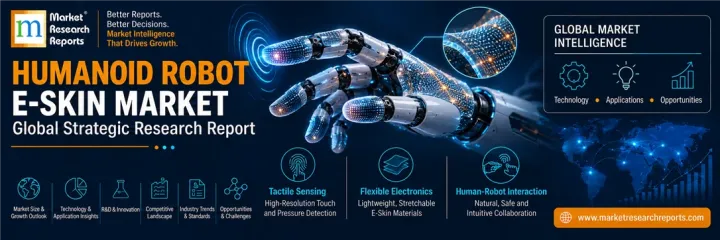
MRR® Investor Brief on Industrial Machinery and Robotics
Humanoid robots can now see and move, and touch is the next capability to scale. E-skin sells by the module, its volume grows ninefold by 2031, and strategic capital from carmakers, platforms, and Big Tech is already choosing the winners.
Research in Brief
- Small market, steep curve. The humanoid robot e-skin market is estimated at US$49.9 million (2025) and is forecast to reach US$260.5 million by 2031, a 31.7% CAGR (Market Research Reports).
- Three scenarios, all steep. The 2031 range runs from US$196.3 million (bear, 25.6% CAGR) through US$260.5 million (base) to US$344.0 million (bull, 38.0% CAGR) (Market Research Reports).
- A volume business. Module shipments rise from about 1.7 million (2025) to 15.3 million (2031), roughly a ninefold increase (Market Research Reports).
- Asia Pacific is the centre of gravity at 70.7% of 2025 value (Market Research Reports). China's tactile-sensor leader PaXini has raised billions of yuan from BYD, JD.com and Samsung.
- Commercial deployment is next. Research, education and data collection account for 88.0% of today's value, while logistics and warehousing grows fastest at 84.3% a year (Market Research Reports).
Why Now: Three Forces Opening the Market
1. Embodied AI needs touch data. MRR names growing demand for dexterous manipulation and embodied-AI training data as a core driver. Vendors are moving up the stack accordingly. Daimon Robotics has released Daimon-Infinity, a large tactile, full-modal embodied dataset built with Google DeepMind and dozens of research institutions.
2. Strategic capital is concentrating fast. MRR's drivers chapter highlights surging venture and strategic investment into tactile sensing, and company disclosures confirm it:
- PaXini: BYD invested in April 2025, JD.com led its Series A, and the company closed a Series B of more than ¥1 billion in March 2026 that valued it above ¥10 billion.
- Daimon Robotics: has added China Mobile-backed and Ant Group-led strategic rounds.
3. Price deflation unlocks volume. MRR's figures imply the average module price falls from about US$29 (2025) to about US$17 (2031), even as total value grows more than fivefold. Cheaper modules move e-skin from fingertips to palms, arms and torsos, and from research labs to factory and warehouse floors.
Where the Money Is
| Lens | MRR data point | Investor read |
|---|---|---|
| Market size, 2025 | US$49.9M | Early, with share still being allocated |
| Growth (base) | 31.7% CAGR, 2025–2031 | Roughly doubles every 2.5 years |
| Module volume | ~1.7M (2025) → ~15.3M (2031) | A volume-manufacturing race |
| Largest technology | Piezoresistive: US$21.0M (42.0%) | The cost-effective incumbent |
| Fastest technology | Optical & vision-based: +42.0%/yr | The high-resolution platform bet |
| Other routes | Capacitive, magnetic/Hall-effect, textile/piezoelectric | Multiple modalities still competing |
| Largest application | Research, education & data collection: 88.0% | Today's revenue base |
| Fastest application | Logistics & warehousing: +84.3%/yr | The first commercial scale-up |
| Largest region | Asia Pacific: 70.7% | China-led supply chain |
| Fastest region | Middle East & Africa: +47.0%/yr | New greenfield demand |
Implied module economics (illustrative). Dividing value by modules gives:
- 2025: US$29 per module (US$49.9M ÷ 1.72M)
- 2031: US$17 per module (US$260.5M ÷ 15.3M)
Average module prices fall by roughly 40% while the market grows fivefold. The winners will be the companies that pair falling cost with rising tactile intelligence.
Three Scenarios to 2031
| Scenario | 2031 market | Multiple of 2025 | What gets it there |
|---|---|---|---|
| Bear case | US$196.3M | 3.9x | E-skin stays concentrated in research and data-collection fleets, and module price deflation outpaces volume. |
| Base case | US$260.5M | 5.2x | Humanoid volumes ramp steadily, and logistics and industrial deployments scale from pilots. |
| Bull case | US$344.0M | 6.9x | Large-area skin moves to torsos and limbs, multimodal vision-tactile sensing becomes standard, and service and healthcare robots adopt touch. |
The US$147.7 million gap between the bear and bull cases is the value of execution, and the catalyst calendar below shows where it will be decided. MRR is transparent that confidence in the absolute base is low because published estimates conflict. The direction of growth, however, is well supported.
Ways to Play It
1. PaXini Tech — The scale leader with strategic backers (private, Shenzhen)
What it does. PaXini makes multi-dimensional tactile sensors, tactile dexterous hands and the TORA humanoid robot. Its Hall-array sensor line starts at an entry price point aimed at volume adoption.
Public milestones.
- Strategic investment from BYD (April 2025), followed by a JD.com-led Series A .
- Series B of more than ¥1 billion (March 2026), valuing the company above ¥10 billion, with participation from Meta affiliates and JD.com.
- A further ¥1 billion strategic round (August 2026), bringing total funding to ¥3.5 billion
- Reported to be weighing a Hong Kong IPO.
MRR's Take: PaXini is the category's capital-formation leader. It sits in MRR's largest region (Asia Pacific) and spans the Magnetic and Hall-Effect and multi-dimensional tactile routes. Backing from a carmaker, an e-commerce logistics giant and global electronics players maps directly onto MRR's industrial and logistics growth segments. A listing would give public investors the first pure-play tactile-sensing benchmark.
2. Daimon Robotics — The vision-tactile data platform (private, Shenzhen)
What it does. Daimon makes vision-based tactile sensors (DM-Tac), a visuotactile dexterous hand, a wearable teleoperation and data-collection system, and a multimodal manipulation model.
Public milestones.
- An Angel++ round of more than RMB 100 million (about US$14 million, August 2025), led by China Merchants Venture.
- Sensor specifications: about 40,000 sensing units per square centimetre, more than 5 million press cycles passed in durability testing, and both CE and FCC certification.
- Further rounds: a China Mobile-backed round (December 2025), a 100 million yuan Series A, and an Ant Group-led strategic round.
MRR's Take: Daimon is the leading exposure to MRR's fastest-growing technology, Optical and Vision-Based sensing at 42.0% a year. By pairing hardware with datasets and a manipulation model, it captures value in what MRR calls AI-integrated tactile intelligence, where product value increasingly sits in the data layer.
3. GelSight — The Western vision-tactile pioneer (private, Massachusetts)
What it does. GelSight makes elastomeric, imaging-based tactile sensors used in robotics research, aerospace and automotive inspection, and forensics.
Public milestones.
- Commercial manufacturer of Meta AI's DIGIT tactile sensor, and later co-developer of Digit 360 for robotic fingers.
- U.S. NSF SBIR-backed development of high-resolution tactile and surface-topography technology
CEO briefing. CEO Youssef Benmokhtar frames the Meta partnership as a shared goal to make tactile sensing "more ubiquitous and accessible".
MRR's Take: GelSight anchors the North American side of the Optical and Vision-Based segment. Its industrial inspection revenue gives it a commercial base beyond robotics, and its Big Tech partnership positions it in the research and data-collection segment that holds 88% of MRR's 2025 value.
4. Touchlab — The large-area e-skin specialist (private, Edinburgh)
What it does. Touchlab makes thin, retrofittable triaxial e-skin that senses pressure, location and direction across robot surfaces, including grippers, hands and bodies.
Public milestones.
- A £3.5 million (US$4.8 million) seed round led by Octopus Ventures.
- Incubated at the STFC Higgs Centre for Innovation (UK Research and Innovation), with EIT Digital support for hospital telerobotics.
- Deployments across logistics and fulfilment, humanoid robotics, healthcare and nuclear decommissioning.
CEO briefing. Founder-CEO Dr. Zaki Hussein calls touch "the final frontier for robot interaction and entry into physical environments".
MRR's Take: Touchlab targets the bull-case driver: large-area skin on torsos, arms and legs, which MRR's trends chapter tracks as textile and conformal skin moving from research to pre-commercial. Its harsh-environment durability matches the logistics and industrial segments that grow fastest in the forecast.
5. Interlink Electronics — The listed force-sensing play (NASDAQ: LINK)
What it does. Interlink makes force-sensing resistors and printed-electronics sensors, the piezoresistive building block behind much of today's tactile hardware.
Public milestones.
- Q2 2026 revenue of US$3.77 million, up 10.4%, with a 44.4% gross margin and a return to profitability.
- Growth driven by force-sensing and printed-electronics shipments. The company also has a pending acquisition that management describes as transformative.
CEO briefing. Chairman and CEO Steven Bronson says the company expects the pending acquisition "will be a transformative event for the Company".
MRR's Take: Interlink gives public-market investors direct exposure to MRR's largest technology segment, Piezoresistive sensing at 42% of value. Its manufacturing know-how in printed force sensors is the kind of cost-down capability the volume ramp to 15 million modules will reward.
MRR also profiles Tashan Technology, XELA Robotics, Contactile, BeBop Sensors and Tekscan in the full report.
Catalyst Calendar
| Timing | Catalyst | Company | Points toward |
|---|---|---|---|
| 2026–2027 | Possible Hong Kong IPO | PaXini | Public valuation benchmark |
| Nov 2026 | Q3 2026 results and acquisition progress | Interlink | Piezoresistive scale-up |
| Rolling | Humanoid OEM tactile sourcing announcements | All | Base to bull |
| Rolling | Large-area skin deployments on torsos and limbs | Touchlab, PaXini | Bull case |
| Rolling | Tactile dataset and model releases | Daimon, GelSight | AI-integrated value |
Five Signals to Watch
- Strategic investor identity. Carmakers, logistics platforms and telecoms backing tactile startups signal where the first commercial volumes will land.
- Module price points. Published entry prices for tactile modules show how fast the US$29-to-US$17 deflation path is unfolding.
- Application mix. Watch for announced deployments in logistics and industrial settings. That is the shift from MRR's 88% research base toward its fastest-growing segments.
- Body coverage. Watch how much of a robot's surface carries e-skin. Moving beyond fingertips is the clearest bull-case signal.
- Listings. An IPO by a tactile leader would give the category a public valuation anchor.
What the Full Report Adds
The Global Humanoid Robot E-Skin Market Strategic Research Report (262 pages, base year 2025, forecast to 2031) gives investors:
- Value and volume: market value and module volume for 2022–2031, split across five sensing technologies and four deployment segments
- Geography: five regions and 24 named countries
- Company profiles: verified profiles of 10 companies
- Scenarios and sizing: bear, base and bull scenarios, with a transparent sizing method
- Strategy frameworks: a competitive response matrix, Porter's Five Forces, PESTLE, SWOT, and eight future trends shaping the market through 2031
Request a free sample → · Need a country-, segment- or company-specific cut? Request custom research →
Sources
Market data
- Market Research Reports: Global Humanoid Robot E-Skin Market Strategic Research Report. All market size, CAGR, scenario, volume, segment and regional figures come from this report.
Government and public bodies
- U.S. SEC: Interlink Electronics Form 8-K, Q2 2026
- UK Research and Innovation: Touchlab seed funding
- European Institute of Innovation & Technology: Touchlab
- U.S. NSF America's Seed Fund: GelSight
Company disclosures and announcements
- PaXini: Series B (EqualOcean), Series B (Caixin Global), strategic round (Gasgoo), IPO consideration (CnEVPost)
- Daimon Robotics: Angel++ round (Evertiq), Series A and dataset (Gasgoo), Ant Group round (Gasgoo)
- GelSight: Digit 360 with Meta AI
- Interlink Electronics: Q2 2026 results
Disclaimer: For information only. Based on public disclosures as of October 2026. Not investment advice; please do your own due diligence before investing.