


Market Intelligence vs. Market Research: Understanding the Difference and Why Organizations Need Both
MRR® Market Intelligence Market Research · Competitive Intelligence
The market is voting with its capital allocation. Gartner's Insights segment - pure continuous intelligence - now accounts for nearly four-fifths of its revenue, while Forrester's research and advisory business, built on the same subscription logic, just posted an 8% revenue decline and a nine-figure impairment. The difference is not the business model; it is execution and AI-readiness within that model. Buyers are not abandoning intelligence subscriptions - they are abandoning the ones that haven't kept pace with what an AI-assisted analyst can now do faster. Any organization evaluating "build vs. buy" for an intelligence function should treat Forrester's 2025 results as the more instructive case study, not Gartner's.
Executive Summary
Market research and market intelligence are frequently used interchangeably, and that conflation costs organizations money. Market research answers a defined question through a bounded project; market intelligence sustains situational awareness through an ongoing process. The distinction is not academic - it shows up directly in how research and advisory firms structure their revenue. Gartner, the largest pure-play research and advisory firm by revenue, generated approximately 78% of its $6.50 billion in FY2025 revenue from subscription-based Insights products - the intelligence model - versus 9% from project-based Consulting engagements, the research model. Forrester Research, by contrast, saw the same subscription model contract sharply in FY2025, with total revenue falling 8% to $396.9 million and a $110.7 million goodwill impairment tied to its Research segment, illustrating that the intelligence model is not immune to disruption - particularly from AI-native competitors entering the same buyer conversations. Organizations that understand which discipline they actually need, and when, avoid paying for an ongoing monitoring capability when what they need is a single rigorous answer, or vice versa.
What Is Market Research?
Market research is a structured, time-bound investigation designed to answer a specific business question - such as the size of a market opportunity, the viability of a new product, or which customer segment to prioritize - using primary data collection, secondary data synthesis, and statistical analysis. It produces a defined deliverable with a start and end date.
What Is Market Intelligence?
Market intelligence is the continuous collection, analysis, and synthesis of information about competitors, customers, technologies, and regulatory conditions to maintain situational awareness of a market over time. Unlike research, it has no fixed endpoint - it is a standing capability, not a project.
Key Differences: A Framework Comparison
| Dimension | Market Research | Market Intelligence |
|---|---|---|
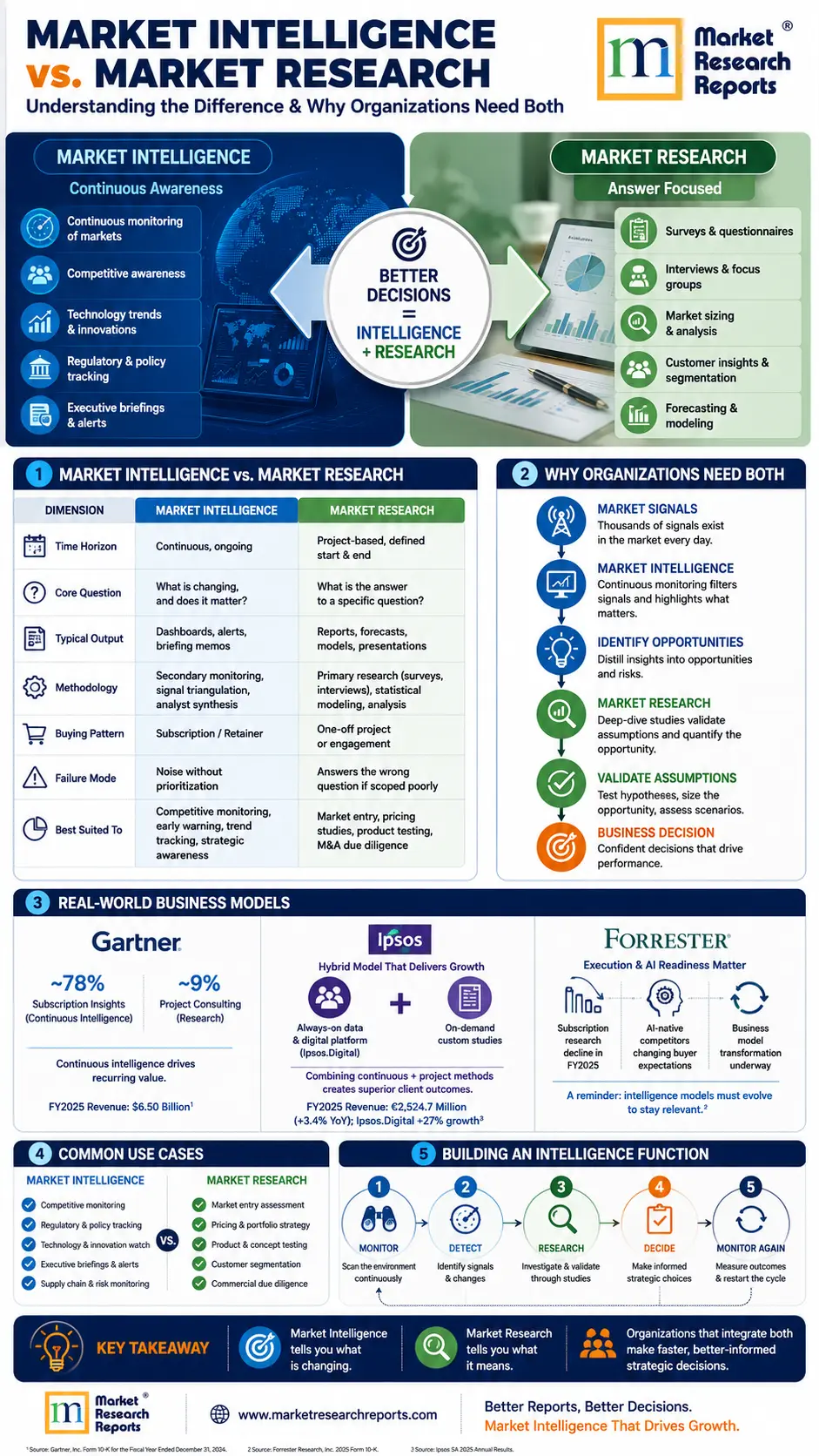
| Time horizon | Project-based, defined start/end | Continuous, ongoing |
| Core question | "What is the answer to X?" | "What is changing, and does it matter?" |
| Typical output | Report, forecast model, segmentation study | Dashboard, alert, briefing memo |
| Methodology | Primary research (surveys, interviews), statistical modeling | Secondary monitoring, signal triangulation, structured analyst review |
| Buying pattern | One-off purchase or engagement | Subscription or retainer |
| Failure mode | Answers the wrong question if scoped poorly | Generates noise without prioritization if unmanaged |
| Representative vendor revenue mix | Forrester Consulting: ~16% of FY2025 revenue | Gartner Insights: ~78% of FY2025 revenue |
| Best suited to | Market entry, M&A diligence, pricing studies, concept testing | Competitive monitoring, regulatory tracking, early-warning systems |
Why Organizations Need Both
A company that relies exclusively on project research gets rigorous answers to the questions it remembered to ask - and is blind to the ones it didn't. A company that relies exclusively on continuous monitoring sees change happening but lacks the depth to quantify it or test it against alternatives. Gartner's own three-segment structure - Insights (continuous), Consulting (project-based), and Conferences - is itself evidence that even the firms selling these capabilities don't treat one as a substitute for the other; in FY2025 Insights revenue grew while the company simultaneously sold its Digital Markets business for roughly $110.0 million, reallocating capital toward the segments where the continuous-subscription model was working.
How Leading Organizations Integrate Both
The integration pattern that recurs across well-run intelligence functions is sequential, not parallel: continuous monitoring identifies a signal worth investigating, and project research validates it before capital is committed. Ipsos - the world's third-largest market research firm by revenue, which reported €2,524.7 million in FY2025 revenue, up 3.4% - has been explicit about this convergence in its own strategy. Its Ipsos.Digital platform, which blends always-on data collection with on-demand custom studies, grew 27% in FY2025 and now operates at roughly twice the margin of the rest of the group, which is the clearest evidence available that the combination of continuous and project-based methods, not either alone, is where commercial value is concentrating.
Real-World Examples
Gartner (NYSE: IT). FY2025 total revenue of $6,497 million, up 4% year-over-year, with Insights (the company's renamed Research segment) contributing approximately 78% of revenue on a subscription basis and Consulting - explicitly described in its 10-K as "project-based and non-recurring" - contributing approximately 9%. This is the clearest publicly disclosed proof that intelligence (subscription) and research (project) are distinct revenue lines even within the same firm.
Forrester Research (NASDAQ: FORR). FY2025 total revenue fell 8% to $396.9 million from $432.5 million in FY2024. Research revenue, Forrester's subscription-based intelligence product, actually grew as a share of total revenue (from 73% to 75%), but the underlying dollar base shrank, contract value fell 6% to $292.4 million, and the company recorded a $110.7 million goodwill impairment specifically tied to the Research segment. CEO George Colony attributed part of the response to "the launch of Forrester AI Access," the firm's new self-service AI offering - a direct acknowledgment that the continuous-intelligence model is being restructured around AI delivery, not replaced by it.
Ipsos SA (Euronext Paris: IPS). FY2025 revenue of €2,524.7 million, up 3.4% (0.6% organic), driven in part by 27% growth in the Ipsos.Digital platform - a hybrid product combining continuous data infrastructure with custom research delivery, now running at roughly double the group's average operating margin. Ipsos's own characterization of 2025 was explicit: persistent macro and political uncertainty hit its public-affairs (project) business by 8% organically, while its always-on digital infrastructure outgrew the company average - a live illustration of intelligence outperforming research within the same portfolio in the same year.
Market Research Use Cases
- Market entry assessment - sizing a new geography or vertical before committing capital
- Win/loss and pricing studies - quantifying price elasticity or competitive loss reasons through structured customer interviews
- M&A commercial due diligence - validating a target's market position and growth assumptions within a fixed deal timeline
- Concept and product testing - measuring customer response to a defined set of product concepts before launch
- Custom segmentation - building a proprietary customer taxonomy tied to a specific go-to-market redesign
Market Intelligence Use Cases
- Competitive monitoring - tracking pricing, hiring, and product-release signals from named competitors on a rolling basis
- Regulatory and policy tracking - maintaining awareness of pending legislation relevant to market access
- Technology and patent surveillance - monitoring filing activity in adjacent fields for early signs of disruptive entry
- Supply chain risk monitoring - tracking supplier financial health and geopolitical exposure continuously rather than at renewal
- Executive briefing programs - synthesizing the above into a recurring cadence for leadership decision-making
Building the Capability: A Four-Step Sequence
Organizations standing up an intelligence function for the first time tend to fail in a predictable way - they buy a monitoring tool, generate volume, and never close the loop back to a decision. The sequence that avoids this:
- Define the decisions the function exists to support. Not "track competitors" but "flag any competitor pricing move within 48 hours so the pricing committee can respond before the next quarterly cycle." A decision-anchored mandate prevents the function from drifting into undirected data collection.
- Separate the monitoring layer from the validation layer. The monitoring layer (intelligence) should be cheap to run and biased toward speed; it exists to surface candidates for attention, not to produce final answers. The validation layer (research) should be reserved for the subset of signals that clear a materiality threshold.
- Set an explicit materiality threshold before signals start arriving. Without a pre-agreed bar - for example, "only signals implying more than 2% category share movement get escalated to a research brief" - every signal looks urgent and the function collapses into noise, which is the most common reason internal intelligence functions lose executive sponsorship within 18 months.
- Report in decision language, not data language. Gartner's own product naming change in Q2 2025 - rebranding "Research" to "Business and Technology Insights" - reflects an industry-wide recognition that buyers respond to the word "insight," implying a conclusion, far more than the word "research," which implies raw input requiring further work.
Frequently Asked Questions
Is market intelligence the same as competitive intelligence?
No. Competitive intelligence is a subset of market intelligence focused specifically on competitor behavior. Market intelligence also covers regulatory, technological, and macroeconomic signals that have no direct competitor attached.
How much should a mid-size company budget for market intelligence versus market research?
There is no universal ratio, but the structural evidence from public research firms is informative: Gartner's clients collectively allocate roughly eight times more to subscription Insights than to project Consulting, while Forrester's client base splits closer to three-to-one in favor of subscription Research over Consulting. Internal budgets should be weighted toward continuous monitoring for fast-moving categories and toward project research for infrequent, high-stakes decisions like market entry or M&A.
Can one team run both functions?
Yes, and most well-run intelligence functions are organized this way - a small continuous-monitoring core that flags signals, supported by the ability to commission deeper project research (internally or externally) when a signal warrants validation.
Why did Forrester's research revenue grow as a percentage but the company still lost money?
Forrester's Research segment grew from 73% to 75% of a shrinking total revenue base - the percentage increase reflects that Consulting and Events declined even faster (down 9% and 29% respectively), not that the underlying Research business was thriving in absolute terms. This is a useful caution against reading segment-mix percentages without checking the absolute revenue trend underneath them.
Does AI replace the need for either discipline?
No. AI is changing how both are delivered - faster monitoring, faster synthesis - but Forrester's own 2025 restructuring around its "AI Access" product shows the firms closest to this transition are repositioning their human analyst layer around AI tools, not removing it.
For market intelligence built to professional standards, browse our syndicated report library or commission custom research scoped to your specific question. For a detailed account of how our reports are produced, see our research methodology page.