


What to Expect When You Commission Custom Research: Timeline, Deliverables and Process
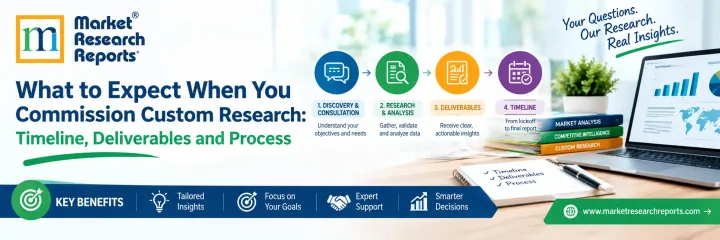
Commissioning custom research can feel like sending your brief into a black box - you know what you asked for, but not what happens between submission and delivery. It does not have to feel that way. Understanding the process helps you ask the right questions, contribute effectively at each stage, and evaluate the final deliverable with the right expectations.
The typical custom research timeline
A standard custom research engagement at MarketResearchReports.com runs in 24–48 hours from brief confirmation. For engagements requiring extensive primary research across multiple geographies, timelines extend accordingly. Here is what happens at each stage.
Day 1 - Scoping call and brief confirmation. The research team reviews your brief, identifies any ambiguities, and conducts a scoping call to confirm research questions, scope boundaries, methodology approach, and deliverable format. By the end of day 1, both parties have agreed on exactly what the engagement will produce. No research begins before this confirmation.
Days 1–2 - Methodology design and source identification. The assigned analyst designs the specific research methodology for your question, identifies the primary and secondary sources most likely to contain relevant data, and flags any scope areas where data availability may be limited. You receive a brief methodology confirmation outlining the planned approach.
Days 2–5 - Secondary research and data collection. Analysts systematically collect, extract, and validate data from identified sources. The AI-assisted data pipeline extracts data points, flags inconsistencies, and runs initial mathematical validation. Analysts review flagged items and resolve source conflicts.
Days 3–7 - Primary research (where applicable). Expert interviews, industry surveys, or supply chain conversations are conducted in parallel with secondary research. Primary sources are documented with date, role, and geography. Interview outputs are synthesised and integrated with secondary data.
Days 5–8 - Data modelling and analysis. The data model is built, forecasts are calculated, and competitive landscape analysis is completed. The 47-point quality checklist is applied. Every checkpoint must be cleared before the draft is approved for formatting.
Days 7–10 - Draft delivery and client review. The first draft is delivered in the agreed format. You review the draft and provide written feedback. The research team addresses comments and clarifications.
Days 10–14 - Final delivery. The final deliverable is delivered in all agreed formats and languages.
What you need to do at each stage
Custom research is a collaboration, not a handoff. Your active participation at key stages materially improves the quality of the final output.
Before the scoping call: Review your brief one more time and identify any ambiguities. Prepare your priority ranking of research questions in case scope needs to be reduced. Identify any internal subject-matter experts who might be available for a brief conversation with the research team.
During the scoping call: Be specific about the decision this research will inform. The more context the analyst has about how the intelligence will be used, the better they can prioritise the right analytical angles. Confirm timeline constraints and identify any hard deadlines.
During the engagement: Respond promptly to clarification requests from the research team. Delays in answering a clarification question can hold up fieldwork that is waiting for scope confirmation. If you become aware of a relevant development (a competitor announcement, a regulatory change, a market event) during the engagement, notify the research team immediately.
During draft review: Review the draft against the research questions in your original brief. For each question, ask: has this been answered with sufficient specificity and with verifiable evidence? Note any data points that look inconsistent with your own market knowledge and flag them for discussion - you may be right, or there may be a legitimate explanation that improves your understanding.
Understanding your deliverables
The PDF report is the complete, formatted intelligence deliverable. Read the methodology section first - it tells you how the data was sourced and validated, and flags any material limitations. The executive summary should accurately reflect the key findings in the body; any inconsistency between summary and detail is worth flagging.
The Excel data model contains the underlying data tables, segmentation, and forecasting model. It is designed for integration into your own analytical workflows - you can apply different scenarios, adjust assumptions, and cross-reference against your internal data.
The PowerPoint deck is structured for direct use in stakeholder presentations. Review the narrative flow before presenting - each slide should support a clear argument, not just display data.
Red flags - signs your research provider is cutting corners
Not all research providers apply the same standards. These are the warning signs to watch for when reviewing a deliverable.
Vague methodology description with no specific sources cited. A methodology section that says "we used industry reports, government data, and expert interviews" without identifying which reports, which government databases, or how many interviews - and with whom - is not a methodology section. It is a cover story for an undocumented process.
No named analyst sign-off. Every credible professional research deliverable should identify the analyst responsible for it. An anonymous research deliverable has no professional accountability.
Single-point forecasts with no scenario analysis. Markets are uncertain. A research deliverable that presents a single market size forecast without an optimistic case, base case, and conservative case is claiming a precision that no methodology can support.
Executive summary that does not match the body. This indicates the document was assembled without adequate internal review - the executive summary was written from one version of the findings and the body from another.
Getting maximum ROI from the findings
Research creates value only when it changes decisions or improves their quality. Plan a structured output session immediately after delivery - a workshop or presentation where the key findings are translated into explicit strategic implications and action items. The research team should be available for this session to answer questions and contextualise findings that need additional explanation.
For recurring strategic decisions, a research relationship with a consistent provider builds institutional knowledge over time. The second engagement on a market is always more efficient and more insightful than the first, because the analyst brings context from the previous engagement.
For further guidance on the commissioning process, see how to commission custom market research and how to write a research brief. To start a conversation about your specific requirement, contact our custom research team.