


Global Pharmaceuticals Market Forecast: Drivers, Value Chain Analysis & Trends
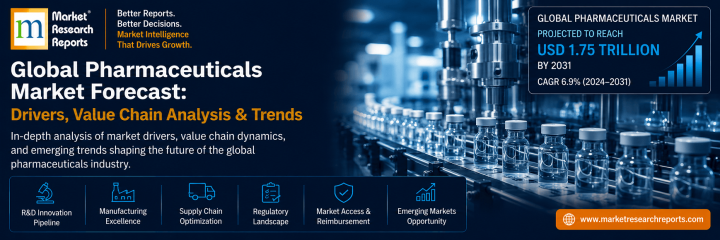
Global pharma market is expected to be worth USD 2.45 trillion by 2031 as per "Global Pharmaceuticals Market Strategic Intelligence Suite 2026-2031" report by NAVADHI Market Research. The market was valued at approximately USD 1.66 trillion in 2025, the report's base year, and is projected to grow at a compound annual growth rate of 6.8% through 2031 - a material acceleration from the 4.3% CAGR recorded over 2022-2024.
This blog post covers a brief analysis of Global pharma industry in following sections:
Forecast of Global Pharma Industry
Growth Drivers and Inhibitors
Industry Value Chain Analysis
Pharma Industry R&D Phases
Industry Wise R&D Investment
Phase Wise R&D Investment
Pharmaceuticals Industry Trends
1. Forecast of Global Pharma Industry
North America holds the largest regional share of the global pharma market at an estimated 46.8% in 2025, moderating slightly to 46% by 2031 as other regions grow faster. Europe is the second largest region at 21.6% in 2025. Asia-Pacific is the fastest-growing major region, expanding from 25.1% share in 2025 toward a larger share by 2031, driven by fleet digitization, biologics manufacturing investment, and rising healthcare access. Latin America and Middle East & Africa together account for approximately 6.6% of the global pharma market in 2025.
2. Growth Drivers and Inhibitors of Global Pharmaceuticals Industry
The single largest driver of pharmaceutical market growth today is the GLP-1 receptor agonist and broader cardiometabolic therapy revolution. GLP-1/cardiometabolic franchise expansion is estimated to add approximately USD 280 billion of incremental consumption value by 2031 alone -- more incremental growth than most entire national pharmaceutical markets. This shift has real, measurable competitive consequences: Eli Lilly's real, disclosed FY2025 revenue reached USD 65.2 billion, up 45% year-over-year, and the company's market capitalization crossed USD 1 trillion in August 2026, the first healthcare company in history to do so.
Beyond GLP-1, sustained oncology innovation, an aging global population, and continued expansion of biologics and specialty therapies remain durable, structural growth drivers. The aging population trend flagged in earlier editions of this analysis has continued as projected -- the United Nations continues to project a growing share of the global population aged 60 and above through mid-century, sustaining long-term demand for chronic disease management therapies.
On the inhibitor side, drug pricing pressure and cost-control policy remain persistent themes across major markets, though the specific policy mechanisms continue to evolve. Generic and biosimilar price erosion continues to compress returns in mature, off-patent therapeutic categories, pushing both originator and generic manufacturers toward specialty and complex-generic strategies. Patent-cliff exposure remains a real, ongoing risk -- AbbVie's Humira, once the world's best-selling drug, now generates a fraction of its peak revenue following biosimilar competition, though the company's Skyrizi franchise has grown to nearly four times Humira's current run rate, illustrating both the risk and the successful-replacement pathway major manufacturers now plan around.
3. Global Pharmaceuticals Industry Value Chain Analysis
Pharmaceuticals industry value chain can be broadly segregated in to 5 major steps. The initial stage of the value chain constitutes the research and development of a new medicinal molecule. The next phase involves getting patents for the new medicines and licenses in various countries where the new drug will be manufactured or sold.
The next stage involves procuring raw materials like active pharmaceutical ingredients (APIs), packaging materials etc. and sourcing them to manufacturing plant(s). In the next step new medicine is manufactured. This is done using either in-house manufacturing facilities or contract manufacturing methods. In the last stage the new medicine is sent to various pharmacies and hospitals using distribution channels (wholesalers, retailers etc).

4. Global Pharmaceuticals Industry Research and Development (R&D) Phases
Research and development in pharmaceuticals industry is quite time consuming and hence costly affair. It normally takes anywhere between 12-15 years for a new drug to enter market after patent application. It takes around 4 years to complete pre-clinical process which includes checks for acute toxicity, pharmacology and chronic toxicity.
Once pre-clinical development is completed, clinical trials begin which are conducted in 3 phases and can take up to 5 years to finish. Then it takes 3-5 years to complete the registration, price formulation and reimbursements to launch the new drug to the market. Once launched pharmacovigilance process is initiated to track the long-term effects (sometimes also referred as adverse drug reactions (ADRs)) of the newly launched drug.
The initial patent expires in 20 years from the date of filing which gives exclusive manufacturing rights to the pharma company developing new drug which can be extended for another 5 years using supplementary protection certificate (SPC) mechanism.

5. Industry Wise Research and Development (R&D) Investment
Pharmaceuticals remains one of the most research-intensive industries globally, historically spending a substantially higher share of revenue on R&D than most other sectors (as of the 2016 EU Industrial R&D Investment Scoreboard, pharmaceuticals spent nearly 15% of revenue on R&D, compared to under 3% for Aerospace & Defense, with only Software & Computer Services spending a comparably high share). While more recent industry-wide benchmarking data was not independently re-verified for this update, the underlying pattern - pharmaceuticals as one of the most R&D-intensive sectors in the global economy - remains a defining structural characteristic of the industry.
6. Phase Wise Research and Development (R&D) Investment in Global Pharmaceuticals Industry
Clinical trial phases have historically consumed the largest share of pharmaceutical R&D budgets (as of the 2017 PhRMA Annual Membership Survey, approximately 48.5% of R&D spend), followed by pre-clinical development, with pharmacovigilance and regulatory approval processes accounting for smaller but still material shares. This allocation pattern remains directionally representative of how pharmaceutical R&D budgets are structured today, though the absolute dollar figures have grown substantially alongside overall industry R&D investment.
7. Global Pharmaceuticals Industry Trends
7.1 GLP-1 and Cardiometabolic Therapy Dominance
The defining trend in pharmaceuticals today is the scale and speed of the GLP-1 receptor agonist revolution. What began as a diabetes therapy category has become the fastest-growing major drug class in pharmaceutical history, with Eli Lilly and Novo Nordisk's competitive positions shifting dramatically within an 18-month window. Real, disclosed data confirms Eli Lilly's 2025 revenue grew 45% to USD 65.2 billion while Novo Nordisk's 2026 guidance was cut to 0%-6% adjusted growth following approximately 9,000 confirmed job cuts -- a genuine, ongoing case study in how fast category leadership can change hands in this therapeutic class.
7.2 Continued Severity of Drug Price Controls
Government-initiated drug price controls remain a persistent theme across major pharmaceutical markets, with the specific policy mechanisms continuing to evolve across administrations and jurisdictions. Direct pricing controls, reimbursement policy changes, and generic-substitution mandates continue to shape manufacturer pricing strategy globally, and companies continue to build pricing resilience into portfolio and geographic diversification strategy as a structural response.
7.3 Sustained Focus on Rare Diseases and Orphan Drugs
The rare disease and orphan drug segment, initially catalyzed by regulatory frameworks like the 1983 U.S. Orphan Drug Act, has matured from an emerging strategy into an established, core commercial pathway for both innovator and generic manufacturers facing price erosion in mature categories. The combination of accelerated regulatory pathways, extended market exclusivity, and high per-patient value continues to attract sustained investment across the industry.
7.4 Biologics, Cell and Gene Therapy Manufacturing Scale-Up
Biologics manufacturing capacity continues to expand faster than small-molecule manufacturing, reflecting both the shift toward biologic therapeutics and the substantially higher capital intensity biologics production requires. Cell and gene therapy manufacturing, while still a comparatively small share of total pharmaceutical manufacturing value, is expanding rapidly as more therapies in this class reach commercial approval, requiring genuinely new manufacturing infrastructure and expertise distinct from both small-molecule and traditional biologics production.
7.5 AI-Driven Drug Discovery Reaching Commercial Maturity
Artificial intelligence in drug discovery has progressed from an emerging capability to an increasingly standard part of pharmaceutical R&D workflows, accelerating target identification, compound screening, and clinical trial design. This trend, flagged as emerging in earlier analysis, has continued to mature as major pharmaceutical companies and specialized AI-drug-discovery partners have moved multiple AI-originated or AI-accelerated candidates into and through clinical development.
7.6 CDMO and Contract Manufacturing Reshoring
A genuinely new trend since earlier editions of this analysis: geopolitical and supply-chain disruption affecting Chinese contract development and manufacturing organizations (CDMOs) has triggered a real, quantified reshoring wave. Of USD 24.86 billion in total 2025 CDMO capacity investment industry-wide, approximately USD 18.48 billion -- nearly three-quarters -- flowed specifically to United States and other non-China facilities, reshaping where global biologics and GLP-1 manufacturing capacity is being built for the remainder of the decade.
8. Recent Developments in the Global Pharmaceuticals Industry
- August 2026: Eli Lilly's market capitalization crossed USD 1 trillion, the first healthcare company in history to reach that threshold, following real, disclosed FY2025 revenue growth of 45% to USD 65.2 billion, driven primarily by its tirzepatide (Mounjaro/Zepbound) GLP-1 franchise.
- 2026 guidance: Novo Nordisk cut its 2026 adjusted operating profit growth guidance to a range of 0% to -6%, following approximately 9,000 confirmed job cuts, as competitive pressure from Eli Lilly's tirzepatide franchise intensified.
- 2025: AbbVie's Skyrizi franchise reached USD 17.6 billion in annual sales, nearly four times the current run rate of Humira (USD 4.5 billion), which was the world's best-selling drug for most of the 2010s before biosimilar competition eroded its revenue following patent expiration.
- 2025: Of USD 24.86 billion in total global CDMO (contract development and manufacturing organization) capacity investment, approximately USD 18.48 billion flowed to United States and other non-China facilities, a real, quantified reshoring wave following geopolitical and export-control disruption affecting Chinese CDMOs.
- H2 2026: Samsung Biologics' fifth manufacturing plant in Incheon, South Korea — at over 600,000 liters of capacity, the world's largest single-location biologics manufacturing hub — is scheduled to become operational, directly positioned to capture reshoring-driven demand.
- 2025-2026: Novo Holdings (parent of Novo Nordisk) completed its acquisition of Catalent, a major contract development and manufacturing organization specializing in GLP-1 fill-finish and drug-device combination capacity, raising strategic-alignment questions for competing sponsors sourcing fill-finish capacity from the same company.
Related Market Research Reports
1. Global Pharmaceuticals Industry Strategic Research Report
2. Global Pharmaceuticals Manufacturing Market Strategic Research Report
3. Global Pharmaceuticals Market Strategic Intelligence Suite
Related Pharmaceutical Industry Articles
1. Top 15 Pharma Companies in India
2. World’s Top 10 Pharmaceutical Companies by Revenue
3. U.S. Top 10 Pharmaceutical Companies by Market Turnover
4. World's Top Selling Pharmaceutical Drugs and Manufacturers by Sales
5. Top 6 Therapeutic Companies to Look out for Acute Renal Failure (Acute Kidney Injury)
6. Top 10 Oncology Pharma Companies in the World
7. Top 10 Antidiabetics Pharma Companies in the World
8. Covid-19 Impact on Global Economy: Analysis of Major Industries